This article was originally published by John W. Whitehead at The Rutherford Institution It has been republished with permission from the author. Please contact the author directly for republishing information.
“Behind the ostensible government sits enthroned an invisible government, owing no allegiance and acknowledging no responsibility to the people.“—Theodore Roosevelt
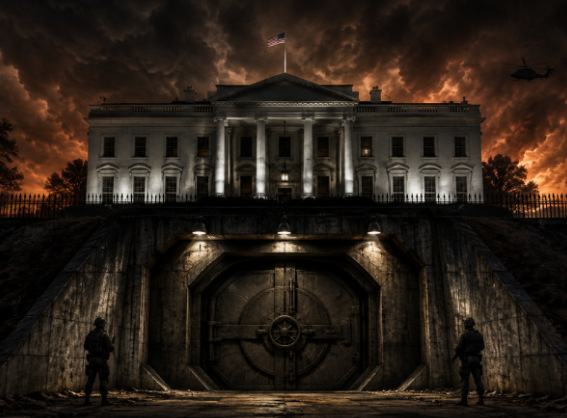
What began publicly as Donald Trump’s lavish, taxpayer-funded vision of a gilded White House ballroom is now being justified by the administration—in and out of court—as a matter of national security.
To President Trump, it seems, a ballroom by any other name is a bunker.
And what a bunker it is.
Court documents indicate the massive subterranean military complex being constructed five stories beneath the White House grounds will include bomb shelters, a hospital, “top secret military structures and equipment, military-grade venting, a single integrated air conditioning and heating system, sniper nests and a drone port on top.”
Stephen Miller, Trump’s White House Deputy Chief of Staff, has explicitly invoked “continuity-of-government interests“ in defending the ballroom/bunker project, arguing that the reinforced underground military installation is necessary to ensure uninterrupted presidential command during an attack or global crisis.
The White House, however, already has a bunker built for precisely this purpose.
According to former officials, a nuclear-hardened facility buried more than 60 feet underground was secretly completed during the Obama administration. It can reportedly shelter dozens of officials for weeks and provide the president and senior officials with a secure command center during an extreme national-security crisis.
Which raises an obvious question: if the White House already has a nuclear-hardened Continuity of Government bunker, why does it need another one?
What threat justifies a new five-story military complex beneath the People’s House—one large enough to include bomb shelters, a hospital, military infrastructure, sniper positions and drone facilities? And if this is really about national security, why has so much of the project been wrapped around a ballroom that the administration initially presented as something quite different?
It is telling that they are building it at breakneck speed.
According to court filings, hundreds of workers have been laboring around the clock, 20 hours a day, seven days a week, to push the project forward as quickly as possible.
The message seems clear: get far enough along, fast enough, and it becomes that much harder for Congress, the courts or some future administration to undo what has already been built.
There is a lesson in that, and it speaks to much more than a ballroom or a bunker.
That is how the architecture of authoritarian government becomes permanent: Build the surveillance system. Build the detention centers. Expand the raids. Normalize executive rule by decree. Weaken the courts. Sideline Congress. Militarize the machinery of enforcement. Then hand it all to the next administration.
The faces change. The powers remain.
So much of what Trump is using today was inherited from presidents before him. So much of what he is building now will remain available to presidents after him.
That is the deeper problem with the Bunker State.
It is not merely about where government officials go when disaster strikes.
It is about the mindset of a government that increasingly treats preservation of its own power as the highest form of national security.
There is a grim irony in watching Washington spend enormous sums fortifying itself against catastrophe while government itself lurches from crisis to crisis and foreign conflict to economic disruption. Again and again, the pattern is the same: create or exploit the crisis, invoke extraordinary powers to manage it, insulate those in power from the consequences, and leave the public to absorb the cost.
That is the bunker mentality in practice.
And Continuity of Government gives it a blueprint to follow.
Continuity of Government planning, or COG, was devised during the Cold War to ensure that the federal government could survive a Soviet nuclear attack. If Washington were destroyed, surviving officials would disperse to secure locations, maintain command and eventually reconstitute constitutional government.
The goal, at least in theory, was survival long enough to restore constitutional order.
But 9/11 changed the equation.
Nearly twenty-five years later, we are still living with the consequences.
The terrorist attacks of September 11, 2001, did more than kill nearly 3,000 people. They gave Washington the crisis it needed to dramatically expand emergency powers, surveillance and the national-security state.
COG was part of that transformation.
What had been designed for doomsday became part of everyday government. The bunkers at Raven Rock and Mount Weather were part of the plan to keep Washington functioning even if Washington itself could no longer function.
The government has spent billions making certain that it can survive almost anything. But survival of the government is not the same as preservation of the republic.
Presidents, agencies, military commands, intelligence operations and critical records can all be relocated so that the machinery of government can keep functioning underground.
But what about the Constitution?
That is the question all of this elaborate government survival planning never answers satisfactorily. Who guarantees that Congress remains meaningful, the courts independent, elections intact, emergency powers temporary and the rights of the people protected?
Those questions matter because COG is no longer merely about bunkers.
It is part of a much larger emergency state—a government that has learned to govern through crisis, fear and claims of necessity.
After 9/11 came the Patriot Act, warrantless surveillance, secret courts, watchlists, military detention and a vastly expanded national-security state. COVID showed how quickly emergency orders could intrude on movement, assembly, commerce and ordinary constitutional processes in the name of public safety.
Wars have expanded executive power. Border emergencies have expanded executive power. Civil unrest has expanded executive power. Public-health emergencies have expanded executive power.
The emergencies change. The response does not: government claims extraordinary powers, and the extraordinary gradually becomes ordinary.
This is the real danger of a government accustomed to governing by emergency: the trigger does not have to be Armageddon. It can be terrorism, a cyberattack, a pandemic, civil disorder or some broadly defined threat to national security. It merely has to be a crisis serious enough for those in power to declare that ordinary rules can no longer apply.
The most dangerous words in government are often some variation of: this is an emergency.
That is when temporary measures become precedents, precedents become policies, and policies become permanent powers.
This is how the police state grows—incrementally, across administrations and parties.
Every president inherits the emergency powers, secret directives, surveillance machinery, militarized forces and weaponry assembled by his predecessors. Every president adds something to the arsenal. And every president leaves the next occupant of the White House more powerful than the one before.
Trump inherited Obama’s powers. Obama inherited Bush’s. Bush inherited those accumulated before him. And whoever follows Trump will inherit everything Trump leaves behind.
That is the lesson of the modern police state: presidents are temporary. The powers they leave behind are not.
Trump did not invent the Bunker State. He inherited it—and he is expanding it while further erasing the lines between presidential power, personal power and the national interest.
The government beneath Trump was built over decades, with the complicity of presidents, Congresses and courts that repeatedly allowed extraordinary powers to become permanent.
And behind it all sits another government—a shadow government—that elections rarely disturb.
More than a decade ago, we warned that America effectively had two shadow governments: Continuity of Government, the emergency government waiting in the wings for catastrophe, and the Deep State, the permanent government that carries on regardless of who occupies the White House.
Today, it’s hard to tell them apart.
One operates in the background. The other waits for the so-called emergency. But both run on the same machinery.
The Deep State supplies the permanent personnel and institutions. The surveillance state supplies the intelligence. The militarized police state supplies the enforcement. The presidency supplies the command authority. Continuity of Government supplies the emergency architecture. And the bunker supplies the headquarters.
Under ordinary circumstances, these systems may appear to operate separately.
Under emergency conditions, they can become one.
That is how the permanent state becomes the emergency state. And that is when Continuity of Government becomes Continuity of Tyranny.
The issue is not whether government officials have somewhere safe to go during an attack. The issue is what kind of government emerges afterwards.
A constitutional republic depends on divided power, public accountability and limits that cannot disappear whenever a president invokes emergency.
A bunker government is built on a very different logic. Command must continue. Government must survive. Constitutional restraints become negotiable.
That is the bunker mindset.
And increasingly, we do not need an actual bunker to see it at work.
We see it whenever presidents bypass Congress in the name of necessity, whenever surveillance expands in the name of security, and whenever courts are treated as obstacles rather than constitutional checks.
The bunker mentality begins long before anyone goes underground. It begins the moment government decides its own power matters more than constitutional restraint.
That is why the central question is not simply whether the federal government will survive the next catastrophe.
It almost certainly will.
The government has spent decades and untold billions making certain of that.
The more important question is whether constitutional government survives with it.
Will Congress retain meaningful authority? Will the courts continue functioning independently? Will elections remain meaningful? Will habeas corpus remain intact?
Or will the next emergency merely provide the justification for suspending restraints that have already been weakened in practice?
These are not questions for some distant doomsday.
They are questions for right now.
A government that already possesses mass surveillance, militarized police, detention powers, biometric tracking, drones and facial recognition does not need to invent the machinery of authoritarian control during an emergency.
It already has it.
All an emergency does is change the rules governing how freely that machinery can be used.
That is why the government’s obsession with Continuity of Government should concern anyone who cares about continuity of constitutional government.
A bunker can preserve a president—it cannot preserve a republic. A military command center can ensure continuity of power—it cannot ensure continuity of liberty.
Stanley Kubrick depicted the grotesque logic behind government survival in Dr. Strangelove more than 60 years ago.
As political and military leaders push the world toward nuclear annihilation, Dr. Strangelove proposes retreating into a government bunker, where officials, military leaders and other carefully selected survivors can wait out the radioactive fallout and eventually emerge to rebuild civilization in their own image. The people being saved, naturally, include many of the same people who helped create the catastrophe.
Kubrick’s black comedy bears an unnerving resemblance to current events.
The unsettling question is the same: when catastrophe comes, will the government preserve constitutional government—or merely preserve itself?
A constitutional government is defined by the limits placed on those who govern.
Serious government requires presidents who respect the limits of office, a Congress that exercises its authority, courts willing to restrain power, military force subordinate to constitutional authority, and citizens who understand that liberty depends on keeping power restrained.
The Founders understood this better than most.
They did not design the Constitution on the assumption that those who govern would always be wise, honorable or restrained. They assumed the opposite. They understood that power attracts ambition, that ambition seeks more power, and that government must therefore be divided, checked and bound down by law.
Thomas Jefferson put it bluntly: “In questions of power, let no more be heard of confidence in man, but bind him down from mischief by the chains of the Constitution.”
Those chains are already being weakened.
Presidents declare emergencies. Presidents wage wars without meaningful congressional restraint. Presidents deploy military forces. Presidents conduct surveillance. Presidents issue decrees carrying the force of law. Presidents inherit extraordinary powers from their predecessors and add still more for whoever comes next.
Meanwhile, as we make clear in Battlefield America: The War on the American People and its fictional counterpart The Erik Blair Diaries, the unelected machinery of government carries on.
This is what happens when a constitutional republic adopts a bunker mindset: government survival becomes the priority, and constitutional survival becomes an afterthought.
That is backwards.
The government exists to preserve liberty. Liberty does not exist to preserve the government.
If constitutional government cannot survive above ground, in ordinary times, when the courts are open, Congress is sitting and elections are still being held, there is little reason to believe it will somehow be resurrected underground in the wake of a national catastrophe.
What deserves continuity is not merely the federal bureaucracy.
What deserves continuity is the Constitution. The separation of powers. The rule of law. Representative government. Due process. Habeas corpus. The rights of the people.
That is what must survive.
And if we cannot preserve those things now—before the sirens sound, before the government retreats underground, before some president invokes the next great emergency—then no bunker, however deep, however secure and however lavishly equipped, will save the republic.
Because the Constitution cannot survive in a bunker underground if we have already allowed it to die above ground.