From “The Free Thought Project”
Dozens of cities that ripped out Flock’s license plate readers have a new surveillance network watching them anyway — this one hidden inside the streetlight over their driveway.
Communities across the country spent the better part of two years fighting to tear down Flock Safety’s license plate readers, and in city after city, they won. Then, in the same council chambers where residents celebrated those victories, officials quietly signed even bigger checks to a company that builds the exact same surveillance apparatus, only this time it’s hidden inside the streetlight over your driveway.
Since January of this year alone, roughly 23 cities have canceled, rejected, or deactivated their Flock contracts, and close to 98 have done so since 2021, as residents raised alarms over warrantless tracking, indefinite data retention, and a vendor-run national database that agencies across the country could tap into without a warrant. Asheville, North Carolina became the latest flashpoint in late August, when its city council voted 5-2 to terminate the city’s contract and order every piece of Flock hardware removed from its streets, following a marathon public comment session and a public call from the mayor herself to shut the cameras down. Lansing, Michigan followed almost the same week, with residents packing council chambers to demand an end to what one described as adjusting his daily commute just to avoid being logged by the cameras. Cleveland’s safety committee, for its part, voted down a quarter-million-dollar Flock renewal outright after council members openly questioned whether the cameras made anyone safer at all.
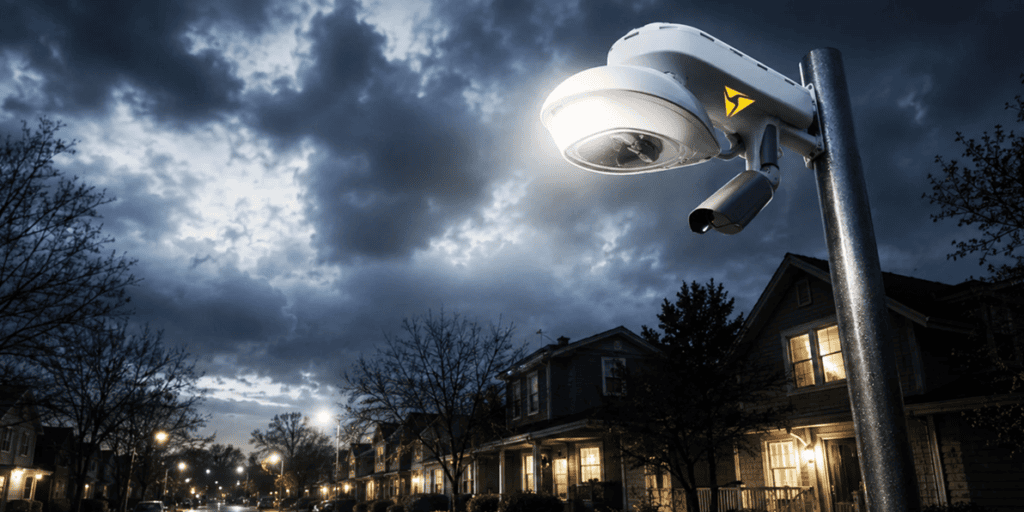
By every surface-level measure, this looks like a movement winning. It isn’t. It’s a market-share transfer, and the company picking up the business is Axon, the Scottsdale, Arizona outfit better known for Tasers and police body cameras, which has spent the past year building a product engineered specifically to defeat the kind of organizing that just took Flock down. Axon calls it Lightpost, and unlike Flock’s freestanding poles, it clips directly onto a streetlight that’s already there, drawing power straight from the light’s own socket. No new poles. No trenching. No visible object for a resident to photograph, protest, or bring to a council meeting.
Axon’s own marketing describes it as a way to turn streetlights into real-time detection tools, combining license plate recognition, vehicle attribute recognition, and live streaming video into a form factor built for speed of deployment. A companion product, Axon Outpost, offers the same capability as a standalone unit that can be mounted on new or existing poles, buildings, vehicles, trailers, or even trees, and can run on solar power when no electrical hookup is available. Both feed directly into Axon Fusus, a platform that integrates footage from body cameras, squad cars, drones, and third-party cameras into a single searchable, real-time operational view for police departments.
The company building this doesn’t hide the fact that blending in is the point. Ubicquia, the infrastructure firm Axon partnered with to build Lightpost, markets the devices as mounting directly on existing streetlight infrastructure and blending seamlessly into the urban landscape, while avoiding complex permitting processes altogether. That single sentence is the entire strategy laid bare. Flock’s cameras became targets because they were visible, arguable, votable things sitting on a pole at an intersection. A camera hidden inside the fixture that already lights your street at night isn’t something most residents will ever notice, let alone organize against, and that is by design rather than accident.
The receipts on the vendor swap itself are not subtle. Denver spent more than a year fighting with Flock over what the company was doing with footage of every car crossing city limits, and when that contract finally lapsed on March 31, the city didn’t shut its camera network down. It called Axon instead. Sixty miles south, Douglas County watched the same fight play out and responded by signing off on nearly $23 million to make sure it never had to have that fight at all, a ten-year deal that swaps 50 old Flock cameras for 100 new Axon units and adds a countywide drone network on top. Syracuse lawmakers voted 7-1 to approve their own Axon plate-reader contract after a stretch with Flock, and Grand Chute, Wisconsin, ditched Flock for Axon after repeated problems accelerated a transition officials were already considering. According to reporting compiled from local coverage nationwide, at least 53 cities that canceled Flock contracts have gone on to sign with Axon instead, meaning the camera count sometimes drops on paper while the underlying tracking architecture, real-time video, and centralized database access all expand.
Axon and Flock spent years as data-sharing partners before Axon ended that relationship to build its own competing hardware with Ubicquia, so this isn’t a story of two rival ideologies squaring off. It’s one company outcompeting its former partner for the same pool of taxpayer money by insidiously hiding their spying. Up until about a year ago, Axon and Flock were partners for years in sharing license plate reader data, before Axon ended that partnership and traded it for a new one with Ubicquia, resulting in the Axon Lightpost. And some of the specific contract terms cities have negotiated with Axon are genuinely tighter than what they had with Flock. Denver’s new agreement runs fewer cameras, shorter data retention, and no access to a vendor-run national database. But a better contract with a different logo answers a narrower question than the one that actually matters, which is who decides how much of your daily movement gets logged into a searchable government database in the first place, and who reviews that decision once it’s made.
Increasingly, in city after city, the answer is: nobody has to. Denver’s mayor didn’t need city council approval to move forward with the new Axon contract at all, because the deal fell under the $500,000 threshold that triggers council review, and the city actually decommissioned its old Flock system hours before the council’s scheduled vote on the Axon replacement was even held. In Boston, police piloted Axon and Motorola plate-reader systems as Flock replacements, and two city councilors say they only found out after the fact, despite a 2022 city ordinance specifically requiring council notification before any new surveillance technology gets deployed. Now, installation, by design, requires no public hearing in most cities, and the entire transaction tends to move through procurement offices as a routine vendor swap rather than a policy decision anyone has to defend in public.
None of this is happening by accident, and it isn’t happening because Axon is a scrappy underdog either. The company just posted its tenth consecutive quarter of revenue growth above 30 percent, with second-quarter 2026 revenue hitting $904 million, up 35 percent year over year. Its backlog of future contracted bookings now stands at $15.1 billion, up more than 40 percent from a year earlier, and management raised full-year guidance yet again on the strength of it. AI-related revenue climbed more than 700 percent in a single quarter earlier this year, and the company’s own president told investors at a conference in June that federal law enforcement is simply a better market for Axon than defense contracting has ever been. None of that growth is a mystery or a conspiracy. It’s a business model, filed quarterly with the SEC and celebrated on earnings calls, and every city that swaps Flock for Axon feeds it directly.
When you look at who’s bank rolling this panopticon, things get really bleak. Roughly 80 percent of Axon is owned by institutional shareholders, and the three largest are Vanguard, at around 10 to 11 percent, BlackRock, at around 8 to 9 percent, and State Street, at around 4 percent, a combined stake in the low-to-mid twenties. BlackRock’s chairman has publicly described infrastructure investing as one of the fastest-growing segments in private markets today, a framing the firm has backed with a $12.5 billion acquisition of an infrastructure fund manager and its own annual infrastructure summit. But this is hardly anything even close to “private.”
When a company’s revenue is drawn almost entirely from state, county, and federal law enforcement contracts, funded not through voluntary purchase but through property taxes, sales taxes, and federal grants extracted under threat of law, “private markets” stops being an honest description. Axon isn’t competing for your business. It’s competing for a slice of money that was stolen from you before you ever had a say in the matter. Strip away the label and what’s left looks less like a private company and more like a subsidiary of the very apparatus that funds it, a parasitic entity feeding off the U.S. tax farm one municipal budget line at a time. No peaceful person would ever voluntarily pay to have their own license plate, driving pattern, and vehicle characteristics logged into a searchable, federally-adjacent database every time they leave their driveway. That is precisely why this system was never built on voluntary exchange to begin with, and never could be. It survives only because the money funding it is extorted from US citizens before anyone gets asked.
It is important to point out that residents who fought and won against Flock deserve real credit for that organizing. But the fight was never really about one company’s name on the hardware. It was about whether the state gets to build a permanent, searchable record of where every person in a city goes, without ever having to ask.
That’s the fight that has to continue, and it has to be aimed differently than it was the first time. Any local ordinance that bans automated license plate readers by naming Flock specifically is a loophole with a different company’s logo already waiting to fill it, as Denver and Douglas County and 53 other cities have just proven.
What actually closes the gap is vendor-neutral policy: hard limits on data retention regardless of who holds the contract, a warrant requirement before any search of the database, public audit trails for every query, and a firm rule that installing plate-reading cameras across an entire city’s streetlight grid is significant enough to require a public vote, not a procurement memo that slides in under a dollar threshold. Until that kind of policy exists, canceling Flock will keep producing the same headline it just produced in Asheville and Lansing and a dozen other cities: a celebration, followed within weeks by an invoice to Axon for doing the exact same job, just better hidden.