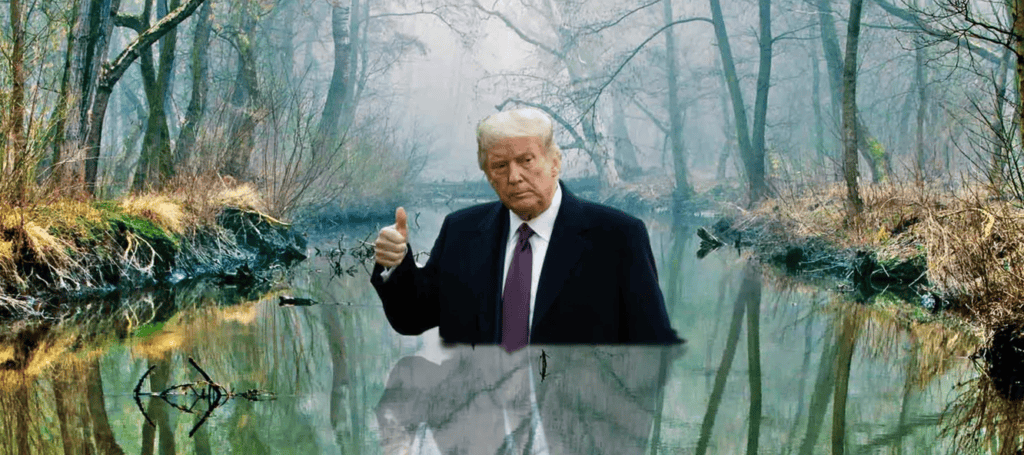
From “The Free Thought Project”
The prevailing sentiment upon among some MAGA supporters that Trump has only recently sold out to the establishment is entirely rooted in fiction.
A growing number of MAGA voters are finding Donald Trump to be a colossal, dystopian disappointment. Many of these former supporters have taken to social media to wonder, ‘What happened to him?’
According to this perception of reality, Donald Trump was once America’s savior—a champion of the people, a warrior for freedom and against powerful interests, and the president of peace. But then something happened. He was compromised in his second term. He stopped caring and started selling out. Their hero fell from grace to join the swamp he once worked to drain. He abandoned America First principles to bow to Israel and AIPAC. He sold out to Big Tech, and he betrayed the MAHA crowd (to name a few examples).
I’ve seen countless expressions of this sentiment across social media platforms.
“I miss this guy…To see what he’s become today depresses me greatly,” reads one tweet accompanying a clip of Trump in 2016 criticizing the war in Iraq. A quote tweet of this clip says, “Me too, all of us OG real MAGA miss the guy we actually voted for 3 times, not sure what we have now.”
An Instagram reel titled “Trump before PAC money,” which features the same old Trump clip, has comments that feature a similar sentiment:
“He eventually became a real politician.”
“Before Don sold out! I just can’t believe he sold us out. He was a good first term president and terrible 2nd term.”
The only problem with these views? They’re rooted in a grotesquely false premise: that Trump was ever the anti-establishment hero he painted himself to be. The “old Trump” never existed. It was all smoke, mirrors, and rhetoric that told voters what they longed to hear (in a telling instance of this disconnect from reality, Trump received PAC money in 2016, when he made the comments in the featured clip, and was actively courting such donors).
Perception vs. reality
I could write a standalone article about all the evidence from Trump’s first term proving he never actually challenged the system or served the people. That would be a very lengthy article, so I’ll name just some prime examples:
He appointed a dizzying number of lobbyists and corporatist insiders. He empowered the pharmaceutical industry in numerous ways. Even before he won the election, he had aligned with Big Tech, notably receiving a million dollars from Palantir founder Peter Thiel. He presided over a staggering number of bombings, including in the Iraq war he previously condemned, and he failed to end a single war. In fact, he escalated bombing campaigns overseas at the expense of civilian lives.
He added trillions of dollars to the national debt after promising to eliminate it. He signed the extension of the unconstitutional FISA Section 702 after excoriating it because the FBI reportedly used it to spy on his campaign (he claimed it was not the same law that enabled such surveillance but provided no explanation as to how it differed). His Department of Justice prosecuted Julian Assange, a whistleblower on war crimes, in a chilling attack on press freedom. Even the Obama administration was unwilling to go that far. He failed to follow through on his fantastical campaign rhetoric about putting Hillary Clinton in prison.
Trump also approved of sending gratuitous aid to Israel (codified under Obama and praised and enacted under Trump) long before he drew criticism for catering to Benjamin Netanyahu. He was making policy decisions that indicated his subservience well before he faced outrage for taking obscene amounts of money from pro-Israel individuals and organizations in the 2024 election.
For anyone who looked beyond Trump’s appealing rhetoric and bravado, it was abundantly clear that he never made good on his expertly crafted image as a liberator and patriot. But none of this mattered to millions of people in the 2024 election. They sincerely believed he would provide accountability for COVID policies, reveal the whole truth about JFK’s assassination, and go after Jeffrey Epstein’s friends. They believed the endless slew of propaganda that he was “the peace president.” They trusted that he would resolve the national debt and enact policies to lower the skyrocketing costs of living while cleaning up America’s toxic food supply. Most of us know how all that is going.
They know not what they do
These specific examples are not really the point. More and more people are beginning to see the cracks in Trump’s facade, but too many still believe he started with pure intentions and excelled in his first term—he’s just been “compromised.” I’m willing to concede that it’s possible Trump started out with good intentions in 2016 and immediately abandoned them once he entered the halls of power in 2017 (I don’t subscribe to this view, but I am open to the possibility; I am not, however, open to the popular delusion among disillusioned MAGA voters that he was great in his first term and became “compromised” in his second).
This all reflects a deeper issue: the gullibility of American voters, who repeatedly take politicians at their word despite overwhelming evidence that nearly all politicians make grandiose commitments and fail to deliver on them. In fact, they often do the exact opposite of what they promise to voters during election seasons.
I have compassion for people who perpetually fall for the ruse, whether from Trump or any other politician. Many feel so hopeless, downtrodden, and frustrated with the political system that they are desperate to believe anyone who promises to fix it for them. They are thirsting for relief. They’ve been so conditioned to believe in this governing paradigm, the Constitution, and authority itself that it’s understandable they would outsource their agency to a smooth-talking “outsider”—or anyone else—promising to take control of that system and relieve their stress, anxiety, and hardships (note: he was never actually an outsider; he openly disclosed his entrenchment in the system before he was elected to his first term). Further, given the many shortcomings of public schooling and the constant onslaught of mind-numbing infotainment, it’s predictable that people lack the research and critical thinking abilities to poke holes in the prestige and hypnotizing allure of someone promising to save them. Most of us are set up to be led to slaughter.
On that note, I also have compassion for those who fall for snake-oil salesmen and women because I have been there, too. As I’ve discussed often over the years, I was once a starry-eyed Obama supporter who gushed over his rhetoric about hope, change, peace, and righting the wrongs of George W. Bush. I never checked Obama’s documented record when he was campaigning. If I had, I might have predicted that he was not going to stop wars or end mass surveillance and corporate influence in government. I was caught up in the image Obama projected and trusted him so wholeheartedly that I never paused to check whether that image matched reality. More broadly, I was so programmed to believe in the system that I was incapable of questioning its legitimacy.
Look in the mirror
It’s easy to blame politicians and statism at large for so many people’s inability to see through the lies. I do blame politicians and statism (special credit to the media, too). However, at some point, the people who continue to fall for the theater and manipulation must bear some responsibility. It may be true that they have been conditioned to fall into politicians’ traps. But it’s also true that unless this dynamic changes, the same cycles will keep repeating—and politicians won’t be the ones to end them. That would require them to relinquish power, and that’s not how power works.
Unfortunately, even as many MAGA voters realize Trump is not their savior, they are looking to the next election for someone to save them and the country. They are once again seeking a guardian and defender—one who promises to use the system to rescue them from the system. Maybe they’ll vote for Vance out of desperation and opposition to the left. Maybe they’ll switch to a tolerable Democratic option, just as some longtime Democrats voted for Trump after giving up on their own party. Others are pinning their hopes on Rep. Thomas Massie, who himself endorsed Trump in 2024 but is now a strong voice of opposition.
There may be a staggeringly small handful of politicians who have principles—and even maintain them once taking power. This is not enough to turn the tide considering those with good intentions face the barrage of the machine and either sell out or are kicked out (see: Massie, who supported Trump only to criticize him and lose his House primary earlier this year after the president and AIPAC worked to oust him).
Ultimately, the problem isn’t who takes power but the power itself. Our actual power lies in rejecting that power—both its institutional levers and the stranglehold it has over so many of our minds. The more we can recognize that true power is within us—and that it is not coercive or violent like government power but peaceful and proactive—the less it will matter which megalomaniac is lusting for authority within the system.
In my view, solutions come in many forms, from addressing our emotional and spiritual well-being to challenging the fundamental “legitimacy” of “authority.” Solutions must also include taking tangible actions to build parallel systems outside of government. You can read an extensive three-part series on all of these ideas here.
It’s a tall order, but the more people recognize that no one is coming to save them (at least no politician or wing of government), the more power they will actually have. We have been programmed to rely on “representatives” to solve problems (often ones they create). As a result, far too many people spend more energy and time fixating on the horrors of the political system, craving power within it, and waiting for political solutions than they do taking action themselves.
Rather than lamenting the demise of the heroic Trump who never actually existed, people would be much better off undertaking a sober reflection on the political system and those who rise to the highest echelons of power.