(This information comes from “The Leah Files” on Substack. that I learned about from “DDGotAPodcast”
Part 1-Inside Turning Point USA’s $400 Million Paper Trail
Shell companies, insider deals, a $350,000 life insurance loan, and the audit that began eight days before the CEO was killed.
An investigation based on seven years of IRS Form 990 filings, corporate registry records, and public reporting. This analysis is based on findings from public sources and for entertainment purposes only.
Eight Days
On September 2, 2025, Charlie Kirk sent an internal memo to Turning Point USA staff. He named Justin Strieff as the organization’s new chief operating officer and tasked him with leading what Kirk called a “DOGE” initiative, borrowing the language of Elon Musk’s government efficiency push. The mandate was blunt: make TPUSA “more efficient,” “more cost-effective,” and “reshape company culture.” In plainer terms, Kirk wanted a “internal audit” of the organization he had built from scratch as an 18-year-old in 2012.
Eight days later, on September 10, Kirk was shot and killed by a sniper while speaking at an outdoor campus debate at Utah Valley University in Orem, Utah. He was 31 years old.
Within a week, his widow Erika Kirk was elected the new CEO.
The DOGE like audit, as far as anyone can tell publicly, never happened.
But the financial questions Kirk apparently wanted answered? They’re still sitting right there in the public record, buried in seven years of IRS Form 990 filings, state corporate registries, and a trail of limited liability companies that leads from the desks of TPUSA employees to their own bank accounts.
This is what those records show.
• • •
The Scale of the Machine
Turning Point USA is not a small operation. Between its 2017 and 2023 fiscal years (each running July to June), TPUSA pulled in close to $400 million in total revenue. In its 2023 filing alone, the organization reported $84.9 million in revenue and $81 million in expenses. It employed 458 people. It had 67 independent contractors each pulling more than $100,000.
The growth was explosive. In fiscal year 2017, TPUSA brought in roughly $8.2 million. By 2021, that had surged past $80 million. Revenue more than doubled again relative to its early years. Total assets at the end of the 2023 fiscal year stood at $26.3 million.
Contributions and grants made up the vast majority of revenue, with $84.3 million coming from donors in 2023. Most of the rest came from conference fees and advertising income.
But where did it all go?
The 990 filings tell a story about a handful of contractors who, in some cases, appeared out of nowhere, collected millions, and then vanished. Some of those contractors turn out to be owned by TPUSA’s own staff. Others share addresses with companies that dissolved under unclear circumstances. And one of them received a $350,000 loan from the nonprofit to fund a life insurance policy on the CEO himself.
• • •
The Insider Pipeline: Lionrock, Cloverstone, and GSM
In TPUSA’s 2020 Form 990, a company called Lionrock Ventures LLC appears as one of the top five highest-paid contractors. Lionrock was paid $386,693 for “fundraising and event planning.” Its listed address: 13510 Bayliss Road, Los Angeles, California 90049.
Corporate records tell the rest. Lionrock Ventures was incorporated in Delaware in February 2019, with a registered agent address at 919 North Market Street, Suite 950, in Wilmington. It opened a California branch in January 2020 and terminated that branch just six months later, in July 2020. The inactive director listed on the California filing: Stacy Sherean.
Stacy Sheridan (the name appears in slightly different forms across records) was not just any contractor. She was TPUSA’s Senior Advancement Director, earning over $180,000 per year in salary, according to ProPublica’s reporting on the organization. In other words, a TPUSA employee was running a company that was being paid by TPUSA for the exact type of work she was already being paid a salary to do.
But here’s where it gets interesting. After Lionrock stopped receiving payments on the 990s (its last reported payment was in fiscal year 2020), a new company appeared in the 2021 filing: Cloverstone Ventures LLC. Cloverstone was paid $827,821 for “fundraising and event planning.”
Its address? 919 North Market Street, Suite 950, Wilmington, Delaware 19801.
The exact same address as Lionrock Ventures.
According to public fundraising records, Cloverstone Ventures went on to raise $31.5 million for TPUSA, retaining $1.7 million for its services.
Then there’s GSM Strategy LLC. ProPublica’s investigation found that GSM Strategy was another entity connected to Sheridan. Corporate records show two GSM Strategies LLCs registered, one in Nevada (May 2020) and one in Illinois (January 2020), the latter at 847 Metropolis Drive Way #303, Des Plaines, Illinois. Between the three entities Sheridan was connected to, at least $2.7 million flowed from TPUSA to companies she was involved with.
All of this while she was on the TPUSA payroll.
TPUSA does have a written conflict-of-interest policy. On every 990 filing from 2017 through 2023, the organization checked “Yes” on the question about whether officers, directors, and key employees were required to disclose conflicts. It also checked “Yes” that it regularly monitored and enforced compliance with that policy.
The question is whether anyone was actually looking.
• • •
$9 Million to a Tulsa Print Shop
In the 2022 filing, a company called Resource One appeared for the first time among TPUSA’s top contractors. It was paid $2,938,688 for “printing and publication.” By the 2023 filing, that number had more than doubled to $6,146,883 for “printing, publication, educational matter.”
Total payments to Resource One across just those two years: $9,085,571.
Resource One’s listed address on the 990s is 2900 East Apache Street, Tulsa, Oklahoma 74110.
That address is significant. It is the same address listed for Worldwide Printing and Distribution, Inc., an Oklahoma corporation incorporated in May 1986. According to OpenCorporates records, the company’s agent and director is Jeffrey Pelcher. The company operates branches in multiple states, including a North Dakota branch (incorporated September 2010, dissolved February 2023) and a Georgia branch (incorporated April 2016, status: revoked).
Here’s where it gets odd. The North Dakota Secretary of State classified Worldwide Printing and Distribution’s business as: “Fundraising Consultant.”
Not printing. Not distribution. Fundraising consultant.
Why would a printing company register as a fundraising consultant in North Dakota? And why did that branch dissolve in 2023, the same period Resource One’s payments from TPUSA were skyrocketing?
Resource One itself is a real company. Public business listings describe it as a commercial printing, direct mail, telemarketing, and fulfillment operation with roughly 300 employees and estimated annual revenues around $115 million. Its CEO is listed as James R. Moore.
But the confluence of the shared address with Worldwide Printing, the North Dakota fundraising classification, and the rapid escalation of payments from TPUSA (from zero to over $9 million in two years) raises questions about the nature of the relationship. $9 million is a lot of printing for an organization whose entire “printing and publication” expense line on the 2023 990 was $1.35 million. The gap between those two numbers suggests Resource One’s payments were being categorized differently on the contractor list than on the functional expense breakdown.
Top Contractor Payments by Year
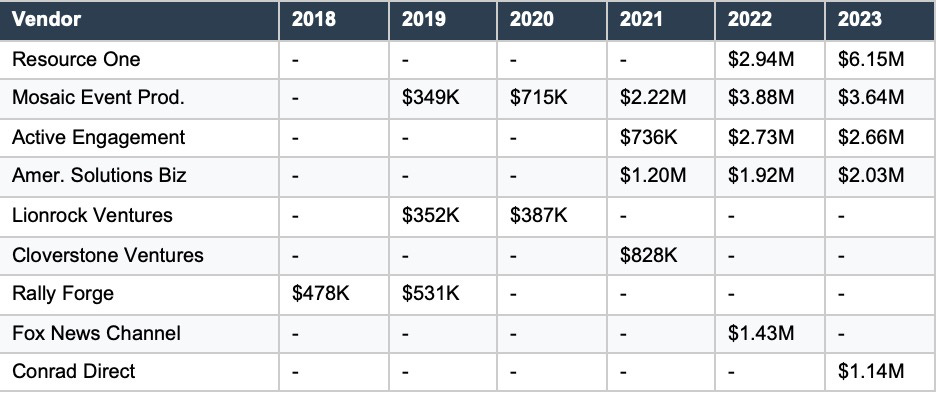
Source: IRS Form 990, Part VII, Section B. Top 5 contractors by year, 2017-2023.
• • •
The $350,000 Life Insurance Loan
On May 15, 2023, a limited liability company called GGLF 2023, LLC was incorporated in Wyoming. Its registered address was 30 North Gould Street, Suite R, Sheridan, Wyoming, a generic registered agent location used by thousands of shell companies. The organizer listed on the filing was Stephanie L. Hooper, LL.M. Its mailing address: 16 Charlotte Street, Charleston, South Carolina.
GGLF 2023 was not a contractor. It was not a vendor. According to TPUSA’s 2023 Form 990, it was the recipient of a $350,000 loan from the nonprofit to fund a “split dollar life insurance policy.” The entity was described as being owned by Charlie Kirk.
This shows up on the 990’s balance sheet. Line 5, “Loans and other receivables from any current or former officer, director, trustee, key employee, creator or founder, substantial contributor, or 35% controlled entity or family member,” went from $0 in the 2022 filing to $355,268 in the 2023 filing. Prior to 2023, that line had been blank for years.
A split dollar life insurance arrangement is a mechanism where an employer (in this case, a nonprofit) and an employee share the costs and benefits of a life insurance policy. The $350,000 premium suggests a policy with a substantial payout, with industry estimates placing the death benefit somewhere in the range of $10 million to $40 million.
The 2023 Form 990 was signed by Tom Sodeika, TPUSA’s Secretary and Treasurer, on May 14, 2025, and submitted the following day. Charlie Kirk was assassinated less than four months later.
There is nothing inherently illegal about a split dollar life insurance arrangement. Nonprofits do use them as part of executive compensation packages, and the IRS has specific rules governing how they should be reported and taxed. But several features of this particular arrangement deserve scrutiny.
First, the loan was made to an LLC owned by Kirk, not to Kirk directly. Why structure it that way? The use of a Wyoming LLC (a state known for corporate privacy) as an intermediary adds a layer of opacity that would not exist if the policy had been purchased directly.
Second, the timing. GGLF 2023 was incorporated in May 2023, and the loan appears on a filing covering the fiscal year ending June 30, 2024. That means this arrangement was set up relatively late in Kirk’s tenure, after the organization had been running for over a decade.
Third, and most uncomfortably, Kirk was dead within months of the filing being submitted. The life insurance policy paid out. To whom, and how much, is not yet public.
• • •
The Troll Farm on the Payroll
Before Resource One, before Lionrock Ventures, there was Rally Forge.
Rally Forge was an Arizona-based marketing firm owned by Jake Hoffman that appeared on TPUSA’s contractor rolls starting in 2018. It was paid $478,439 that year and $531,198 in 2019, for a total of roughly $1 million over two years. On the 990s, its services were not described.
In October 2020, Facebook permanently banned Rally Forge for running what the platform described as a coordinated inauthentic behavior campaign. The operation involved approximately 200 fake Facebook identities, 76 fake Instagram accounts, and 55 Facebook pages, all posting content that criticized Joe Biden and praised Donald Trump. Rally Forge had hired teenagers, including minors, to generate thousands of social media messages without disclosing they were paid by Turning Point Action, TPUSA’s political affiliate.
Hoffman later rebranded Rally Forge as 1TEN, which continued producing ads for TPUSA and its affiliated organizations. Hoffman himself was indicted in Arizona’s 2024 alternate electors case alongside TPUSA COO Tyler Bowyer.
That same Tyler Bowyer earned $153,670 in direct compensation from TPUSA in the 2022 fiscal year, plus another $79,363 from related organizations. His title changed from “Assistant Secretary/COO” to “Former Assistant Secretary” between the 2021 and 2022 filings, suggesting a complicated departure. He was working 15 hours per week for TPUSA and 30 hours per week for related organizations as of the 2022 filing.
• • •
The Year the Money Ran Out
In fiscal year 2022, something went wrong.
Revenue came in at $81.7 million. Expenses hit $91.4 million. TPUSA burned through $9.6 million more than it brought in. Net assets dropped from $23.6 million to $13.9 million in a single year.
That’s a $10 million swing in the wrong direction.
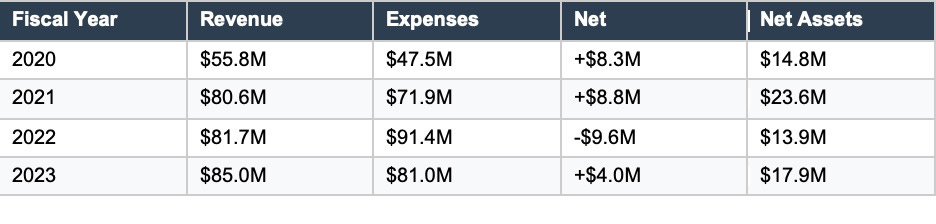
Source: IRS Form 990, Parts I and X.
The 2022 deficit coincided with massive spikes in contractor payments. Conferences, conventions, and meetings alone cost $28.7 million. Advertising and promotion hit $9.7 million. Grants to other organizations ran to $5 million. And $12 million went to “educational materials,” which presumably includes some of the printing and publication work that Resource One and American Solutions for Business were being paid for.
By 2023, TPUSA had managed to right the ship somewhat, posting a modest $4 million surplus. But the damage from 2022 was real: the organization started the year with $20.2 million in total assets and ended with $26.3 million, but total liabilities had also ballooned from $6.3 million to $8.4 million. The $1.9 million in “other liabilities” jumped to $1.9 million at year end, suggesting new financial obligations were being taken on.
• • •
Who Was Watching?
TPUSA’s 990 filings say the organization maintained separate, independent audited financial statements, prepared by outside accountants. The 2020 and earlier filings listed Henry & Horne LLP as the preparer. Starting in 2022, the accounting firm changed to Baker Tilly US LLP (later Baker Tilly Advisory Group LP), based in Tempe, Arizona.
ProPublica’s investigation noted that TPUSA’s “independent” audits came from a firm connected to co-founder Bill Montgomery’s former business associate, raising questions about the independence of the oversight.
The board of directors, which was supposed to be overseeing all of this, consisted of just five voting members throughout the period reviewed, with four of them classified as independent. The board included Doug DeGroote, Mike Miller, David Englehardt, Tom Sodeika (Secretary/Treasurer), and Kirk himself. None of the directors received compensation from TPUSA.
Whether a five-person board can meaningfully oversee an $85 million operation with 458 employees, 67 major contractors, and a tangle of insider-connected LLCs is an open question. The 990 filings check all the right governance boxes: written conflict-of-interest policy, whistleblower policy, document retention policy, review of CEO compensation by independent persons. But governance on paper is not the same thing as governance in practice.
• • •
The Questions That Remain
Charlie Kirk is dead, but the DOGE like audit he started eight days before his assassination never became public. His widow now runs the organization. The Treasury Department has said TPUSA is not under IRS investigation.
But the 990 filings are public record, and they raise questions that have not been adequately answered.
Why was TPUSA’s Senior Advancement Director allowed to run multiple companies that collectively received millions from the organization she worked for? Why did those companies cycle through the same Delaware registered agent address? Why was one replaced by another doing the exact same work?
Why did a printing company’s branch register as a “fundraising consultant” in North Dakota? Why did payments to Resource One jump from zero to over $9 million in two years, even as the functional expense line for “printing and publication” showed a fraction of that amount?
Why was $350,000 in nonprofit funds loaned to an LLC created by the CEO, registered in a privacy-friendly state, for a life insurance policy that paid out after he was killed four months after the filing was submitted?
Why did Rally Forge, a company that was banned from Facebook for running a domestic troll farm using teenagers, remain on TPUSA’s contractor rolls for two years?
And perhaps most importantly: who was supposed to be asking these questions, and why weren’t they?
Part 2- The TPUSA Deep Dive Is A Rabbit Hole
This analysis is based on findings from public sources and for entertainment purposes only.
In Part I, we went on a journey through seven years of TPUSA’s IRS filings and found $9 million flowing to a Tulsa print shop that didn’t add up, a $350,000 life insurance loan routed through a Wyoming shell company, and employees cycling through side businesses that billed the nonprofit for millions. The records raised questions and nobody in a position of authority appeared to be asking them.
But I have ADD, so I kept pulling threads, and the picture got worse.
Resource One, the Tulsa company that collected $9 million for “printing,” turned out to be a subsidiary of a $700 million political fundraising conglomerate. A second subsidiary of the same conglomerate was simultaneously collecting over $1 million from TPUSA. The gap between what TPUSA paid for “printing” and what it reported spending on printing was $4.8 million.
Beyond Resource One, I identified at least five TPUSA insiders, employees and board members, who ran their own companies on the side and billed the nonprofit they worked for. I found a troll farm that got banned from Facebook, changed its name, moved to a strip mall address, and kept collecting checks. I found a payroll company owned by the man who signed the tax filings. And I found TPUSA writing seven-figure checks to firms whose entire identity is partisan Republican politics — firms that a tax-exempt 501(c)(3) has absolutely no business paying.
• • •
The $700 Million Empire Behind the Print Shop
Part I noted the $9 million in payments to Resource One and the oddity of a printing company’s branch registering as a “fundraising consultant” in North Dakota. Here is what further digging turned up.
Resource One is a subsidiary of Moore (formerly Moore DM Group), one of the largest direct mail and fundraising conglomerates in the United States. Moore operates roughly 33 subsidiary companies with over 2,500 employees across 36 locations and annual revenues exceeding $700 million. The founder is James R. Moore. The current CEO is Gretchen Littlefield, who also serves as vice chair of The Nonprofit Alliance.
Jeffrey Pelcher, who shows up on the Tulsa corporate filings as director of Worldwide Printing and Distribution, is President of Resource One and has worked within the Moore organization for more than 29 years. He is not some small-time print shop owner in Oklahoma. He is a senior executive in a sprawling political fundraising operation.
And Moore is not just a printer. Visit wearemoore.com and the company lists “political” as one of its four core client sectors, right alongside education, association, and commercial. Moore maintains a dedicated political services page. It operates a subsidiary called Moore Campaigns, a division built specifically to serve political campaigns. Another subsidiary, Navistar Direct Marketing, explicitly advertises “full-service direct mail production servicing nonprofit, commercial and political clients.”
According to FEC records, Moore and its subsidiaries received $16.5 million in disbursements during the 2024 election cycle from various political committees and PACs. In the 2020 cycle, a related entity called Moore Campaigns pulled in nearly $10 million in political payments.
This is not a company that does some politics on the side. This is a company with dedicated political infrastructure, a political division, political clients, and tens of millions in political revenue.
Two Companies, One Name
Until February 2021, Moore operated two separate entities both using the name “ResourceOne.”
The first was ResourceOne (printing and production), the commercial printing operation at 2900 East Apache Street in Tulsa. This is the entity that shows up on TPUSA’s 990 filings.
The second was ResourceOne Fundraising Group, a full-service direct response fundraising agency that designed and implemented donor acquisition campaigns, fundraising strategy, and data-driven marketing programs for nonprofits and political organizations.
In February 2021, Moore rebranded the fundraising side. ResourceOne Fundraising Group became Altus Marketing. According to Moore’s own press release, the name change was made specifically to “distinguish Altus Marketing’s fundraising and marketing solutions from the printing and production services of ResourceOne, also a Moore company.”
Moore itself acknowledged that the two entities, which shared a name, provided fundamentally different services. One did printing. The other did fundraising.
The president of the fundraising side, Andrew Olsen, had, by Moore’s own account, “helped more than 500 nonprofits and political organizations raise in excess of $350 million.”
The $4.8 Million Question
So when TPUSA paid $6,146,883 to “Resource One” in fiscal year 2023 and described the service as “printing, publication, educational matter,” was all of that money going to the printing side? Or was some of it flowing to what was, until recently, the fundraising, donor acquisition, and strategic marketing arm?
The numbers suggest the latter.
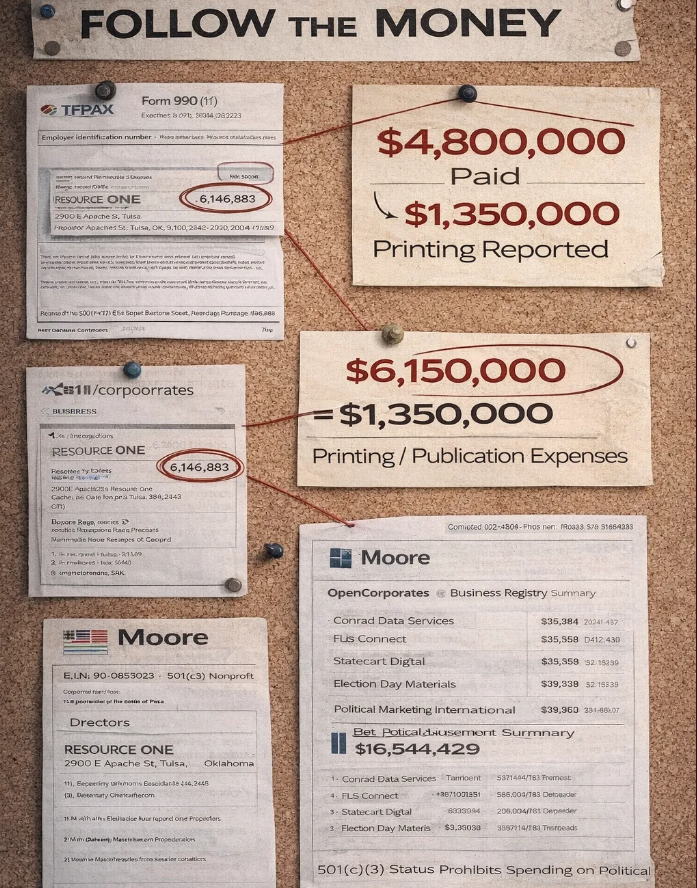
On TPUSA’s 2023 Form 990 functional expense breakdown (Part IX), the entire “printing and publication” line shows $1.35 million. But Resource One alone was paid $6.15 million that year for “printing.”
That is a gap of nearly $4.8 million.
If TPUSA spent only $1.35 million on actual printing across the entire organization, where did the other $4.8 million paid to Resource One go? The most logical explanation is that a substantial portion of those payments were not for printing at all — they were for fundraising services, donor acquisition, data analytics, and direct response marketing.
This matters because on a 990, fundraising expenses are supposed to be reported separately from program expenses. If millions in fundraising costs were categorized as “printing and publication,” that would make TPUSA’s fundraising efficiency ratios look significantly better to donors and watchdog organizations than they actually were.
Conrad Direct: A Second Moore Entity
Resource One was not the only Moore subsidiary on the contractor list. In the 2023 filing, Conrad Direct received $1,144,800 from TPUSA. Conrad Direct is another Moore company that specializes in direct mail fundraising and donor list management.
Combined, two Moore subsidiaries collected $7.3 million from TPUSA in a single fiscal year. Roughly 9% of the organization’s total expenses flowing into one corporate family.
• • •
Five Insiders, Five Side Businesses
Part I covered Stacy Sheridan’s three entities — Lionrock Ventures, Cloverstone Ventures, and GSM Strategy — and the $2.7 million that flowed through them. Since then, the full picture has come into sharper focus.
None of those entities has a website. None appears to have employees besides Sheridan. None markets its services publicly. All three are registered in privacy-friendly states: Delaware, Nevada, California. They have the hallmarks of shell companies — entities that exist primarily to receive payments, not to conduct independent business.
In fiscal year 2023, Cloverstone and other outside fundraisers raised $42 million for TPUSA but retained $3 million in fees. The year before that, they raised $37 million and retained $1.5 million. Sheridan’s actual annual take from TPUSA — salary plus business income flowing through her entities — lands somewhere in the range of $360,000 to $500,000.
Former IRS official Philip Hackney told ProPublica that arrangements like these could indicate the “organization is being operated for the private interests of those who control the organization.” That language matters. It is one of the grounds for revoking a nonprofit’s tax-exempt status.
But Sheridan was not alone. Across seven years of filings, I counted at least five TPUSA insiders running companies that billed the nonprofit.
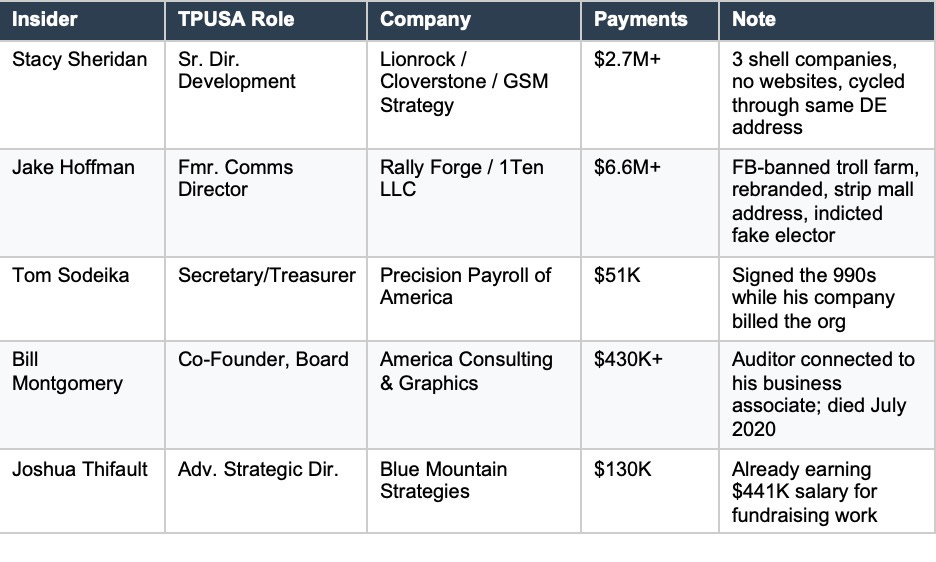
Source: IRS Form 990 filings, corporate registry records, ProPublica reporting.
Combined payments across all insider-owned entities: over $10 million.
Every year, TPUSA checked “Yes” on its 990 that it monitored and enforced its conflict-of-interest policy. Every year, employees were running side companies collecting TPUSA money.
• • •
The Troll Farm, Expanded
Part I covered Rally Forge’s Facebook ban and Jake Hoffman’s indictment. The fuller picture is more damaging.
Hoffman was not an outside contractor. He was TPUSA’s Communications Director before launching Rally Forge. According to campaign finance disclosures and tax filings, Hoffman has received at least $6.6 million from Turning Point entities since 2017.
The Washington Post’s October 2020 investigation revealed that Rally Forge’s operation went beyond simple paid posting. The troll farm used artificial intelligence — specifically Generative Adversarial Networks — to create fake profile pictures for accounts. It fabricated a phony progressive organization called “America Progress Now” that bought Facebook ads promoting Green Party candidates in 2018 swing districts, specifically to split the Democratic vote. The fake accounts across Facebook and Instagram accumulated over 400,000 likes and generated $1 million in ad spending before Facebook caught on.
After the ban, Rally Forge became 1Ten LLC. Registered address: 18521 E. Queen Creek Road, Queen Creek, Arizona 85142, a strip mall. No website. No disclosed employees. Turning Point Action paid 1Ten $1,456,261 over three years for “social/digital media/ad placement.”
Hoffman was elected to the Arizona State Senate in 2022. In April 2024, he was indicted by an Arizona grand jury alongside TPUSA COO Tyler Bowyer for submitting fraudulent elector documents claiming Trump won Arizona in 2020.
The rebrand changed the name. It did not change the ownership, the work, or the money.
• • •
The Vendors a 501(c)(3) Has No Business Paying
Turning Point USA is a 501(c)(3). Under Section 501(c)(3) of the Internal Revenue Code, that designation comes with an absolute prohibition on political campaign activity. The IRS does not recognize a threshold. Any amount of political campaign intervention can trigger loss of tax-exempt status.
With that framework in mind, look at what TPUSA paid.
Mentzer Media: $1.5 Million to the Swift Boat Firm
In fiscal year 2020, TPUSA paid $1,500,000 to Mentzer Media Services for television advertisements.
Mentzer Media is one of the most prominent Republican media buying firms in Washington. Founded by Bruce Mentzer in 1991, the firm was the media buyer behind the Swift Boat Veterans for Truth ads in 2004, the campaign that spent $18 million attacking John Kerry’s military record. During the 2020 election cycle, Mentzer handled $168.7 million in reported media placements.
A company whose reputation was built on partisan political advertising received $1.5 million from a tax-exempt nonprofit. Mentzer Media appeared on the 990 for one year and then vanished from the top contractor list.
MWPolitical: It’s in the Name
Also in fiscal year 2020, TPUSA paid $386,000 to MWPolitical Inc. for digital media services.
MWPolitical is a digital and TV media buying firm founded by Jim Valentine in 2017. Valentine has been public about what his company does: “I exclusively work with the Republican party although I wish that wasn’t the case.” His firm has worked on, in his own words, “hundreds of Republican races since 2016.” In 2020, SEAL PAC, a conservative veterans group, paid MWPolitical over $1.8 million.
A 501(c)(3) paid $386,000 to a company with “Political” in its legal name whose founder says he exclusively works with one party. Like Mentzer, it appeared for one year and vanished.
Active Engagement: $6.1 Million for “Education”
Active Engagement LLC, based in Leesburg, Virginia, first appeared in fiscal year 2021 at $736,000 and quickly grew: $2.73 million in 2022, $2.66 million in 2023. Total: approximately $6.1 million over three years.
Active Engagement describes itself as a “digital political fundraising agency” that has raised over $125 million for conservative clients. It is run by JD Norman, a member of the Council for National Policy, the secretive conservative networking organization that connects major donors, political operatives, and media figures.
On the 990, Active Engagement’s work for TPUSA is categorized as “digital education and fundraising.” The company’s actual specialties are donor acquisition, email fundraising campaigns, and data management. The word “education” in that description is doing a lot of heavy lifting.
• • •
The 501(c)(3) Problem
Add it up.
Moore/Resource One and Conrad Direct: $9 million+ to a conglomerate that lists “political” as a core business sector and received $16.5 million from political committees in the 2024 cycle.
Mentzer Media: $1.5 million to the Swift Boat Veterans firm.
MWPolitical: $386,000 to a company whose founder says he exclusively works with Republicans.
Active Engagement: $6.1 million to a self-described “digital political fundraising agency.”
Rally Forge/1Ten: over $6.6 million total to a firm that ran a troll farm for political content, owned by a man indicted for submitting fake elector documents.
Under IRC Section 4955, a 501(c)(3) that makes political expenditures faces a 10% excise tax on each expenditure, plus a 2.5% tax on organization managers who approved the spending. If the expenditure is not corrected, the penalty jumps to 100%. Beyond the excise taxes, the ultimate penalty is revocation of tax-exempt status — meaning every donation to TPUSA would cease to be tax-deductible.
TPUSA would likely argue that it hired these firms for legitimate nonprofit services, not political work. Moore does serve the nonprofit sector. Mentzer does place non-political ads. But the factual record makes that defense hard to sustain when the vendors themselves describe their core business as political, when the numbers don’t reconcile with the expense categories on the 990, and when the vendor list reads like a who’s who of Republican campaign infrastructure.
• • •
The Network Problem
The 501(c)(3) issue compounds when you look at the broader Turning Point ecosystem.
TPUSA (the 501(c)(3)) shares leadership, office space, and vendors with Turning Point Action (a 501(c)(4) that can engage in political activity). Charlie Kirk founded and ran both. Erika Kirk now leads both. Tyler Bowyer served as COO of Turning Point Action while on TPUSA’s rolls.
The vendor overlap is extensive. Mosaic Event Productions, TPUSA’s most consistent high-dollar vendor ($10.8 million from TPUSA over five years), also received $1.3 million from Turning Point Action in 2024 for the same type of work. When the same vendors serve both the tax-exempt nonprofit and the political operation, and the same leadership runs both, the question of where 501(c)(3) money ends and political money begins becomes nearly impossible to answer.
TPUSA transferred $13 million in grants to affiliated entities in 2023. The total Turning Point ecosystem includes at least seven entities: TPUSA (501(c)(3)), Turning Point Action (501(c)(4)), Turning Point Action PAC, America’s Turning Point (501(c)(3)), Turning Point Endowment (501(c)(3)), TPUSA Faith, and Turning Point Charitable Foundation. One family, one address at 4940 East Beverly Road in Phoenix, seven organizations.
• • •
The Appear-and-Vanish Pattern
Step back and look at the vendor list across all seven years, and a pattern becomes obvious: vendors appear for one or two years, collect large payments, and disappear. New names take their place doing identical work.
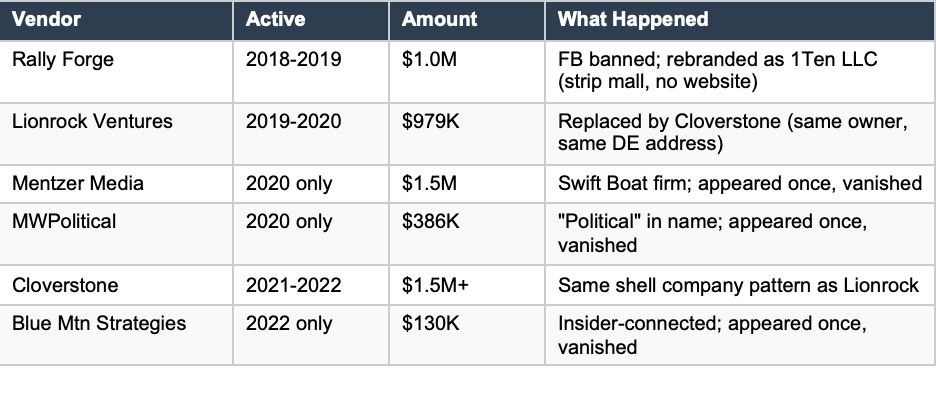
Insider-connected; appeared once, then vanished.
The vendors that stuck around tend to provide concrete, verifiable services: Mosaic (event production, $349K to $3.88M over five years), American Solutions for Business (a legitimate employee-owned Minnesota printing company, $1.2M to $2.0M). The one-and-done vendors tend to be the ones with political connections, insider ties, or no visible business operations.
That pattern suggests someone, at some point, realized certain vendor relationships were too hot to sustain and rotated them out. The money kept flowing. Only the names changed.
• • •
What Remains
Charlie Kirk announced a DOGE style audit on September 2, 2025. He was shot and killed eight days later. Erika Kirk took over as CEO and the DOGE style audit never happened.
Here is what I can say based on the public record.
At least $10 million went to companies owned by TPUSA’s own employees and board members, several of which had no websites, no employees, and no visible operations beyond collecting payments. Over $9 million went to a printing company that is actually a subsidiary of a $700 million political fundraising empire, with a $4.8 million gap between what was paid and what was reported as printing expenses. Millions more went to firms that describe their own work as political — a Swift Boat media buyer, a firm with “Political” in its name, a “digital political fundraising agency” — in apparent tension with the absolute prohibition on political activity that comes with 501(c)(3) status.
The organization’s COO was indicted alongside the owner of a Facebook-banned troll farm that TPUSA was paying. The man who signed the 990s was simultaneously billing the organization through his own payroll company. The CEO’s mother-in-law’s company collected $120,000 from the affiliated PAC. The CEO’s father-in-law reportedly sat on the board.
Every year, the 990 checked the box that said the conflict-of-interest policy was being enforced.
All of this is public record. The 990 filings are on ProPublica’s Nonprofit Explorer. The corporate registries are searchable. The FEC data is available to anyone.
Nobody with subpoena power has asked a single question.
Part 3- TPUSA- The $12.5 Million Pipeline That Feeds Itself
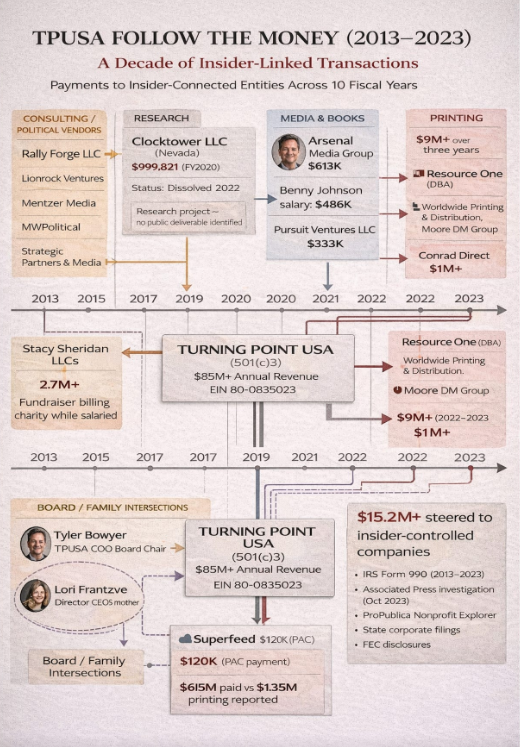
Welcome to my TPUSA Rabbit Hole! Part III
In October 2023, the Associated Press published an investigation into Turning Point USA that landed like a grenade in conservative media circles and then, strangely disappeared. The headline was about Charlie Kirk becoming a millionaire, but the real story was buried in the numbers, so let’s follow the money.
The AP found that top Turning Point officials had steered at least $15.2 million to companies owned by themselves, their friends, and their associates. Not to outside vendors with competitive bids or the educational mission the charity was built around. $15.2M to people already collecting salaries from the organization.
So, I fired up my laptop and went into my new favorite place, TPUSA’s 990 Forms. I pulled every 990 Form available on ProPublica, going all the way back to fiscal year 2013 when the organization first filed. The pattern was so consistent, that by the third shell company the playbook was in my face.
This piece puts the full picture together, because the individual transactions only tell half the story. The other half is in what happens when you lay them all side by side.
The Fundraiser Who Bills the Charity She Fundraises For
We have already covered Stacy Sheridan and her three LLC’s that brought in more than 2.7M since 2018 from TPUSA.
ProPublica flagged this arrangement in December 2023. Philip Hackney, a former IRS official, told them the pattern was concerning. His exact words: “As the number of self-interested transactions go up, the potential goes up for the possibility that the organization is being operated for the private interests of those who control the organization.”
That language matters, because it mirrors the legal standard the IRS uses when deciding whether to revoke a nonprofit’s tax-exempt status.
When reporters asked Turning Point and Sheridan about the arrangement, neither provided a comment.
A Million Dollars for Research Nobody Has Seen
In fiscal year 2020, Turning Point USA paid $999,821 to a company called Clocktower LLC in Nevada.
The description on the tax filing reads: “research project on educational outputs.”
Let’s start with the number, $999,821. One hundred and seventy-nine dollars short of a million. If you have worked in finance, government, or compliance, you know what that number looks like. It looks like someone was told the threshold was a million dollars and deliberately came in just under it, literally.
The company was registered in Nevada. It was dissolved in 2022. The only person listed on its business filings is Nicholas R. Miller, who serves as the president of a firm that advises clients on tax avoidance strategies.
When the AP reached out to Miller, he did not respond.
There is no public record of the research, no report, no publication, no white paper, no conference presentation, and no mention of it on any Turning Point website or promotional material. Nearly a million dollars of donor money went to a Nevada shell company for a research project, and no one has ever seen the results. Seems about right thus far.
Some online investigators have drawn connections between Clocktower LLC and Clock Tower X LLC, a separate entity linked to Brad Parscale that was registered as a foreign agent under FARA for Israel’s Ministry of Foreign Affairs. I have not been able to independently verify a direct link between the two companies, but the naming similarity and the Nevada registration have drawn scrutiny.
When Turning Point’s spokesperson Andrew Kolvet was asked about the payment, his response was that any suggestion insiders benefited from it was “defamatory.”
That is not a denial that the payment was made. It is not an explanation of what the research produced. It is a legal threat.
Look TPUSA, it’s not our fault you are bad at this game.
The Chief Creative Officer and the Company He Did Not Own
Benny Johnson served as Turning Point USA’s chief creative officer and his compensation from the organization totaled at least $486,000.
During the same period, a company called Arsenal Media Group received $613,000 from Turning Point between 2020 and 2021 for “videos and ad placement.” Arsenal described itself as having a “viral influencer network.”
Johnson’s personal website stated that he co-founded Arsenal Media Group.
After the AP contacted Johnson’s team about this, a spokesman responded that Johnson was “never an owner or executive of Arsenal Media” and that “any work Benny did with Arsenal was as an independent contractor”, but his own website had already said otherwise.
Combined, Johnson’s salary and the payments to his company totaled over $1.1 million.
$333,000 in Books
In 2020, Turning Point paid $333,000 to Pursuit Ventures LLC, a company belonging to Donald Trump Jr. The stated purpose was to purchase copies of a book Trump Jr. had written and the books were then offered as gifts during a fundraising drive.
Can we pause for one second? Because a tax-exempt educational charity seemingly spent a third of a million dollars buying books from the son of the sitting President of the United States, then gave those books away to donors as a fundraising incentive. The money left the charity and went into Trump Jr.’s LLC. Whew, stay with me.
This is legal. Nonprofits buy promotional materials all the time. But the scale matters, especially considering $333,000 is more than most Americans make in five years. And it went to an LLC controlled by a political figure whose support was foundational to the organization’s growth.
In the same period, Trump’s former bodyguard John McEntee collected $107,500 for consulting work. McEntee had previously served as head of the Presidential Personnel Office. His consulting firm billed Turning Point entities between 2021 and 2022.
$9 Million to a Printing Company That Is Not Really a Printing Company
We broke this down in other articles, but it’s part of the story so skip this section is you know about the $9.9M and want to keep grinding through this web.
The largest single vendor on Turning Point’s recent filings is Resource One, a Tulsa-based company that has collected over $9.9 million across three fiscal years.
In fiscal year 2023, Resource One was the #1 independent contractor at $6 million. In FY2023, it was #2 at $2.9 million. In FY2022, it received over $1 million. The service listed on every filing is the same: printing and publications.
On the same FY2023 filing, Part IX breaks down functional expenses by category. The total amount Turning Point reported spending on printing across the entire organization was $1.3 million, but they paid Resource One alone $6 million for printing.
That is a $4.7 million discrepancy. The charity says it spent $1.3 million on printing. So it paid one company $6 million for printing, but if both numbers cannot be accurate.
Resource One is not an independent print shop. It is a subsidiary of a $700 million political fundraising conglomerate and a second subsidiary of that same parent company was simultaneously collecting over $1 million from Turning Point.
Again, I’m not saying the payments were illegal. But I am saying that when a charity reports $1.3 million in total printing expenses on one page and $6 million to a single printing vendor on another page of the same tax return, someone should be asking questions.
The Mother-in-Law, the Indicted COO, and the Vendor Board (read that one 5 times fast)
There is a company called Superfeed Technologies that builds get-out-the-vote apps for Republican campaigns. Turning Point’s PAC paid Superfeed $120,000 in 2023.
Guess who is the chairman of Superfeed’s board? No other than Tyler Bowyer, who also serves as Turning Point USA’s Chief Operating Officer. Bowyer was indicted on nine felony counts in Arizona as a fake elector in the 2020 presidential election, go to Part 4 of my Tiktok series for my take on this mess.
Another interesting connection in our web is who is listed as a director (since December 2022) on Superfeed Technologies board. No other than Lori Frantzve, Erika Kirk’s mother.
So, the charity’s own COO chairs the board of a company the charity pays. And the founder’s mother-in-law sits on that same board with a daughter who is now CEO of the $85-million-a-year organization.
When asked about the Superfeed arrangement, Kolvet told reporters that Turning Point’s leaders and Kirk’s mother-in-law “have not earned a dime” from the company. I honestly love their commitment.
The question is not only whether individuals are being directly compensated. The question is whether the pattern of relationships between the charity, its officers, and its vendors creates a web of financial entanglement that undermines the independence a 501(c)(3) is supposed to maintain.
The charity also paid for Charlie and Erika Kirk’s wedding reception. It was held at the Fairmont Scottsdale Princess, a luxury resort. Turning Point described the event as a “ninth anniversary celebration and fundraiser” on the invitation, which was obtained by the AP. Anyone donating to this organization, what is your thought process?
The Pattern
In case TPUSA has made it this far in my writeup, everything in this article comes from publicly available tax filings, state corporate records, campaign finance disclosures, and reporting by the Associated Press and ProPublica. None of it is hidden. All of it is sitting in plain sight on the IRS website and in state databases.
That is part of what makes it so striking.
The lead fundraiser runs three shell companies billing the charity $2.7 million while collecting a six-figure salary. A million-dollar research project goes to a Nevada LLC managed by a tax avoidance specialist and produces nothing that anyone can find. The chief creative officer’s own company collects $613,000 while he is already on the payroll. A printing vendor collects $6 million despite the charity reporting only $1.3 million in total printing costs. The COO chairs the board of a vendor alongside the CEO’s mother. And the charity paid for the founder’s wedding.
Whew. I don’t smoke but I feel like I need a cigarette.
Each of these transactions, taken alone, might have an explanation, and I’m sure they do. Nonprofits hire consultants, organizations buy books for fundraising drives, events serve multiple purposes. But the follow the money does not evaluate self-dealing transactions in isolation, it looks at the totality. And the totality here is $15.2 million flowing to companies controlled by insiders, across multiple fiscal years, through entities registered in privacy-friendly states, with vague service descriptions and no public accountability.
Turning Point USA is a 501(c)(3) tax-exempt educational charity with donations to it being tax-deductible. It brought in $84.9 million in contributions in fiscal year 2023 alone. Its stated mission is to educate young Americans about the principles of fiscal responsibility, free markets, and limited government. Anyone beginning to see the problem?
Whether $15.2 million flowing to insider-controlled companies is consistent with that mission is a question for the IRS, the state attorneys general who regulate charities, and the donors whose money is involved. I’m just asking questions.
When the AP asked Turning Point about their findings, the response was that any insinuation that insiders benefited was “defamatory.” Honestly, at this point it’s embarrassing how dumb they are.
The filings are public. The corporate records are public. The numbers are on the page where we can see them.
I am not insinuating anything,I am reading the documents and reporting findings.
___
Sources and Documents Referenced (CYA documentation)
Tax Filings (Form 990, EIN 80-0835023):
All filings available at ProPublica Nonprofit Explorer: projects.propublica.org/nonprofits/organizations/800835023
FY2023 — Top 5 contractors: Resource One ($6M), Mosaic Event Productions ($4M), Active Engagement ($3M), American Solutions for Business ($2M), Conrad Direct ($1M). Schedule L: GGLF 2023 LLC, $350,000 loan for split-dollar life insurance, entity owned by President/CEO.
FY2022 — Top 5 contractors: Mosaic Event Productions ($3.9M), Resource One ($2.9M), Active Engagement ($2.7M), American Solutions for Business ($1.9M), Fox News Channel ($1.4M).
FY2021 — Top 5 contractors: Mosaic Event Productions ($2.2M), American Solutions for Business ($1.2M), American Philanthropic ($884K), Cloverstone Ventures LLC ($827K), Active Engagement ($736K).
FY2020 — Top 5 contractors: Mentzer Media Services ($1.5M), Mosaic Event Productions ($714K), Lionrock Ventures ($386K), MWPolitical ($385K), Strategic Partners and Media ($350K). Schedule G: Lionrock Ventures additional $627K in fundraising fees.
Investigative Reporting:
Associated Press, “How Trump’s MAGA movement helped a 29-year-old activist become a millionaire,” Brian Slodysko, October 2023. Published in The Hill, Detroit News, Las Vegas Sun, and others.
ProPublica, “At This Trump-Favored Charity, Financial Reporting Is Questionable and Insiders Are Cashing In,” December 2023.
State Corporate Records:
Arizona Corporation Commission (ecorp.azcc.gov): Superfeed Technologies board filing, December 2022. Directors: Tyler Bowyer (Chairman), Lori Frantzve (Director).
Nevada Secretary of State (nvsos.gov): Clocktower LLC filing. Manager: Nicholas R. Miller. Status: Dissolved 2022.
Wyoming Secretary of State (wyobiz.wyo.gov): GGLF 2023 LLC. Filed May 15, 2023. Agent resigned October 2024. Tax dissolution September 7, 2025. Reinstated December 3, 2025.
Campaign Finance:
Turning Point PAC payment to Superfeed Technologies: $120,000. Source: FEC filings.
Legal Standard Referenced:
IRS criteria for revocation of 501(c)(3) status based on private benefit/private inurement. Philip Hackney, former IRS official, quoted in ProPublica regarding pattern of self-interested transactions.
___
The Leah Files is an independent investigative newsletter. If you found this piece valuable, share it. If you have documents or tips related to Turning Point USA’s finances, reach out. The filings are public. The questions should be too.
If this investigation matters to you, a paid subscription is the best way to support it. It costs less than one of Stacy Sheridan’s shell companies charges for a day of “fundraising.” Below the paywall: the full vendor network map, the raw 990 cross-reference analysis, and what I’m looking at next.
@theleahfiles Follow the money TPUSA – Part 1 #tpusa #followthemoney #charliekirkspeech #candaceowens @CANDACE ♬ original sound – theleahfiles
@theleahfiles Follow the money TPUSa – Part 2 #tpusa #followthemoney #charliekirk #candaceowens ♬ original sound – theleahfiles
@theleahfiles Follow the Money TPUSA – Part 3 #tpusa #followthemoney #charliekirk #candaceowens @CANDACE #greenscreen ♬ original sound – theleahfiles
@theleahfiles TPUSA Follow The Money – Part 4 #charliekirk #followthemoney #tpusa #candace @CANDACE ♬ original sound – theleahfiles