From “technocracy.news”
I wrote this white paper to lay bare the myths surrounding the war in Iran and to expose the master plan to restructure global trade routes in order to dominate world trade. This is a tectonic shift in the geopolitical structure of the world. Further, this is the master plan for global Technocracy, even down to making Gaza into the poster child for the technocratic state. If you cannot connect the dots here, then you will be left in the fog of delusion. ⁃ Patrick Wood, Editor.
The India-Middle East-Europe Economic Corridor — IMEC — is being called one of the largest and most ambitious infrastructure projects in modern history. Trump called it [1] ‘one of the greatest trade routes in all of history.’
IMEC is not just a trade route. It is a control corridor — a fully integrated system of rails, roads, shipping lanes, ports, fiber optic cables, energy pipelines, and data centers stretching from India to Europe. Whoever controls the architecture of that system controls the flow of goods, energy, data, and money across three continents. That is precisely why Technocrats want it, and precisely why you should understand what it is and who is building it.
IMEC is the commercial payoff of a decade of deliberate geopolitical engineering — engineering that runs directly through Jared Kushner, the Abraham Accords, the war with Iran, and the technocratic reconstruction of Gaza. Connect the dots and the picture is unmistakable.
What IMEC Actually Is
On September 9, 2023, the governments of India, the United States, Saudi Arabia, the UAE, France, Germany, Italy, and the European Union signed a Memorandum of Understanding at the G20 Summit in New Delhi. [2] They called it the India-Middle East-Europe Economic Corridor. The official purpose: to bolster economic development, enhance connectivity, and offer an alternative to both the Suez Canal and China’s Belt and Road Initiative.
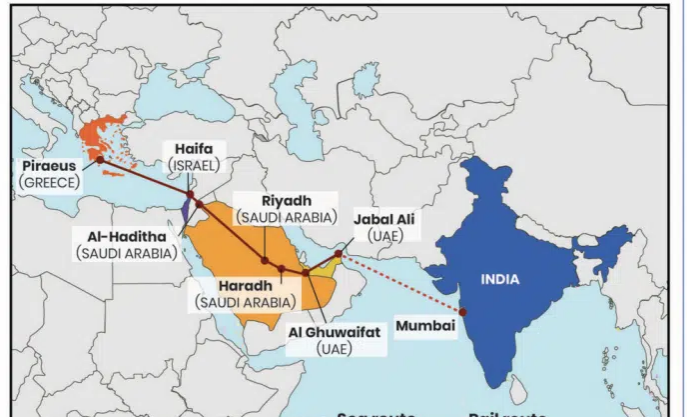
The corridor runs in two legs. The East Corridor links Indian ports — Mundra, Kandla, and Jawaharlal Nehru Port Trust in Navi Mumbai — by sea to Arabian Gulf terminals: Fujairah, Jebel Ali, and Abu Dhabi in the UAE, plus Dammam and Ras Al Khair in Saudi Arabia. From there, the Northern Corridor continues by rail across Saudi Arabia through Ghuwaifat and Haradh, into Jordan, and on to the Israeli port of Haifa. From Haifa, ships carry cargo west across the Mediterranean to Greece or Italy and onward into Europe. [3]
That is the transportation pillar. But IMEC is three pillars, not one. The energy pillar threads electricity cables and hydrogen pipelines along the same route, designed to carry Gulf energy — and eventually Indian-produced green hydrogen — into European markets. The digital pillar runs high-speed fiber optic cables and cross-border data infrastructure the entire length of the corridor, anchored by data centers at key nodes. [4] Think of it as a nervous system laid alongside the circulatory system.
Initial cost estimates run from $3 billion to $8 billion per segment. The G7’s Partnership for Global Infrastructure and Investment has pledged to mobilize $600 billion globally for projects of this type. Construction of key rail lines, ports, and highway segments officially began in April 2025. [5]
IMEC promises to cut transit time between India and Europe by 40 percent compared to the Suez Canal route.⁶ What it does not advertise is who holds the keys to every chokepoint along the way.
Adani Ports of India now owns Haifa Port — IMEC’s Israeli gateway into Europe — having won the privatization tender in July 2022 and completing the acquisition in January 2023. [7] Adani is simultaneously developing Vadhavan deep-water port on India’s western coast, the corridor’s eastern anchor. [8] The same company sits at both ends of the sea lane. France’s CMA CGM and Dubai-based DP World both signed major 30-year port concession deals in 2025 — for Syria’s Latakia and Tartus ports respectively, Mediterranean nodes positioned directly on the IMEC-adjacent Levant corridor. [9] These are not coincidental private investments. They are the private-sector execution of a state-designed infrastructure strategy — which is the public-private partnership model that Technocracy has always required.

Sunset view of port of Haifa, Israel, Image: Adobe Stock
The Strait of Hormuz: The Choke Point of IMEC
IMEC’s eastern sea lane runs through the Persian Gulf. The Persian Gulf exits to the Arabian Sea through one bottleneck: the Strait of Hormuz. Thirty-three kilometers wide. One-fifth of global petroleum liquids. More than one-quarter of all seaborne oil trade. [10] Every tanker leaving the Gulf terminals that IMEC depends on must pass through that strait — unless Iran decides otherwise.

(photo credit: REUTERS/DADO RUVIC/ILLUSTRATION)
On February 28, 2026, the United States and Israel launched coordinated strikes on Iran under Operation Epic Fury. Supreme Leader Ali Khamenei was killed. Iran’s Islamic Revolutionary Guard Corps responded by declaring the Strait closed to American, Israeli, and Western-allied shipping. Tanker traffic dropped approximately 70 percent. Over 150 ships anchored outside the Strait. Oil prices broke $100 a barrel. Qatar declared force majeure at Ras Laffan, removing roughly 20 percent of global LNG from the market. European natural gas prices surged 63 percent in a week. As of this writing, the crisis is ongoing. [11]
None of this is tangential to IMEC. It is the central issue. A Gulf shipping lane dominated by a hostile Iranian navy is a Gulf shipping lane that cannot anchor a trillion-dollar trade corridor. The removal of Iran’s ability to threaten Hormuz — by neutralizing its naval forces, degrading its military capacity, or forcing regime change — is a strategic prerequisite for IMEC’s eastern corridor to function as designed. Iranian officials understand this perfectly. They have described IMEC as an instrument of strategic encirclement. That is an accurate description.
It is also why analysts tracking IMEC have quietly noted that Oman’s ports of Duqm, Salalah, and Sohar — positioned outside the Strait on the Arabian Sea — have attracted accelerating investment as alternative maritime hubs. [12] The corridor’s architects built in a bypass. They anticipated this problem. Then they went ahead and created it anyway.
The Abraham Accords, which normalized relations between Israel and the Gulf states on the basis of a shared threat perception toward Iran, were not purely diplomatic achievements. They were the opening move in a sequence. The war with Iran is clearing the military obstacle. IMEC is the commercial architecture that moves into the resulting space. These are connected events, not parallel ones.
Jared Kushner: The Architect Who Profits From His Own Blueprint
I have been tracking the intersection of geopolitics and commercial infrastructure for a long time. What makes IMEC uniquely significant is the degree to which the same individual designed the diplomatic preconditions, brokered the commercial relationships, and is now overseeing the governance structure in the key territory the corridor passes through. That individual is Jared Kushner.
The sequence begins in 2017, when Kushner was appointed as Trump’s special adviser for the Middle East. [13] His method was geoeconomics: financial incentives and commercial integration as a substitute for political solutions. He called forty years of the peace process a failure and proposed something different. What he built was the Abraham Accords — normalization agreements between Israel and the UAE, Bahrain, Sudan, and Morocco, signed in August and September 2020. [14] Kushner negotiated all four deals in four months, leveraging Israeli annexation threats, Gulf concerns about Iran, and American security guarantees into a bloc of aligned states bound together by economic interest.
The strategic logic of the Abraham Accords and the strategic logic of IMEC are identical. Both assume that commercial integration produces regional stability. Both assume that a shared threat from Iran provides the necessary political glue. Both require Israel to be normalized as a transit and logistics node in the regional economy. The Abraham Accords created the political foundation. IMEC is the infrastructure built on top of it.
Kushner left government in January 2021 and founded Affinity Partners, a venture capital firm of which he is the sole owner. He raised $2 billion from Saudi Arabia’s sovereign wealth fund. [15] He secured $1.5 billion from Qatar’s sovereign wealth fund and the Abu Dhabi-based Lunate. [16] These are the same Gulf sovereign entities that are cornerstone investors in IMEC infrastructure. Kushner designed the diplomatic framework that made IMEC possible. He then positioned himself financially in the very Gulf capitals that are funding it. That is not a coincidence. It is a business model.
Kushner designed the diplomatic framework that made IMEC possible. He then positioned himself financially in the very Gulf capitals funding it. That is not a coincidence. It is a business model.
In Trump’s second term, Kushner has no formal appointment. He does not need one. Working alongside special envoy Steve Witkoff, he co-authored the 20-point Gaza peace plan and helped broker the October 2025 ceasefire between Israel and Hamas. [17] Then, on January 22, 2026, at the World Economic Forum in Davos, Kushner presented the reconstruction masterplan for Gaza at the signing ceremony for Trump’s Board of Peace — and Trump announced him as an envoy of peace alongside Witkoff. [18]
The Abraham Fund, established under the first Trump term to raise $3 billion for regional infrastructure including a gas pipeline between the Red Sea and Mediterranean, was overseen by Adam Boehler — Kushner’s college roommate. The fund never received money and no projects were begun under Biden. It is now, in effect, being relaunched through the Board of Peace under a different name with a far larger balance sheet. The same network. The same logic. A bigger canvas. [19]
The Board of Peace and “New Gaza”
Trump’s Board of Peace was signed into existence at Davos on January 22, 2026. Trump pledged $10 billion in U.S. commitment. Member nations announced $7 billion in investments. Kushner serves on its executive board. [20] The Board is framed as a coordinating mechanism for Gaza’s reconstruction. What it actually is: an externally governed development authority that sets investment conditions, defines governance standards, and manages the sequencing of reconstruction in a territory whose previous government has been militarily eliminated.
Kushner’s Gaza masterplan — presented at the same Davos ceremony — envisions a territory subdivided into zones, with large areas designated for industry and parks, and a population density that UN-Habitat analysts note is significantly lower than pre-war Gaza. ‘New Gaza,’ in Kushner’s renderings, looks like Dubai or Doha: gleaming towers along a redeveloped coastline, a new port at the southwestern end near Egypt, an airport adjacent to it, 180 high-rise towers, 500,000 promised jobs in construction, agriculture, manufacturing, and the digital sector. [21]
Reconstruction occurs only in areas where Hamas has fully demilitarized or where Israeli military control has been established. A newly formed technocratic committee — Kushner described it explicitly as ‘a technocratic administration’ — oversees the process, supported by Arab partners, working alongside the Palestinian Authority. [21] Governance will not derive from democratic legitimacy. It derives from administrative competence as defined and certified by external actors.
Now look at a map. Haifa is IMEC’s key Israeli port node. Gaza sits on the Mediterranean coast directly to Haifa’s south. A rebuilt Gaza with a new deepwater port, airport, and special economic zone, integrated into the Abraham Accords normalization architecture and connected to Gulf states through Israeli-mediated trade relationships, is not a separate development from IMEC. It is a corridor extension. The territory being cleared, administered, and rebuilt through the Board of Peace sits directly astride the route that IMEC’s designers need to control.
The Infrastructure Itself
Let’s be specific about what IMEC consists of, because the details carry the story.
Rails and Roads: Saudi Arabia will use the existing GCC railway backbone as the corridor’s Arabian spine, carrying critical raw materials from largely untapped interior reserves to international markets. [22] New rail lines are under construction connecting Gulf ports to Jordan and onward to Haifa. Ship-to-rail transfer networks are being built at key Gulf terminals. Road transport infrastructure through Jordan provides redundancy.
Ports: Mundra and Kandla in India. Fujairah — notably the only UAE emirate outside the Strait of Hormuz, positioned as a bypass hub. Jebel Ali and Abu Dhabi. Dammam and Ras Al Khair in Saudi Arabia. Haifa in Israel, now controlled by Adani Ports. Competing European terminals in Trieste, Piraeus, Thessaloniki, and Marseilles, each jockeying to become the corridor’s western anchor. Italy appointed Ambassador Francesco Talò as its special IMEC envoy in April 2025 and announced a ministerial summit in Trieste for later in 2025, branding the corridor the ‘Cotton Route.’ [23]
Fiber Optic Cables: Trump mentioned them twice at his February 2025 White House announcement [1] — ‘many many undersea cables.’ The Blue-Raman submarine cable system — Google’s initiative in collaboration with Telecom Italia Sparkle and Omantel, with 16 fiber pairs and capacity of 218 terabits per second — is already operational along this route, connecting India to Italy via Israel while bypassing Egypt entirely. [24] These cables are not merely commercial investments in internet connectivity. They are the data nervous system of a managed corridor.
Pipelines: Electricity cables and hydrogen pipelines thread alongside the rail lines. The EU has committed under its REPowerEU plan to importing 10 million tons of green hydrogen per year by 2030. [25] India has targeted producing 5 million tons per year by the same date under its National Green Hydrogen Mission. [26] IMEC’s pipeline infrastructure is specifically designed to move that energy from India and the Gulf to European markets — filling the supply vacuum created by Europe’s deliberate decoupling from Russian energy after 2022. This is an energy dependency architecture, not merely a trade route.
Data Centers: Positioned at key nodes throughout the corridor. Combined with the fiber cables and AI-driven smart port logistics systems, these data centers enable real-time monitoring and management of everything moving through the corridor. This is the digital pillar that the Atlantic Council describes as ‘cross-border digital infrastructure.’ [27] In plain language: a surveillance and management architecture embedded in the trade route itself.
Arch-Technocrats Fingerprints are All Over IMEC
I have defined Technocracy consistently for over a decade: it is a system of governance in which society is controlled by scientists, engineers, and technical experts rather than elected representatives, and in which resource allocation and behavior modification replace price mechanisms and democratic consent. The endgame is scientific dictatorship. It does not announce itself. It builds infrastructure.
IMEC is Technocracy in its infrastructure phase. Consider the architecture: a public-private partnership model in which state diplomacy creates the framework and private capital executes it. A managed corridor in which goods, energy, and data flow through systems monitored and controlled by whoever operates the technical infrastructure. A governance model for Gaza — explicitly labeled ‘technocratic’ by its own architects — in which a committee of experts accountable to Gulf Arab investors and American special envoys administers a civilian population. And a digital layer — fiber cables, data centers, AI logistics — that makes every transaction in the corridor legible to its operators.
This is not speculation about future intentions. This is the stated design, documented in MOU texts, Atlantic Council reports, and Davos presentations. When Kushner says ‘technocratic administration,’ he is not using the term loosely. He is describing the governing model — administration by experts accountable to investment frameworks rather than populations. [21]
The Trilateral Commission, which I have tracked since partnering with Antony Sutton in the late 1970s, declared 2023 as Year One of this new global order at its plenary meeting in New Delhi — the same city where the IMEC MOU was signed six months later. [28] The same year. The same participants. The same framework of managed global integration under expert governance structures insulated from democratic accountability.
God established in Genesis that man has dominion over the earth and that property belongs to individuals created in His image — not to administrative zones managed by technocratic committees. What is being built in Gaza and along the IMEC corridor is the opposite of that. It is a system in which populations become resources administered by experts, and in which property and sovereignty are replaced by access privileges granted within a managed economic zone.
That is not peace. That is a control system dressed up as reconstruction.
The Bottom Line
IMEC is real, it is being built, and it will reshape world trade. The routes are documented. The investors are named. The infrastructure is under construction. The geopolitical sequence — Abraham Accords, Iran war, Hormuz crisis, Gaza reconstruction — is not a series of unrelated events. It is a sequenced strategy with a commercial payoff built into its design from the beginning.
Jared Kushner designed the diplomatic preconditions. He positioned himself financially with the Gulf sovereigns who are funding the infrastructure. He is now overseeing the governance architecture for the key territory the corridor requires. Trump is providing the military and political cover. The Board of Peace is the administrative instrument. IMEC is the prize.
The Strait of Hormuz crisis has exposed the corridor’s central vulnerability and simultaneously demonstrated the willingness to use military force to resolve it. Whether Iran’s capacity to threaten the Strait is permanently degraded or not, the intent is clear: the corridor will be secured, one way or another.
I have said for years that Technocracy does not need a revolution. It needs infrastructure. Build the systems, control the data, manage the resources, administer the populations. Consent is not required. Ownership is not required. Elections are not required. What is required is control of the architecture.
IMEC is that architecture. And it is being built right now, while the world watches the smoke rising over the Strait of Hormuz and the cranes moving rubble in Gaza.
Connect the dots.
ENDNOTES
- Trump quoted verbatim at joint White House press conference with Indian Prime Minister Narendra Modi, February 13, 2025. Source: Al Jazeera, “Key takeaways from Donald Trump’s meeting with India’s Narendra Modi,” February 14, 2025; confirmed by Business Standard, February 14, 2025.
- Memorandum of Understanding signed September 9, 2023, at the G20 New Delhi Summit. Signatories: India, United States, Saudi Arabia, UAE, France, Germany, Italy, and the European Union. Source: Wikipedia, “India–Middle East–Europe Economic Corridor” (citing original MOU); Atlantic Council, “The India-Middle East-Europe Economic Corridor: Connectivity in an Era of Geopolitical Uncertainty,” August 27, 2025.
- Port listings sourced from Drishti IAS, “India-Middle East-Europe Corridor,” citing the IMEC MOU geography. Indian ports: Mundra (Gujarat), Kandla (Gujarat), Jawaharlal Nehru Port Trust (Navi Mumbai). UAE ports: Fujairah, Jebel Ali, Abu Dhabi. Saudi ports: Dammam, Ras Al Khair. Rail through Saudi Arabia via Ghuwaifat and Haradh, into Jordan, terminating at Haifa, Israel.
- Three-pillar structure: transportation, energy, and digital. Source: Atlantic Council, “The India-Middle East-Europe Economic Corridor,” August 2025; EGIC (Euro-Gulf Information Centre), “The India-Middle East-Europe Economic Corridor,” November 30, 2025.
- Cost estimates of $3 billion to $8 billion per segment from Drishti IAS analysis of IMEC MOU. G7 PGII pledge of $600 billion: EGIC, November 2025, citing G7 Partnership for Global Infrastructure and Investment documentation. Construction commencement April 2025: imec.international, “Progress,” April 2025.
- 40% faster transit claim: Drishti IAS, “India-Middle East-Europe Corridor,” citing IMEC MOU analysis. Route reduces transit time between India and Europe compared to the Suez Canal route.
- Adani Ports won the Haifa privatization tender in July 2022 (bid: 4.1 billion shekels / approx. $1.18 billion). Finalized January 2023. Adani holds 70% stake; Israel’s Gadot Group holds 30%. Sources: Bloomberg, “Adani Ports Jumps After Winning an Israel Port for $1.2 Billion,” July 15, 2022; Maritime Executive, “Adani Group Completes $1.15B Purchase of Haifa Port Company,” January 11, 2023; Adani Ports press release, July 2022. NOTE: The article states “acquired in 2022.” The tender was won in July 2022; legal transfer completed January 2023.
- Vadhavan deep-water port, Dahanu, Maharashtra: described in TRENDS Research & Advisory, “Reshaping the India-Middle East-Europe Economic Corridor: New Challenges, Old Vulnerabilities,” citing UAE-India cooperation; also Atlantic Council IMEC report, August 2025.
- DP World $800 million and CMA CGM 30-year deal: CORRECTION TO ARTICLE TEXT. These figures refer to Syrian port deals, not primary IMEC corridor investments. DP World signed a 30-year/$800M concession for Syria’s Tartus port (July 13, 2025). CMA CGM signed a 30-year deal for Syria’s Latakia port (May 2025, €200M investment). Syria appears as a “pending political developments” node on the IMEC corridor map (Atlantic Council, August 2025). These investments are corridor-adjacent and strategically linked, but are not primary IMEC port infrastructure. Sources: DP World press release, July 13, 2025; Offshore Energy, “CMA CGM Switches Syria’s Latakia Port Expansion Into High Gear,” August 2025.
- Strait of Hormuz statistics: one-fifth of global petroleum liquids; more than one-quarter of seaborne oil trade. Source: Congressional Research Service, “Iran Conflict and the Strait of Hormuz: Impacts on Oil, Gas, and Other Commodities,” March 11, 2026 (Congress.gov report R45281).
- Operation Epic Fury, February 28, 2026: US-Israel coordinated strikes on Iran. Khamenei killed. IRGC declared Strait closed. Tanker traffic drop ~70%; 150+ ships anchored. Oil broke $100/bbl; Qatar force majeure at Ras Laffan removing ~20% of global LNG. European gas prices +63% week-on-week. Sources: Britannica, “2026 Iran War” (updated March 17, 2026); Congressional Research Service report, March 11, 2026; Wikipedia, “2026 Strait of Hormuz Crisis” (updated March 18, 2026).
- Oman ports (Duqm, Salalah, Sohar) as Hormuz bypass hubs. Source: TRENDS Research & Advisory, “Reshaping the India-Middle East-Europe Economic Corridor: New Challenges, Old Vulnerabilities,” citing Oman’s geographic position as the only GCC state with direct Indian Ocean access and noting targeted investment in all three ports.
- Kushner appointed senior adviser to the President / special adviser on the Middle East from January 2017. His geoeconomic methodology is documented across multiple sources; his private 2017 remarks to congressional interns were reported in The National Interest, “Jared Kushner’s Quiet Middle East Diplomacy,” January 28, 2026.
- Abraham Accords: UAE (August 13, 2020), Bahrain (September 11, 2020), Sudan (October 23, 2020), Morocco (December 10, 2020). All four brokered by Kushner and Avi Berkowitz. Source: Wikipedia, “Abraham Accords” (extensively documented). Also Carnegie Endowment, “The Abraham Accords After Gaza: A Change of Context,” April 2025.
- Affinity Partners: Kushner is sole owner (SEC filing, company name A Fin Management LLC). Saudi Arabia’s Public Investment Fund invested $2 billion, confirmed by congressional investigators (Senate Finance Committee letter, September 25, 2024) and Affinity’s own disclosure that it charges PIF a 1.25% annual fee on $2 billion in committed funds. Sources: Affinity Partners Wikipedia; Senate Finance Committee, September 25, 2024; Reuters via Yahoo Finance, March 28, 2025.
- Qatar + Abu Dhabi (Lunate) investment: $1.5 billion combined (NOT $1.2 billion as initially reported by The Hill). CORRECTION: Kushner himself stated “$1.5 billion” in capital from Qatar Investment Authority and Lunate on the “Invest Like the Best” podcast, December 20, 2024. Reuters confirmed $1.5 billion figure. Sources: Reuters via Yahoo Finance, “Kushner’s Affinity’s Assets Jump to $4.8 Billion After Gulf Cash Injection,” March 28, 2025; Newsweek, December 22, 2024; AGBI, January 23, 2026.
- October 2025 ceasefire: Kushner and Witkoff co-authored 20-point Gaza peace plan; Kushner helped broker ceasefire. Source: The Hill, “Jared Kushner Reenters as Key Player in Middle East Peace Push,” October 11, 2025.
- Board of Peace signing ceremony, Davos, January 22, 2026. Trump named Kushner co-envoy of peace alongside Witkoff at the Board of Peace inaugural meeting, February 2026. Sources: The Hill, “Trump Appoints Jared Kushner as Peace Envoy,” February 2026; CNN, “180 Skyscrapers for Gaza: Trump’s Son-in-Law Kushner Unveils ‘Masterplan,’” January 22, 2026; Media Line, January 22, 2026.
- Abraham Fund: established late 2020 under the first Trump term to raise $3 billion. Overseen by Adam Boehler, CEO of DFC. Boehler was Kushner’s college roommate at the University of Pennsylvania’s Wharton School. First projects included upgrading Israel-Palestinian checkpoints and a gas pipeline between the Red Sea and the Mediterranean. Fund never received substantive funding; no projects begun. Biden administration: fund dissolved. Sources: American Oversight, “Records Reveal New Details About Kushner’s and Mnuchin’s Trips to Middle East,” June 4, 2024 (citing original NYT reporting by Kate Kelly and Kenneth Vogel); Times of Israel, “Trump’s $3 Billion Abraham Fund May Be Tapped Out Before Staking a Dime,” March 2, 2021; Wikipedia, “Adam S. Boehler” (confirms Wharton roommate relationship).
- Board of Peace: Trump pledged $10 billion U.S. commitment; member nations announced $7 billion. Source: Yahoo News / NewsNation, “Trump to Name Jared Kushner Envoy for Peace,” February 2026.
- “New Gaza” masterplan: four zones; port at SW end near Egypt; airport adjacent; 180 towers; 500,000+ jobs. Kushner called governing body “a technocratic administration” explicitly. Population density concern raised by UN-Habitat agency (2024 report: 87% of Gaza was urban area). Sources: CNN, January 22, 2026; NPR, “What Jared Kushner’s ‘New Gaza’ Plan Includes, and What It Leaves Out,” February 2, 2026; ABC News, January 23, 2026; Media Line, January 22, 2026.
- GCC railway backbone as IMEC spine; Saudi Arabia plans to use it to export critical raw materials. Source: TRENDS Research & Advisory, “Reshaping the India-Middle East-Europe Economic Corridor: New Challenges, Old Vulnerabilities,” citing Saudi infrastructure plans within IMEC.
- Italian port competition (Trieste, Piraeus/Thessaloniki, Marseilles). Italy branded IMEC the “Cotton Route” — term coined by Italian Foreign Minister Antonio Tajani during the Italy-India Business Forum. Ambassador Francesco Talò appointed Italy’s Special Envoy for the Cotton Route in April 2025 (announced during Tajani’s visit to New Delhi). Ministerial summit announced for Trieste, second half of 2025. Sources: Decode39, “Italy’s IMEC Vision,” April 11, 2025; EGIC, November 30, 2025; Wikipedia, “India-Middle East-Europe Economic Corridor.”
- Blue-Raman submarine cable system: Google initiative in partnership with Telecom Italia Sparkle (Blue segment: Italy-France-Greece-Israel) and Omantel (Raman segment: Jordan-Saudi Arabia-Djibouti-Oman-India). Each system: 16 fiber pairs, total capacity 218 Tbps. Expected ready for service 2024. Terrestrial link across Israel connects Mediterranean and Red Sea segments (Bezeq). Cost estimated at ~$400 million. Sources: Google Cloud Blog, “Announcing the Blue and Raman Subsea Cable Systems,” July 29, 2021; Sparkle press release, July 2021; Submarine Networks / TeleGeography analysis.
- EU REPowerEU hydrogen targets: 10 million tonnes domestic production + 10 million tonnes imported by 2030. Source: European Commission REPowerEU Plan (COM/2022/230 final), May 2022; European Hydrogen Observatory, “REPowerEU”; EU energy.ec.europa.eu official page, “Hydrogen.”
- India National Green Hydrogen Mission: 5 million metric tonnes per year production capacity by 2030; associated ~125 GW renewable capacity. Approved by Government of India January 2023; budget allocation Rs. 19,744 crore (~$2.4B). Sources: India Ministry of New and Renewable Energy / National Green Hydrogen Mission official page; Green Hydrogen Organisation country page for India; RMI, “From Promise to Purchase: Unlocking India’s Green Hydrogen Demand,” August 2025.
- Atlantic Council description of IMEC digital pillar as “cross-border digital infrastructure.” Source: Atlantic Council, “The India-Middle East-Europe Economic Corridor: Connectivity in an Era of Geopolitical Uncertainty,” August 27, 2025.
- Trilateral Commission “Year One” declaration: at the annual plenary meeting in New Delhi, March 10-12, 2023, an unnamed speaker (identity protected per Commission rules) stated: “Three decades of globalization…has been replaced by what will be a multidecade period of globalization defined as fragmented, not-free-market-based but industrial-policy based and structurally inflationary. This year, 2023, is Year One of this new global order.” Originally reported by Nikkei Asia, March 14, 2023. Patrick Wood’s analysis published March 20, 2023, at Technocracy.News and Liberty Sentinel.