From “technocracy.news”
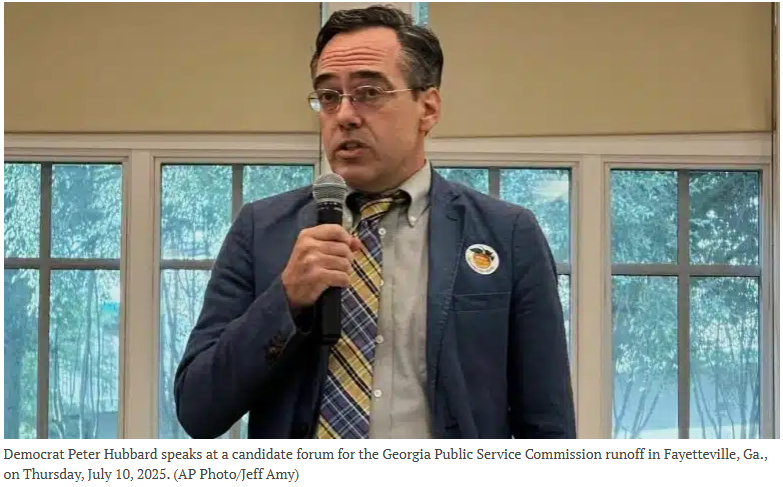
A Democrat, Peter Hubbard, was elevated to the Georgia Public Service Commission because he ran a campaign based on rising consumer energy prices due to the outrageous energy consumption of AI data centers. Hubbard is the first Democrat in 20 years to achieve statewide office in Georgia. Why? Because Republicans, from President Trump on down to states and local communities, are routinely pumping pro-AI data centers. The approaching 2026 midterm elections are likely see significant overturn of Republican fortunes.
We live in Mesa, Arizona where the entire city council is Republican and has been so for years. Under their watch, they have allowed AI data centers to overrun the city. This is the desert for Pete’s sake. Nevertheless, we have no less than 15 major facilities covering 1,500 acres and around 15 million square feet under roof, and more on the way. Here are some notable facilities:
- Meta (Facebook): Meta’s campus covers 396 acres in southeast Mesa, with five buildings totaling more than 2.5 million square feet of data center and support space.
- Novva: Novva’s $3 billion campus spans 159-160 acres, includes five data halls, and provides about 1.1–1.3 million square feet of data hall and office space, with a planned total power capacity of 300 MW.
- EdgeCore: The EdgeCore Mesa campus is expanding from the original 40 acres to an additional 43.87 acres, eventually supporting over 450 MW across 83.87 acres.
- Apple: Apple operates a 1.3 million-square-foot data center on a campus at the corner of Signal Butte and Elliot roads.
- Edged Energy: Edged Energy is building a 12-acre data center site near the Phoenix-Mesa Gateway Airport, with a 210,000-square-foot campus focused on high-density AI workloads.

A new Google facility is under construction about 3 miles down the road from our house. It sits on 187 acres of former farmland, will have 750,000 square feet under roof and consume 430 Megawatts of power.

Mesa’s data center power consumption already far exceeds the city’s non-data center usage, making the area one of the highest-density digital infrastructure clusters in the Southwest.
Meta is currently the largest data center in Mesa, but it employs only 200 full-time staff in Arizona. All told, the town’s data centers will never exceed 2,500 full-time employees.
Do you see what’s wrong with this picture? The political winds are going to change direction in 2026. ⁃ Patrick Wood, Editor.
Is the cost of electricity continues to skyrocket, Georgia voters delivered a political surprise on Election Day – elevating Democrat Peter Hubbard to the state’s Public Service Commission. Hubbard notably ran on rising utility costs and the spread of data centers, and his victory, along with another Democratic win in a separate statewide race, marks the first time in nearly twenty years the party has captured statewide office in Georgia.
Hubbard – who will join the body that regulates the state’s electric utility, ran on a pair of related concerns: rising utility costs and the rapid spread of data centers across the state.
“The number one issue was affordability,” Hubbard said. “But a very close second was data centers and the concern around them just sucking up the water, the electricity, the land – and not really paying any taxes.”
Georgia has become a magnet for data-center investment in recent years, aided by generous tax incentives and a growing footprint of large-scale digital infrastructure. But it is also emerging as an early indicator of a broader national pushback – one that is increasingly bipartisan and increasingly organized, WIRED notes.
A new report released this week by Data Center Watch, a project of AI-security firm 10a Labs, suggests that people are rapidly getting pissed about data centers. The project catalogs community-level opposition across the country using public sources such as news reports, legal filings, and social media. Its latest findings show that between March and June of 2025, local resistance either blocked or delayed $98 billion in data-center projects – surpassing the $64 billion tracked in the project’s first report, which covered May 2024 through March 2025.
“This was a sharp escalation,” the report concludes, with eight projects fully blocked and nine delayed in just three months. Two of the blocked projects were located in Indiana and Kentucky. One of the largest halted developments – a $17 billion proposal in suburban Atlanta – was put on hold after county officials approved a 180-day moratorium in May following extensive public pressure.
between exploding electricity bills and lack of jobs for grads, a new luddite revolution is coming – they will be burning down data centers within a year
— zerohedge (@zerohedge) August 25, 2025
Miquel Vila, the report’s author, said the data suggests a significant shift in public sentiment. While he noted methodological caveats, including the possibility that more total construction simply yields more opportunities for opposition, other indicators point to what he described as “a turning point.” Nearly 50,000 signatures opposing specific data centers were submitted in the March–June window alone.
“Before, [resistance] was something that could happen,” Vila said. “Now it seems that it’s very likely that when you are developing [a data center], potentially someone is going to organize.”
Energy Costs Become a Political Catalyst
As we’ve been noting all year, rising electricity use is a unifying theme in the backlash. Hubbard’s victory in Georgia underscores that point, but similar dynamics are unfolding in other states with concentrated data-center activity.
In Virginia, the country’s largest data-center hub, Governor-elect Abigail Spanberger said during her campaign that she wanted data centers to “pay their own way” for power amid a serious homeowner and consumer advocate backlash – linking the rapid build-out to higher utility bills.
Josh Thomas, a Democratic state delegate representing Loudoun County, said data-center sprawl dominated his most recent campaign. Loudoun County markets itself as having the highest concentration of data centers in the world. Thomas introduced several bills to rein in data-center development during the last legislative session, and he faced a Republican opponent who argued he had not gone far enough.
Thomas’s district includes the proposed Prince William Digital Gateway, a contentious project that would add more than 30 data centers near a national reserve in northern Virginia. A homeowner group challenged the project in court, and a judge voided zoning approvals in August, halting construction. The ruling was subsequently stayed in October, allowing work to resume pending trial next year.
“The little guy finally won, which rarely happens in any industry, let alone where the Magnificent Ten play,” Thomas said, referring to major U.S. technology companies. The case, he added, galvanized voters.
Thomas said residents are increasingly focused on how data centers affect electricity costs. “People are just a lot more cost-conscious,” he said. After years in which energy bills rose only modestly, he argued, the load from data centers has become a factor in driving up utility rates.
A Bipartisan Movement Takes Shape
Resistance to data centers is not confined to Democratic constituencies. According to the Data Center Watch report, pushback has grown across red, blue, and purple states alike. Some national Republicans – including Sen. Josh Hawley and Reps. Thomas Massie and Marjorie Taylor Greene – have become vocal critics (while Trump pushes for rapid development).
Greene, who has highlighted the issue for months, wrote on X on Nov. 7: “People you have got to pay close attention to your local city, county, and state approvals of data centers and demand your water and energy bills be protected!!!”
I have been saying this for months now, they are going to make AI data centers critical infrastructure and I oppose it along with a federal government insuring it. That means you will never be able to get rid of the AI data centers built near you that causes your energy prices to… https://t.co/PIqhTzat1b
— Rep. Marjorie Taylor Greene🇺🇸 (@RepMTG) November 7, 2025
In Indiana and Kentucky, two of the projects blocked earlier this year occurred in heavily Republican areas. The report notes that the cross-party nature of the backlash is one reason it has expanded so quickly.
Separately, reporting by climate publication Heatmap last week profiled John McAuliff, a former Biden climate adviser whose successful campaign leaned heavily on opposition to data centers. Heatmap also released polling showing that fewer than half of Americans across political persuasions would support a data center in their community.
Major technology companies, which are driving an unprecedented wave of infrastructure spending to support artificial intelligence, have issued few public responses to the mounting opposition. Many projects are shielded by nondisclosure agreements during the siting and construction phases, leaving communities with limited insight into which firms are involved.
In a statement, Dan Diorio, vice president of state policy for the Data Center Coalition, a leading industry group, said the sector continues to see “significant interest” from communities nationwide. He added that members remain committed to “continued community engagement and stakeholder education,” as well as to being “responsible and responsive neighbors.”
Diorio said data centers generated substantial economic benefits in 2023, supporting 4.7 million jobs and contributing $162 billion in federal, state, and local taxes that help fund “schools, transportation, public safety, and other community priorities.”
The industry’s capital deployment, however, dwarfs even the billions now tied up in stalled or blocked projects. Meta announced last week that it plans to invest $600 billion over the next three years in AI infrastructure, including data centers – an amount far larger than the $93 billion in investments that, according to Data Center Watch, were disrupted this year.
Policy Reforms Loom as Legislatures Prepare for 2026
While coordinated opposition has slowed or halted some projects, it remains unclear whether community pressure can alter the broader economic trajectory driving the build-out.
Even where residents have secured temporary wins, such as in the Prince William case, judicial stays or revised proposals have allowed construction to continue. Industry analysts note that as long as AI-driven demand remains high, large tech firms are likely to continue seeking new sites – and states will continue competing to host them.
Still, the politics have changed enough that lawmakers in both parties are preparing new proposals. Thomas, whose reform bill passed Virginia’s legislature earlier this year before being vetoed by Gov. Glenn Youngkin, said he plans to reintroduce it in the upcoming session.
“I have Republicans and Democrats coming to me saying, ‘How can we help with this issue? My constituents are talking about it like they never have before,’” he said. “Our coalition of data center reform-minded legislators has just grown to a very large number.”