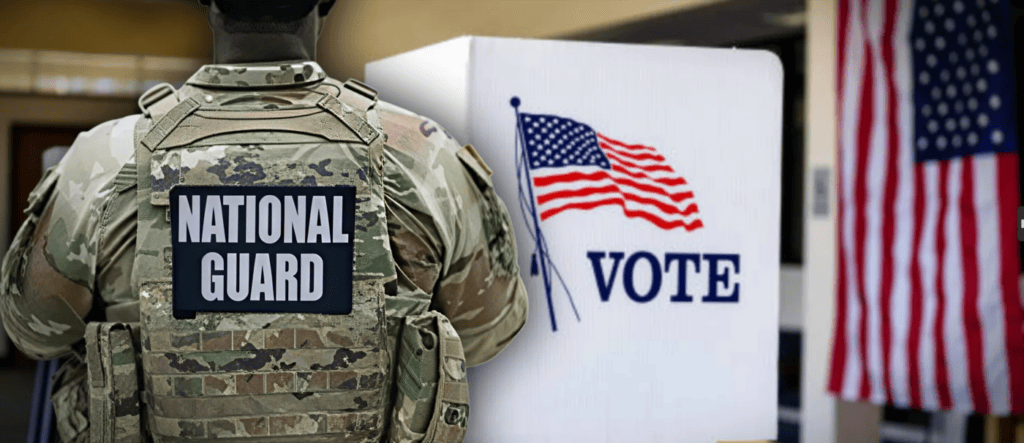
From “The Free Thought Project”
An exclusive investigation from journalist Ken Klippenstein reveals the National Guard’s mission for the midterm elections.
(Ken Klippenstein) National Guard units across the country are being quietly mobilized for next week’s midterm elections, despite reassurances from the Pentagon brass that it has “no plans” to involve itself in the elections.
The Guard’s mission spans all 50 states, military sources tell me. Its focus is supporting federal government cybersecurity efforts; but Guardsmen will also be observing ballot drop boxes and polling places, in addition to safeguarding so-called critical infrastructure.
This follows Secretary of Defense Pete Hegseth’s unprecedented decision to order military spy agencies to “mobilize every asset … to defend our election” so that “every lawful voter can cast their ballot free from foreign intimidation, coercion, or fear.” (See Hegseth’s order in full below.)
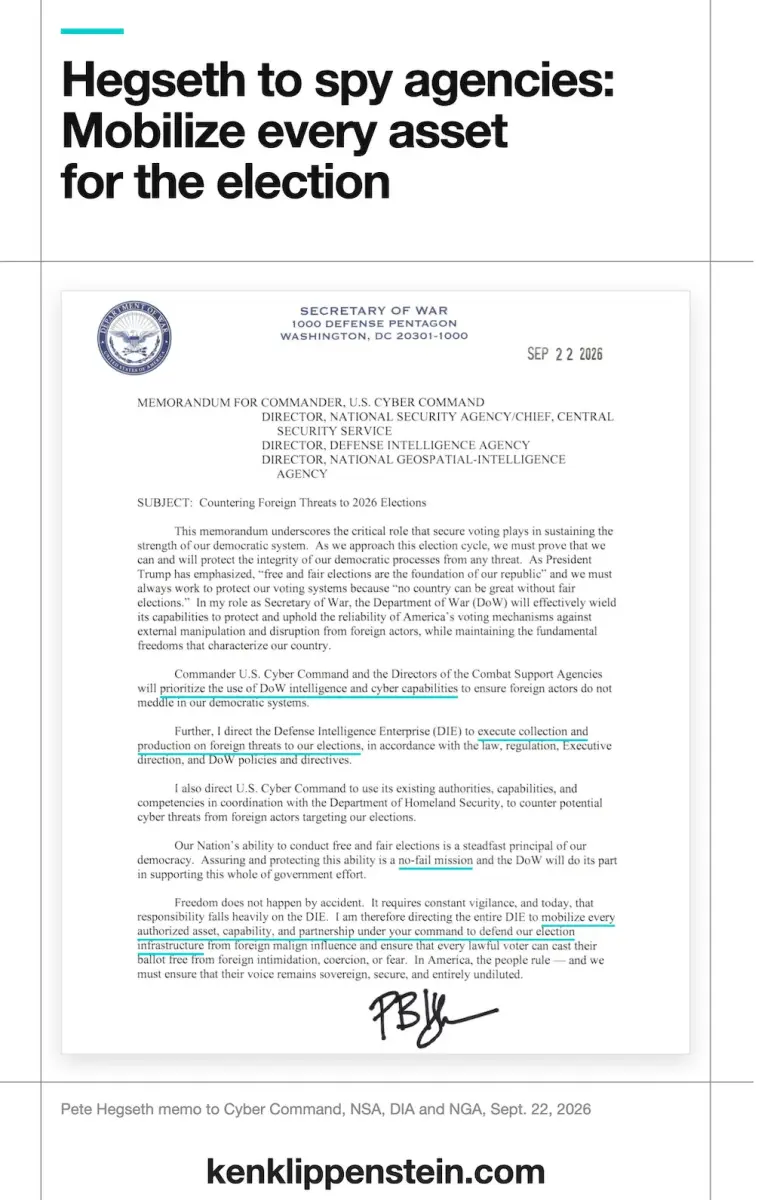
It’s not clear whether Hegseth’s directive that voters be “free” of foreign influence extends to the theories Donald Trump has floated about foreign meddling in the 2024 election. Those theories hang over his suggestion that he’ll accept the midterm results only if the election is fair. Either way, the administration is fixated on the idea of election interference, with Attorney General Todd Blanch recently alluding to a “doomsday” plan, as I reported.
Also without precedent is the direct involvement in the election of Task Force Raider, U.S. Cyber Command’s effort to “protect” the midterm elections (the existence of which I reported earlier this month). Since that report, sources tell me that Task Force Raider is already in full swing.
The National Guard, which normally answers to state Governors, looks different. So far only seven states have publicly acknowledged the Guard’s involvement in any form: Alabama, Arizona, Colorado, Iowa, Oklahoma, Pennsylvania and Washington.
Iowa, for example, mobilized its own “Joint Task Force Cyber” and is manning the state’s Emergency Operations Center to monitor and defend election networks. “Our Guardsmen have supported multiple election cycles and regularly train in national exercises to stay ahead of emerging digital threats,” says the Iowa National Guard’s Brig. Gen. Mark Kappelman.
Then in Washington state, Gov. Bob Ferguson last week wrote to county auditors offering an “Election Neighborhood Watch”: National Guard members in civilian clothes who would observe ballot drop boxes and other voting areas.
Meanwhile, specialists from the Alabama and Oklahoma National Guard earlier this month responded to two incidents where suspicious mail packages containing white powder arrived at the Secretary of State’s office and the State Election Board. The result, military sources tell me, is that all 50 states have placed their “Civil Support Teams” on standby for similar incidents.
And in Colorado back in June, Governor Jared Polis ordered his Colorado National Guard to assist with election cybersecurity.
National Guard involvement in elections appears to be intensifying after steadily growing in recent years.
- 2020: North Carolina and Washington say they mobilized Guard personnel.
- 2022: 14 states used the Guard: Arizona, Colorado, Connecticut, Delaware, Hawaii, Illinois, Iowa, Louisiana, New Mexico, New York, North Carolina, Pennsylvania, Washington and West Virginia.
- 2024: 15 states used the Guard to monitor cybersecurity and assist local authorities. They included Delaware, Illinois, New Mexico and West Virginia, none of which has publicly announced its involvement this year.
“No, I would not see any reason to use armed and uniformed members around a polling place for logistics,” Gen. Gregory Guillot, commander of U.S. Northern Command (NORTHCOM) told Congress on March 19, when asked whether troops supporting federal agents at the polls would be armed. Asked about keeping troops away from polling places, he said they shouldn’t be nearby in any way that suggests unlawful operations.
Gen. Steven Nordhaus, chief of the National Guard Bureau and a member of the Joint Chiefs of Staff, was less reassuring on April 17 when he was asked by Congress what assurances he could offer concerning troops being deployed to polling places.
“The National Guard obviously always follows constitution, law, policy and guidance both at the federal and the state level,” Nordhaus testified.
Then there’s Gen. Dan Caine, chairman of the Joint Chiefs of Staff, who wrote to Congress on August 18, saying “I have neither received nor anticipate receiving any unlawful order concerning the role of the Joint Force in the upcoming November 2026 midterm elections.”
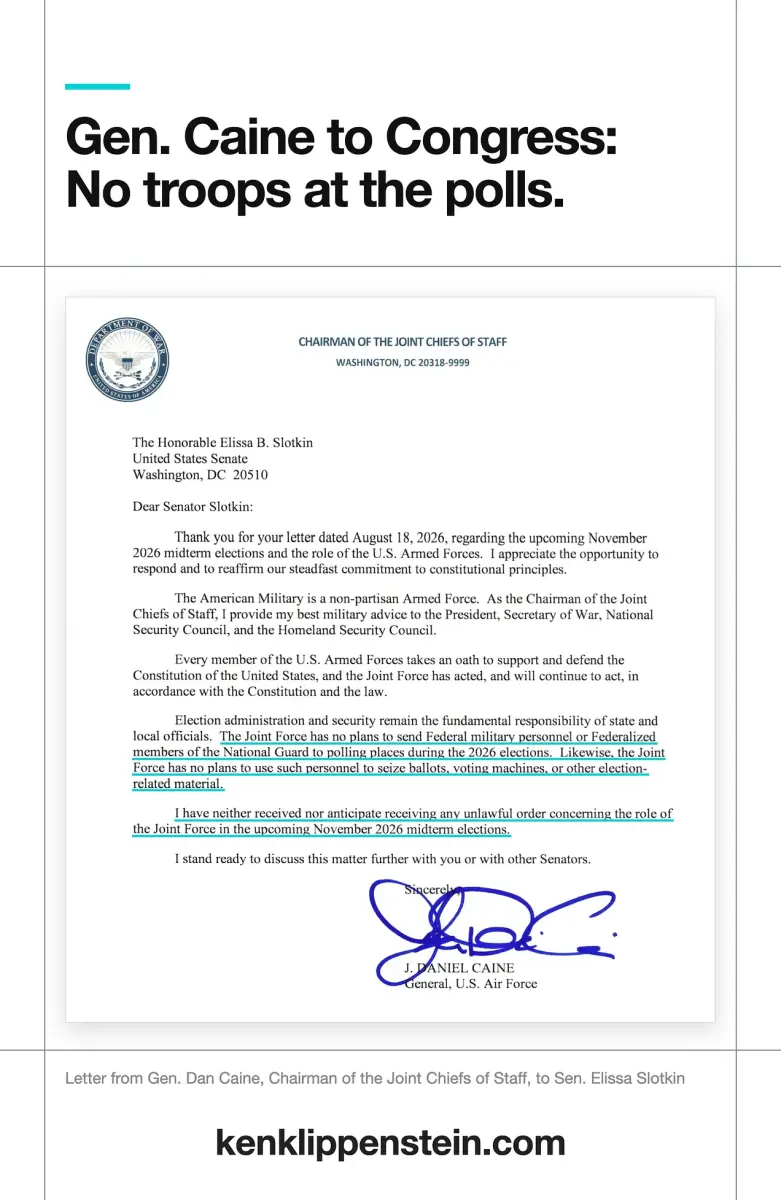
Saying they won’t do anything “unlawful” is a qualifier big enough to drive a Humvee through. Imagine ExxonMobil, asked whether it plans another Valdez, answering: “We have neither received nor anticipate receiving any unlawful order to spill oil.”
How reassuring!
The unlawful order debate misses the point anyway. American tradition and federal law have long kept troops away from polling places, and for good reason. But as I’ve reported, the military’s election role today doesn’t run through polling places. It runs through cyberspace.
The reassurances we do get are hollow. Washington Gov. Bob Ferguson assured the press that his National Guardsmen would wear civilian clothes and not be armed. As if plainclothes men watching drop boxes is soothing in an era of masked federal agents operating undercover across the country.
Meanwhile, NORTHCOM has two operations plans, OPLAN 3500 and 3501, plus a standing operations order, OPORD 01-13. Together they cover every contingency: “defending” the country from cyberattack and foreign influence, responding to “civil unrest” and protecting “critical infrastructure,” which includes elections. As recently as June, a senior military officer told me he was still working to stand up a joint task force just to sort out who does what between civilian and military agencies.
A military that wanted to reassure a worried public would be transparent. Instead, it’s splitting hairs over “lawful” and “unlawful” orders. The military legal experts I’ve spoken to can’t agree on where that line is, and they say Trump doesn’t acknowledge the significance or even seem to care.
Returning to Caine’s August letter to Congress, he also promised the military “has no plans to send Federal military personnel or Federalized members of the National Guard to polling places…” But parse the fine print and you’ll realize this doesn’t apply at all to National Guardsmen answering to the state governors mentioned earlier.
So shoutout to General Caine, and to Congress, for protecting us from a 19th-century era threat of troops stomping around polling places. The 21st-century version is already underway, and nobody’s asking about it. It’s in cyberspace, where “influence” operations blur into defense. And it’s in the ridiculously elastic concept of “critical infrastructure,” which the military still can’t clearly define.
Polls open Tuesday. Happy voting, and don’t forget to smile for the Guard.
This is Part III of my investigation into the national security state’s role in the midterms. Read Part I here, on the military’s secret election security group called Task Force Raider, and Part II here, on the feds’ preparations for an election “doomsday” scenario.