
From “brownestone.org”
By: Maryanne Demasi
Yesterday, I took part in a panel discussion in Washington, D.C., on the weaponisation of science — specifically, how conflicts of interest, industry influence, and scientific deception have reshaped modern medicine.
It was an important conversation about how the scientific process has been hollowed out by financial incentives, regulatory capture, and institutional cowardice.
For me, this is not an abstract debate. I’ve spent much of my career investigating how science becomes distorted — not by a few rogue actors, but through an entire system built on commercial dependence.
Once you start pulling the threads of how evidence is produced, who funds it, who controls the data, and who polices the outcomes, you quickly realise that the corruption of science is structural and systemic.
The Statin Wars: A Case Study in Deception
I first saw this clearly while investigating cholesterol-lowering drugs. My 2013 Catalyst documentary questioned whether statins were being overprescribed, and it unleashed a media firestorm.
The episode was pulled after industry outrage, and I was publicly attacked. None of the critics engaged with the evidence — they simply sought to silence it.
In 2018, I published a narrative review, “Statin wars: have we been misled by the evidence?”
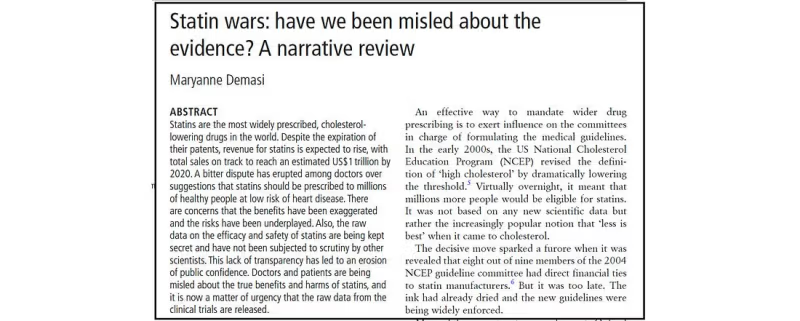
The piece revealed that the raw data underpinning statin trials were held exclusively by the Oxford-based Cholesterol Treatment Trialists (CTT) Collaboration and had never been released.
The CTT group had signed confidentiality agreements with pharmaceutical sponsors, blocking independent access to the raw data and preventing verification.
Yet those same meta-analyses have shaped prescribing guidelines around the world — produced by a group that sits under Oxford’s Clinical Trial Service Unit, which receives millions in funding from statin manufacturers.
In my public talks, I’ve described the statin story as a case study in bias and censorship. The trials used well-worn techniques to amplify benefits and minimise harms.
For example, they use ‘run-in’ periods before the trial to weed out people who couldn’t tolerate the drug, thereby artificially lowering the adverse events detected during the trial.
Often the outcomes were reported in relative, not absolute, terms — effectively exaggerating benefits that were, in reality, minuscule to the individual patient.
The vast majority of statin trials are funded by the manufacturers, and almost all show benefit — except for one publicly funded study that showed the opposite.
So, who funds the trial matters. The system is captured, plain and simple.
Regulatory Capture and the Illusion of Oversight
The same dynamics pervade drug regulation. In a 2022 BMJ investigation, I showed how drug regulators rely heavily on funding from the very industries they oversee.
In Australia, the Therapeutic Goods Administration derives 96% of its operating budget from industry fees.
In the US, the same conflict exists through the Prescription Drug User Fee Act (PDUFA), which allows the FDA to collect billions from drug companies.
Those “user fees” now fund roughly two-thirds of the agency’s drug-review budget — a structural conflict of interest described by one scholar as “institutional corruption.”
And it’s true.
Industry money drives the demand for faster approvals through “expedited pathways,” which often means weaker evidence, shorter trials, and looser post‑marketing obligations.
Regulators defend this as “innovation,” yet the drugs approved under these pathways are far more likely to later receive black-box warnings or be withdrawn from the market due to safety issues.
The result is a system that rewards speed and sales over safety and substance.
The illusion of effective drugs has become even clearer thanks to a landmark investigation this year by Jeanne Lenzer and Shannon Brownlee.
They reviewed more than 400 FDA drug approvals between 2013 and 2022, and found that 73% of the drugs failed to meet four basic scientific criteria for demonstrating effectiveness.
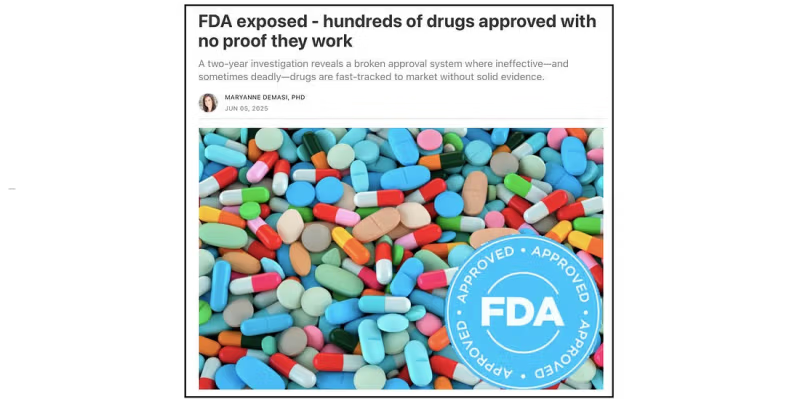
Cancer drugs were especially problematic: only 3 out of 123 met all scientific standards, most approved on surrogate endpoints with no evidence that they improved survival.
It’s the perfect illustration of regulatory capture — an agency funded by industry fees and pressured by politics, approving drugs of uncertain benefit while calling itself the “gold standard.”
Antidepressant Deception
The same playbook has unfolded in psychiatry — beginning with how clinical trials are designed and reported.
Study 329 is one of the best-known examples. It claimed that paroxetine (Paxil) was safe and effective for adolescents aged 12 to 18.
But when researchers reanalysed the original regulatory documents, they found that suicides and suicide attempts had been coded under misleading terms such as “emotional lability” or “worsening depression,” effectively erasing them from view.
A similar pattern emerged when regulatory documents for two fluoxetine (Prozac) trials in children and adolescents were re-examined. Suicide attempts were omitted or misclassified, making the drug appear safer than it was.
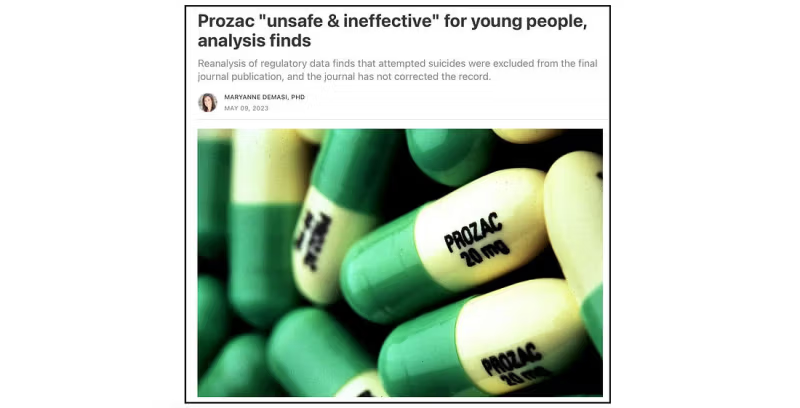
Both reanalyses were carried out under the Restoring Invisible and Abandoned Trials (RIAT) initiative, a project dedicated to “restoring” abandoned or misreported trials by publishing accurate versions of the data submitted to regulators.
Selective publication compounds the problem.
The FDA only requires two trials demonstrating a drug is better than a placebo before it is approved — meaning multiple failed trials get buried.
Psychologist Irving Kirsch, using Freedom of Information requests, uncovered dozens of unpublished SSRI trials that had been withheld from the medical literature.
When those missing studies were included, the apparent benefit of antidepressants over placebo almost vanished — an average gain of less than two points on the Hamilton Depression Scale, far below the threshold for meaningful clinical benefit.
In other words, much of what appears to be a “drug effect” is, in reality, a placebo.
For years, patients have also been sold the marketing myth that depression stems from a “chemical imbalance” in the brain — a debunked theory but an extraordinarily effective sales campaign.
In 2020, we analysed popular health websites across ten countries and found that about 74% falsely claimed depression was caused by a chemical imbalance and implied that antidepressants could correct it.
It may sound like harmless messaging, but its influence is profound.
An Australian study showed that 83% of people who were told they had a chemical imbalance were more likely to take an antidepressant, believing it would “fix” their brain chemistry.
A more recent review in Molecular Psychiatry synthesised the best available evidence and found no consistent link between depression and low serotonin levels or activity.
Together, these findings reveal how psychiatry’s modern narrative was constructed — through distorted trials and deceptive marketing — turning uncertainty into certainty, and speculation into “science.”
Fraud by Omission
Recently, I reported on how journals can weaponise science.
The BMJ’s Peter Doshi raised serious concerns about the pivotal PLATO trial for the anti-clotting drug ticagrelor — including data irregularities and unexplained deaths. But the journal Circulation which published the trial, has refused to investigate.
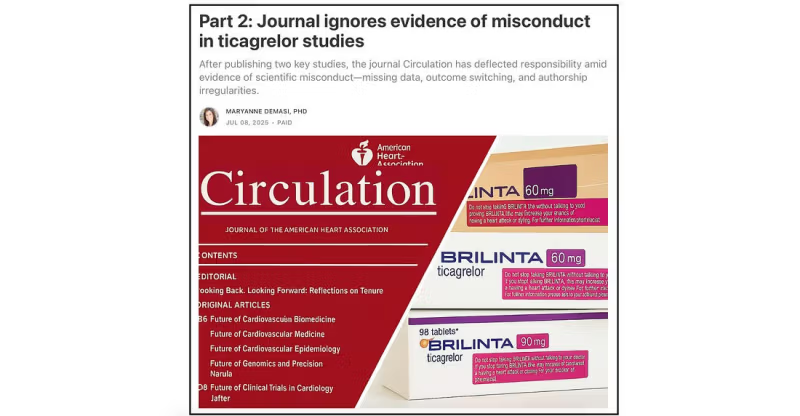
This selective vigilance is telling. Journals will retract small hypothesis papers that challenge orthodoxy, but billion‑dollar drugs with questionable data remain untouchable.
We’ve seen an even more aggressive form of suppression in the vaccine arena.
The recent Covaxin case exposed the extent to which manufacturers will go to suppress inconvenient findings.
After Indian researchers published a peer‑reviewed post‑marketing study suggesting serious adverse events “might not be uncommon,” Bharat Biotech — the vaccine’s manufacturer — filed a defamation lawsuit against the 11 authors and the journal’s editor, demanding retraction and millions in damages.
Within weeks, the journal caved, announcing its intention to retract despite finding no scientific fraud or fabrication. The only “offence” was to suggest that further safety research was warranted.
It’s a chilling example of how corporate and political power now overrides the normal mechanisms of scientific debate — a new form of censorship disguised as quality control.
Punishing Scientists
The weaponisation of science isn’t only about suppressing inconvenient ideas or studies — it extends to the scientists themselves.
During the Vioxx scandal, Merck was caught keeping an actual “hit list” of doctors and academics who criticised the drug’s cardiovascular risks.
Internal emails revealed executives discussing plans to “seek them out and destroy them where they live.” That’s how far industry will go to silence dissent.
Executives are no longer stupid enough to put such threats in writing, but the behaviour persists — now outsourced to lobby groups and front organisations that quietly destroy reputations.
I experienced a version of this myself after my ABC documentaries on statins and sugar.
Like Merck, the Australian Breakfast Cereal Manufacturers Forum — an industry front group — drew up an “active defence” plan to neutralise me for challenging the industry narrative.
And we’ve seen it again recently with the leaked BIO memo detailing a coordinated plan to undermine Health Secretary Robert F. Kennedy Jr. — by co-opting media influencers, partnering with think tanks, and shaping public perception.
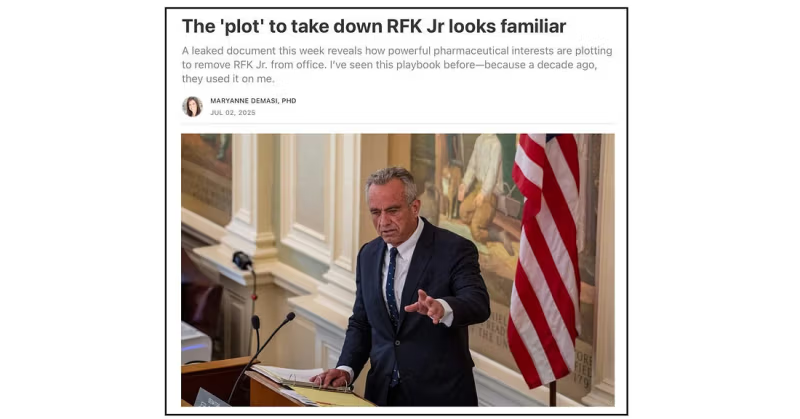
Different industries, same playbook: when billions are at stake, dissent is dangerous, and science becomes a weapon.
Weaponised Fact-Checkers
Look at the rise of fact-checking as a weapon.
In 2024, for example, a peer‑reviewed Japanese study published in the journal Cureus that reported a statistical rise in certain cancers following the Covid‑19 mRNA vaccine rollout was retracted after a Reuters “fact-check.”
The authors, led by Dr Miki Gibo, made no claim of causation and had explicitly called for further investigation, yet the journal retracted the paper after the media controversy, citing concerns about the scrutiny of fact checkers.
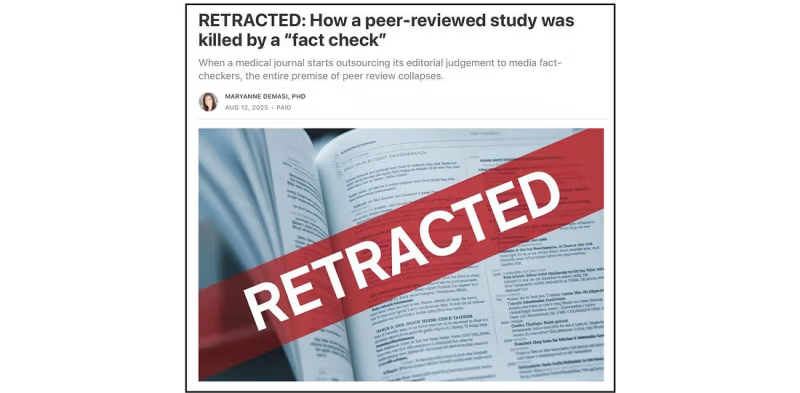
When journals begin outsourcing editorial judgment to media organisations with commercial or institutional conflicts, peer review itself collapses under the weight of narrative control.
This is what I mean by the weaponisation of science.
Fraud today isn’t only about fabricating data — it’s about what institutions choose to suppress. It’s selective enforcement designed to protect profits under the guise of integrity.
Can We Restore Scientific Honesty?
I’m not going to pretend I have all the answers. Whether it’s cholesterol or serotonin, the science too often bends toward profit rather than truth.
Regulators, journals, and academic institutions have become so financially entangled with industry that truly independent science is now the exception, not the rule.
Retractions, fact-checks, and editorial bans are deployed selectively — not to correct fraud, but to erase debate under the banner of “scientific consensus.”
We’ve tried to fix this with transparency measures like open-data policies and the Sunshine Act, which expose payments from pharmaceutical companies to doctors.
But disclosure has become a box-ticking exercise, and raw data is still hard to get. Meanwhile, the machinery of influence keeps turning.
The deeper problem is the absence of accountability. Without accountability, there can be no trust.
When Merck’s painkiller Vioxx was withdrawn after being linked to tens of thousands of deaths, not one executive went to jail. The company paid fines, issued statements, and carried on.
Lives were lost, and no one was held personally responsible. That isn’t justice — it’s the “cost of doing business,” and worse, the people who preside over these disasters are often rewarded for them.
Bonuses are paid, stock options soar, and departing CEOs collect multimillion-dollar severance packages — all while families are left to bury their dead.
If we’re serious about restoring trust, that has to change. CEOs and senior executives who knowingly conceal data or market dangerous drugs should face criminal penalties, not corporate settlements.
A few jail sentences at the top would do more to restore trust in medicine than a thousand press releases about a renewed commitment to safety.
Accountability must also extend to government.
The FDA and other regulators are structurally dependent on industry money. It’s baked into the system, and the only real solution is to rebuild — fund these agencies publicly, remove user fees, and make them independent again.
The barrier isn’t money — it’s political will, compromised by the same corporate lobbying and campaign donations that distort science.
True reform requires the courage to confront the pharmaceutical industry’s financial grip on both major parties, to end the political donations that buy silence, and to legislate for genuine independence in science and medicine.
Perhaps Secretary Kennedy is now best placed to begin dismantling industry’s hold on science. Systemic corruption didn’t happen overnight, and it won’t be undone overnight either.
Commercial conflicts of interest have become normalised — woven through our institutions, universities, journals, and political culture. Until that’s confronted directly, nothing will change.
Disclosure is necessary, but it is not sufficient. The antidote is open debate, public funding, and real accountability.
Science should never be about consensus; it should be about contestability. If we can’t test claims, challenge data, or ask uncomfortable questions without fear of retribution, then we no longer have science — we have marketing.
The weaponisation of science ends only when truth becomes more valuable than profit.
Republished from the author’s Substack