From “reclaimthenet.org”
YouTube’s CEO Lined Up Creators for USAID
These are internal emails released in the “USAID Files” on usaid.gov, and they detail YouTube’s (and Google’s) collaboration with USAID.
The topics themselves are not sinister – lead poisoning, Ukraine, Belarus, Moldova, “trusted flaggers,” and training of creators. What is problematic is the preferential access and treatment that a US government agency had and the secrecy around it.
In January 2024, a meeting took place between USAID’s Garrett Lam and YouTube CEO Neal Mohan, who was briefed on the issue of lead poisoning and “was interested in supporting this by connecting USAID with creators who could help promote the issue (and other USAID priorities).”

Mohan “connected” USAID with two creators who happened to be present, but the agency decided it was not the right time to work with them, and a staffer was to plan a follow-up. Another action item was to work out “how to institutionalize the process” of “latching up local creators with upcoming principal trips.”
Mohan also agreed to connect USAID with popular creators during the agency’s trips abroad, and told USAID that his “partnerships team can identify the creators.”
Mohan told USAID that more important to YouTube than content moderation was “raising/elevating content from legitimate and veritable sources.”
Another action item was to connect USAID’s Vera Zakem with YouTube’s “threat analysis group/intelligence desk for potential partnership on disinfo.”
Another email, sent on July 5, 2022, by Zakem, reveals that YouTube wanted “trusted flaggers,” and that the agency was happy to oblige by identifying local partners in countries that were a priority for USAID.
Zakem wrote that Google’s Josh Blumenfeld would be the contact person for “all things related to removing content to proactive engagement.”
The same email produced several offers from YouTube: training for USAID communicators, and a co-branded program to bring together and support creators, journalists, and media outlets.
The latter, dubbed “Creator Cohorts,” was to be a pilot program that would provide startup funds, equipment, and training on YouTube’s backend analytics. USAID was asked to suggest where the pilot should take place, and the ideas included Ukraine, Moldova, Belarus, as well as Latin America and the Asia mission.
In August 2022, USAID sent a list of creators from Ukraine and Moldova to YouTube for training and support, while a month later, the video giant asked for the follow-up call to be postponed until it had had “a few more internal conversations.”
The last email in this thread, sent on October 3, 2022, has a Google/YouTube staffer sending a link about how YouTube works for creators, and there is no further information on what happened next.
Another email, sent in July 2022, shows that USAID had a direct line to Google/YouTube for resolving issues that a partner was experiencing. The Belarusian workers’ movement, Rabochy Ruh, based in Poland, had its YouTube Ads account blocked, and Zakem turned to Google’s Josh Blumenfeld for help.
Zakem explained that the group had USAID’s “advisory support” and that the blocked account had seven videos with 53,000 average views. The reason for the block was a message from YouTube about “suspicious payments.” The group appealed but got no response. Blumenfeld replied, “I’m engaging with our colleagues in Europe and will circle back asap.”
What Zakem asked for was not to file another appeal, but for Google to directly look into the matter.
The point of the story is not to dispute that the movement was a worthy cause – the email explains that independent trade unions in Belarus face real repression – but to show the direct line that USAID had to Google, and the special treatment that resulted from it. An ordinary channel with a blocked account would have filed an appeal and waited – but this one had USAID, and Zakem, to intercede on its behalf.
In March 2023, USAID sent an email to its partner organizations, asking them to help identify influencers who would take part in a social media campaign promoting the “Second Summit for Democracy.”
The idea was to have these influencers, described as youth leaders, activists, journalists, musicians, actors, and poets, make short videos and post them on their own equipment, using the hashtag #SummitForDemocracy.
The email instructs missions and partners to inform influencers that their content “may be amplified on USAID official social media accounts,” but does not suggest that the agency would pay them for their work. Nor does it tell influencers to reveal that they are working with USAID.
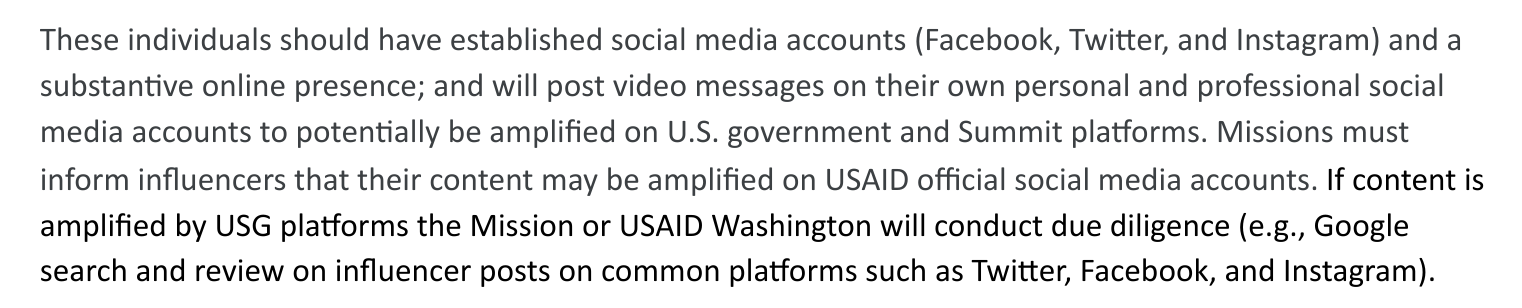
As for the message that should be sent to influencers, USAID suggested this: “By posting a video using the Summit for Democracy hashtag (#SummitForDemocracy) you agree to potentially have your post amplified by U.S. government social media platforms.”
USAID wanted its missions to report back about any posts that “go viral or attract a significant amount of attention in the press.”
It was actually YouTube who came to USAID, and the agency was happy to take it up.
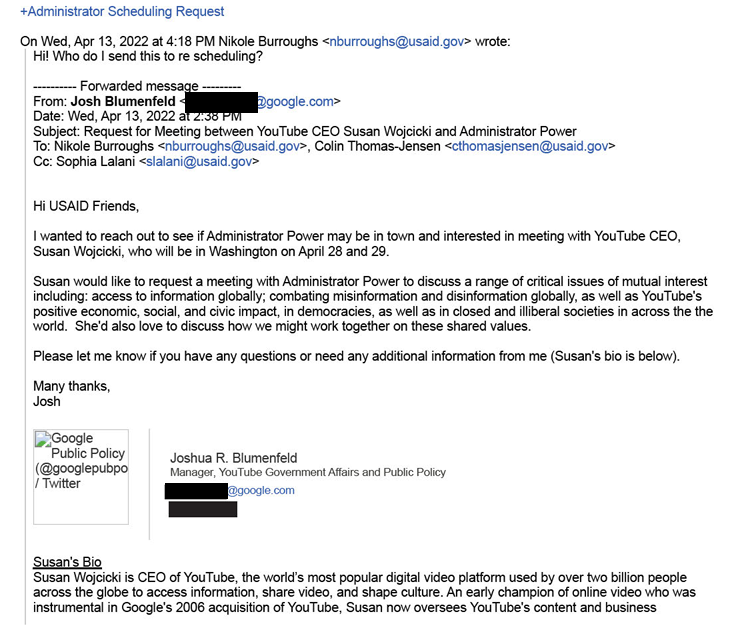
It was Blumenfeld, who on April 13, 2022, emailed USAID to ask whether Administrator Samantha Power would meet then-YouTube CEO Susan Wojcicki, who was going to be in Washington on April 28 and 29.
According to the email, Wojcicki wanted to meet Power to discuss “access to information globally” and “combating misinformation and disinformation globally” – but also YouTube’s role “in democracies, as well as in closed and illiberal societies,” and “how we might work together on these shared values.”
A USAID staffer who received the email forwarded it to another official, asking only who handles scheduling.
It turned out that the same week, Power was also scheduled to have a call with Meta’s Nick Clegg, on April 27, 2022.
The meeting with Wojcicki did take place: in July 2022, USAID’s Vera Zakem referred to a meeting with Blumenfeld as “a follow up meeting that the Administrator had with Susan Wojcicki.”
The same emails show that by July 2022, USAID officials who were planning a YouTube “Creator Cohorts” pilot wrote that “we talked about something like this in general terms when we met with the YT CEO.”
In these internal USAID emails, it is also revealed that YouTube wanted “trusted flaggers” and that the officials were in the process of picking which countries would be their priority for this purpose.
In February 2025, we covered USAID’s network of media funding and what it meant for independent journalism. In 2020, we covered no less than 15 times YouTube turned its back on ordinary creators.
What these documents show is that YouTube was more than happy to work with a US government agency, offer it a fast lane to resolving issues, and even provide it with creators to promote its causes.
The topics may have been benign, but the issue here is the principle – a government agency getting a direct line to YouTube’s CEO and other top officials, while creators, who are the backbone of the platform, are left to fend for themselves, with no such personal lines of communication.
Defund, Downrank, Deplatform
Documents published on the USAID website show that an email from an Office of the Director of National Intelligence (ODNI) official introduced the Global Disinformation Index (GDI) to USAID in June 2022.
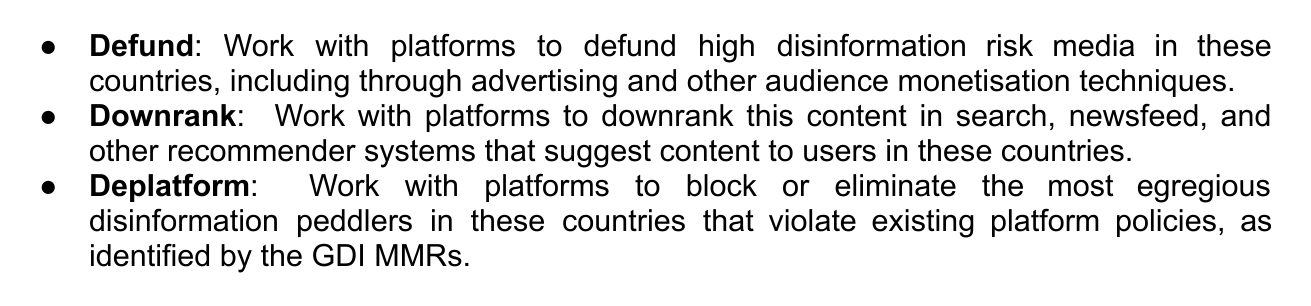
Just weeks later, USAID gave GDI a list of 10 countries to focus on and GDI came up with a plan to “Defund,” “Downrank” and “Deplatform” local news outlets that would be marked as high risk for “disinformation” based on private site-by-site risk ratings that GDI would provide to USAID.
These and other documents, which include a concept note, a call for partners, and a slide deck, are available on usaid.gov.
They show that the US intelligence official sent the introductory email to GDI’s Danny Rogers and Clare Melford on June 10, 2022. The official’s name is redacted in the email, but the signature block reads “Office of the Director of National Intelligence.”
The email said, “I’m writing to introduce my friend Johnny Walsh, DAA for Democracy, Human Rights, and Governance at USAID.”
The official described GDI as “the best organization I know working on the commercial, for-profit side of the disinformation challenge,” and said that USAID was building “a portfolio around countering disinformation.”
“At a minimum they should be aware of the capabilities you have and hear your theory of the case for how to reduce the pernicious spread of political disinformation,” the email reads.
Three days later, on June 13, Walsh replied to the email to add Vera Zakem, “our new Senior Advisor for Tech and Democracy and overall lead on disinformation.”
Zakem wrote that she had “followed your work closely over the last couple of years,” and Melford responded by saying that GDI would be “very interested to hear more about how USAID is thinking about the challenge also.”
Walsh writes, “Here are the 10 countries we particularly have in mind as homes to promising democratic openings, that need help before they backslide.”
The list includes Zambia, Malawi, Tanzania, Dominican Republic, Ecuador, Honduras, Nepal, Maldives, Moldova, and Armenia.
Walsh asked GDI to come up with “a one-pager on whether/how we might collaborate to help them.”
Rogers replied that they would “put together a concept note focused on the countries you outlined, so thank you for the list.”
This note was prepared in August 2022, and it details how GDI would conduct six-month reviews of news sites in Moldova, Zambia, and Armenia.
The output would be “Risk ratings per site that can be shared privately with USAID (as well as with licensees of GDI’s data)” – and a public report.
The plan to “Defund”, “Downrank” and “Deplatform” these outlets is explained as follows: “USAID has indicated that its growing relationships with the large online platforms, including Alphabet and Meta, offer an opportunity to take action in these three countries based on the data that GDI’s MMRs produce.”
The note then spells it out: “Defund: Work with platforms to defund high disinformation risk media in these countries”; “Downrank: Work with platforms to downrank this content in search, newsfeed, and other recommender systems”; and “Deplatform: Work with platforms to block or eliminate the most egregious disinformation peddlers in these countries.”
GDI’s “Dynamic Exclusion List” is “embedded in the systems of thirteen global ad tech companies, including IAS, Peer39 and Oracle.”

The concept note also reveals that GDI defines disinformation as “adversarial narratives” by which actors “seek to delegitimize governments, principles, practices, and policies.”
In other words, criticism of a government can be branded as disinformation and punished by being defunded, downranked, and deplatformed – and the ratings that determine this would not be publicly disclosed, but shared “privately” with USAID, and presumably other licensees of GDI’s data.
The August 2022 concept note for USAID has a footer that reads, “a company limited by guarantee in England & Wales”.
Documents published by USAID also include a 2023 call for partners that GDI issued, which states that the first pilot of the company’s risk ratings was in 2019, and assessed news domains in the UK and South Africa.
The countries that GDI was looking to expand to were listed, with European ones starting with “The United Kingdom.”
GDI’s stated mission is “to catalyse industry and government to defund disinformation.”
The organization also claims that its method is “not an attempt to identify and label disinformation sites or trustworthy news sites.”
It does produce “risk ratings” that determine which outlets should be defunded, downranked, and deplatformed.
The call for partners also reveals that GDI pays a “research honorarium of approximately USD20,000” to those who work with it.
Another email in the USAID files shows a mailing list tagged [ACAN], where a video of UK satirist Jonathan Pie talking about “Londongrad” was shared.
One of the recipients, Nate Sibley, then made a claim about Pie’s past (that we have not verified and cannot state as fact).
Rogers replied to that by saying, “I had no idea – what an insidious world, wow.”
USAID’s Meral Karan sent an email on January 13, 2023, saying, “They came in and met with us a few months ago – would be interesting to connect back with them again.”
The reason for the email was that a USAID adviser at U.S. Special Operations Command (SOCOM) had sent her the call for partners GDI had issued.
A slide deck in USAID’s files shows Rogers pitching to the agency “Policy Interventions to Counter Disinformation.”
The suggestions include antitrust, privacy regulation, and platform liability reform. One of the slides is dedicated to Section 230 of the Communications Decency Act, which “essentially makes internet platforms immune to legal liability for both the content that users post and the decisions they make to remove that content.”
“Fact checking is not enough,” the slide says, adding that the platforms “remain legally immune” and that their algorithms “amplify conspiracy theories.”
It is not clear from the documents whether USAID ever paid for any of the services GDI pitched to the agency. A search for GDI on USAspending.gov did not produce any results, and no published reviews of news sites in Moldova, Zambia, or Armenia were found.
GDI describes itself as “steadfastly bipartisan” and committed to “neutrality” – but the activities described in the USAID documents, as well as some of the email exchanges, suggest that the organization’s “theory of the case” is that of working with governments, as well as tech platforms, to “defund disinformation” – as it defines it.
We have previously covered GDI for receiving a $100,000 grant from the US State Department’s Global Engagement Center, for paying a public college to produce an online blacklist report, and for facing scrutiny over its ties to government.
In December 2025, the US imposed visa restrictions on several individuals around the world accused of involvement in censorship – including Clare Melford.
GDI is the group that runs blacklists that are used by corporations to decide which news outlets to advertise with, and which to shun. In other words, it provides a private service that can be used to censor media outlets – but this time, the service was offered privately to a government.
The Georgia Model for Getting Accounts Taken Down
An internal US government document released this month shows that a USAID-funded partner in Georgia would hand Facebook (Meta) lists of accounts to remove or de-promote, and holds this up as a model for other countries.
The document, an internal USAID guide, describes what is done in Georgia, and how this system can be replicated elsewhere, particularly in Latin America. The “AID/Georgia’s Information Integrity Program” is a USAID-funded activity, and the guide goes into some detail about how it works, while admitting that the system can be abused.
Analyze online narratives and identify actors engaging in “coordinated inauthentic behavior” is the first step. Then “the partner” shares a list of accounts with Meta, which will “dig deeper and ultimately take them down or de-promote content.”
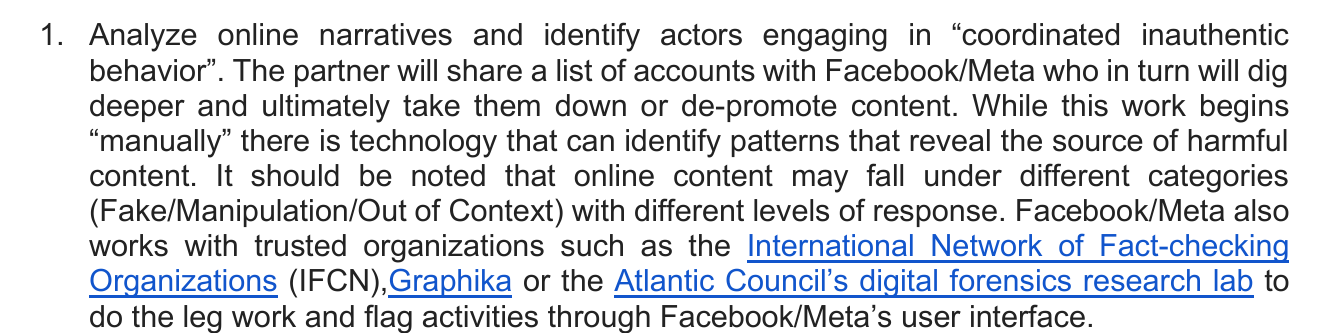
The work begins “manually” but “there is technology that can identify patterns that reveal the source of harmful content,” the document, “Responses to Systematic Harmful Content on Social Media,” says.
USAID’s programs “track the online conversation and point out inappropriate use” – this is how the guide describes the process of having partners, “specifically investigative journalists or think tanks,” “map out the bad actors” and then “petition the platforms to get ‘inauthentic’ accounts taken down.”
This process does not involve making a public list of these accounts, nor is there a publicly available record of who decided what was “inauthentic” in another country’s politics. And while the document was written as a plan rather than a report, it does not go into how many accounts were reported and removed.
Meta’s one-pager that was sent to USAID in March 2022 explains that Trusted Partners get “an expedited way of reporting” that is “staffed 24/7” and that “we keep all Trusted Partners and their reporting practices confidential.” At the time, Meta had “over 400 trusted partners in 113 countries.”
This program is described as sitting “within Facebook’s Content Policy team, the group that creates our Community Standards.” Meta’s email to USAID in March 2022 informed the agency that “many USAID civil society partners are likely already part of the program,” and asked “how we might involve USAID in its expansion.”
The guide does not name the partner in Georgia who is in charge of sharing the account lists with Meta, but according to the USAID activity data sheet, the Georgia Information Integrity Program (GIIP) has Zinc Network Limited (Zinc) as its implementing partner, managing “a consortium of domestic and international experts.” The budget for this is listed as $7.5 million.
The program, which ran from September 2020 to September 2025, also included training local fact-checkers who would “eventually become part of IFCN and Facebook/Meta’s fact checking program.”
Though Meta’s Trusted Partners program allows vetted partners to “weigh in on content takedown requests” and “make determinations on whether a takedown request is legitimate,” the guide notes that Meta works with IFCN, Graphika and the Atlantic Council’s digital forensics research lab “to do the leg work.”
As for advertising, Meta raised its US standards after the recent US elections, and now “the program is lobbying with Facebook/Meta to introduce the same standards overseas, especially during elections,” the guide reads.
Google, YouTube, TikTok, and Twitter, on the other hand, are “behind the curve on controlling harmful content,” the document states.
However, the guide does offer some warnings about how the system works, and can be abused. “Reporting harmful content can be abused by malign entities seeking to discredit their adversaries,” it reads. The document also notes that “public figures receive more leniency to remain online” and that the enforcement of rules is “extremely uneven.”
Moreover, algorithms used by the platforms are “incredibly imperfect, to the point of oftentimes being harmful,” and their work results in posts by journalists and human rights defenders getting “flagged by an algorithm.”
The guide also mentions that Meta “changed its policy to allow users from certain Eastern European countries to call for violence against members of the Russian government and military. This is unprecedented and raises serious concerns.”

The example given in the guide of what is considered to be “coordinated inauthentic behavior” is “troll farms or bots” – i.e., not opinions or political or ideological bias. And Meta’s one-pager assures that “we will only remove the content and accounts that are in violation of our Community Standards.”
The machinery used for censorship can be used fairly or unfairly, depending on who is operating it. For example, Meta’s Q1 2023 threat report, published on May 3, 2023, revealed that 117 assets were removed that the company linked to the Strategic Communications Department of the Government of Georgia. Meta’s report said the network “shared criticisms of the opposition, particularly during the most recent public protests.”
This shows that the system is not only real, but also that who feeds it with reports can decide who gets taken down, and for what.
The guide frames the Georgia program as a model that can be used elsewhere, particularly in Latin America. The document maps countries in that region by internet censorship and government disinformation, noting that Venezuela and Cuba “lean heavily, while others (Brazil, Haiti, Nicaragua, and El Salvador) aren’t far behind.”
As for the Trusted Partner program, Internews, the media-development group, said in August 2022 that “I am pretty sure USAID is currently funding a lot of staff around the world to flag issues to the platforms through these trusted programs.” It said it had “social media monitors already operating in about 20 countries” and said partners worked with “zero accountability or transparency.”
We previously covered USAID’s Disinformation Primer from March 2024, and the $1.5 billion federal “MDM” grants network from May 2025, as well as USAID’s media funding in February 2025.
A government-funded group in someone else’s country compiling lists of accounts to be removed or de-promoted on social media, with no public record or oversight of any kind, is essentially a censorship pipeline, regardless of the label attached to it. And the guide itself admits that it can be turned into a tool against adversaries.
The Trusted Flaggers Nobody Can Audit
A US government-funded NGO told the agency in writing that the agency was paying for people around the world to report content to YouTube and other social media platforms through a “trusted” flagger program with direct access to these companies.
Both YouTube and Meta asked the agency for more names of potential “trusted” partners.
The public, however, has no way of knowing who is in these programs, and therefore cannot audit how they work and whether they are involved in censorship.
The emails were released on the USAID website in November 2026 as part of a large trove of documents known as the USAID Files.
This is how Internews Senior Advisor for Platform Accountability Rafiq Copeland put it in an August 17, 2022, email to USAID’s Joshua Machleder: “Between various partners and sub-awards I am pretty sure USAID is currently funding a lot of staff around the world to flag issues to the platforms through these trusted programs.”

Copeland added that his organization has “social media monitors already operating in about 20 countries” and wanted “to talk with them and get our network plugged into the YouTube system.”
When YouTube asked USAID for a list of recommended “trusted flaggers,” Internews was not willing to share its contacts.
Internews was one of Meta’s “trusted partners” who in 2023 published a report (Safety at Stake) critical of the program, which was based on a survey of other partners. Meta then cut ties with Internews, and some of its partners who were also part of a coalition with Internews also stopped communicating with the NGO.
In April 2024, USAID senior media advisor Ulvi Ismayil wrote in an email that “Meta broke its ties with Internews when this report was published. Internews even noticed that some NGOs that were previously in a coalition with Internews stopped answering emails.”
In an April 30, 2024, email, USAID’s Cara Thanassi said, “From the report, I would be reluctant to recommend organizations participate in the TPP.”
The problem with “trusted flagger” programs goes beyond this incident – it is the lack of transparency and accountability around these programs.
Meta’s one-pager for USAID, sent in March 2022, explains that the program “provides our partner organizations with an expedited way of reporting this content to Facebook” and that it is “staffed 24/7 by a team of escalations specialists.”
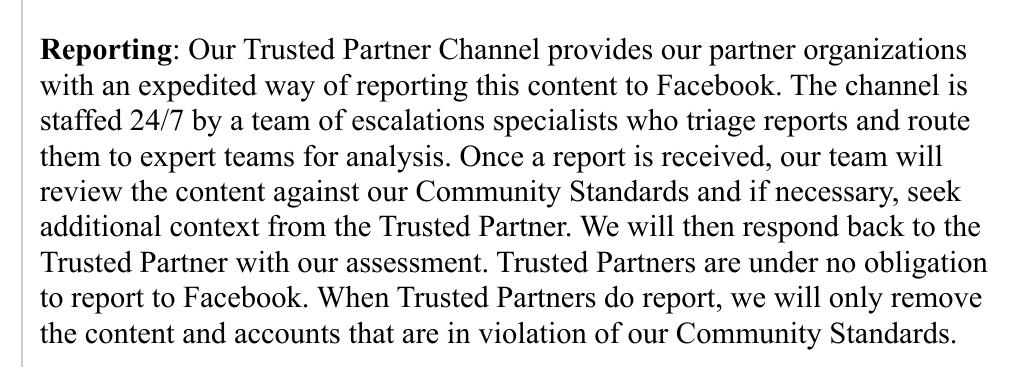
The document further states that the program “sits within Facebook’s Content Policy team, the group that creates our Community Standards.”
Meta also promises that “when Trusted Partners do report, we will only remove the content and accounts that are in violation of our Community Standards.”
The public cannot know who the partners are and what they are reporting, as Meta says “we keep all Trusted Partners and their reporting practices confidential.”
Meta says that this is necessary because of “the challenging environments many of our partner organizations work in.”
In an email sent on August 18, 2022, USAID’s Machleder told Copeland that YouTube “said that if there are local groups that would be recommended to serve as ‘Trusted Flaggers’ that we should send over a list of potential organizations for consideration.”
Copeland declined to hand over his partners’ contacts, saying that “Sending over a list of potential partners’ contacts is not something we would be prepared to do at this stage.”
He also revealed that Internews had earlier refused to sign a non-disclosure agreement (NDA) that YouTube wanted as a condition to work with the NGO. “The NDA they requested us to sign made this untenable,” he said.
Copeland also remarked that the “trusted flagger” programs are “potentially one of the most important tools we have available to protect platform users.”
He added that partners are “volunteering huge amounts of time to make these programs work, with zero accountability or transparency.”
Earlier, on July 5, 2022, USAID’s Vera Zakem wrote in a memo that after a meeting with YouTube, the video giant’s Josh Blumenfeld would be the agency’s “primary POC there for all things related to removing content to proactive engagement.”
It was also decided that USAID should “ID a list of priority countries that are relevant to USAID, where we can help identify local partners to participate in YouTube’s ‘trusted flagger’ partner programs.”
Two days later, Adam Siegel, who is in the Office of the Administrator, wrote that for “civil society trainings and Trusted Flaggers” he would prioritize “countries where we’ve had senior leadership (A/AID and DA Coleman/DA Adams-Allen) travel.”
In the spring of 2022, USAID and Google met and the search and video giant told the agency it was “still mapping out potential partners for Trusted Flaggers, e.g. National Government, Local NGOs, etc.”
In spring 2022, a meeting between USAID and Google (YouTube’s owner) produced a note to “Provide Clement with a list of potential partners to consider for dis/misinfo research projects, Trusted Flagger Program and any reports of problematic content / behavior.”
Meta was also interested in expanding its “trusted partner” program and asked USAID in March 2022 to recommend new partners, saying that many of the agency’s “civil society partners” were likely already part of the program.
In April 2024, Meta’s Sandy Luff told USAID that in Latin America and the Caribbean, “our TPP includes 30 organizations across 15 different countries.”
Luff then asked USAID to recommend more organizations, saying, “If USAID has organizations that it’d like to recommend for the program, please let us know.”
None of the documents show USAID directing the removal of any specific post through this channel.
In the end, USAID’s lawyers in May 2024 advised staff not to follow up on this issue, and not to ask Meta questions that “may be viewed as coercive.”
We covered Internews in February 2025, in a piece titled Internews Exposed, and in May 2022, we covered YouTube shifting flagging powers toward NGOs and government agencies.
The fact that a US government agency was funding people to flag content for social media companies is not the only problematic issue here.
It is also the fact that these flaggers are given a special status thanks to their access to “trusted” programs, which puts them in a position to censor speech, as these reports are given priority treatment by the platforms.
While the “trusted flagger” status is not new, and has been used by both YouTube and Meta for years, the EU has now essentially enshrined this system in law.
The Digital Services Act (DSA) allows member countries to designate “trusted flaggers” whose status must be respected by all platforms operating in the EU.
Regardless of what such flaggers are called, and how they are organized – a secret, unaccountable fast lane to a social media giant’s policy and safety teams is a censorship channel, plain and simple.
The Inclusion List the State Department Opposed
A US government aid agency, USAID, came up with a plan to have Google and YouTube treat a list of handpicked media outlets more favorably in search, recommendations, and ads.
This was revealed in a USAID planning paper, “Big Tech Engagement Action Plan“, published this month among the USAID Files on the usaid.gov website. The document reads like a draft, with empty action sections and tracked changes.
The paper’s Key Recommendation 1 is that tech companies implement an inclusion list for “verified actors.” And, the document says, those lists “should be private and managed in a decentralized manner through trusted third-party implementers.”
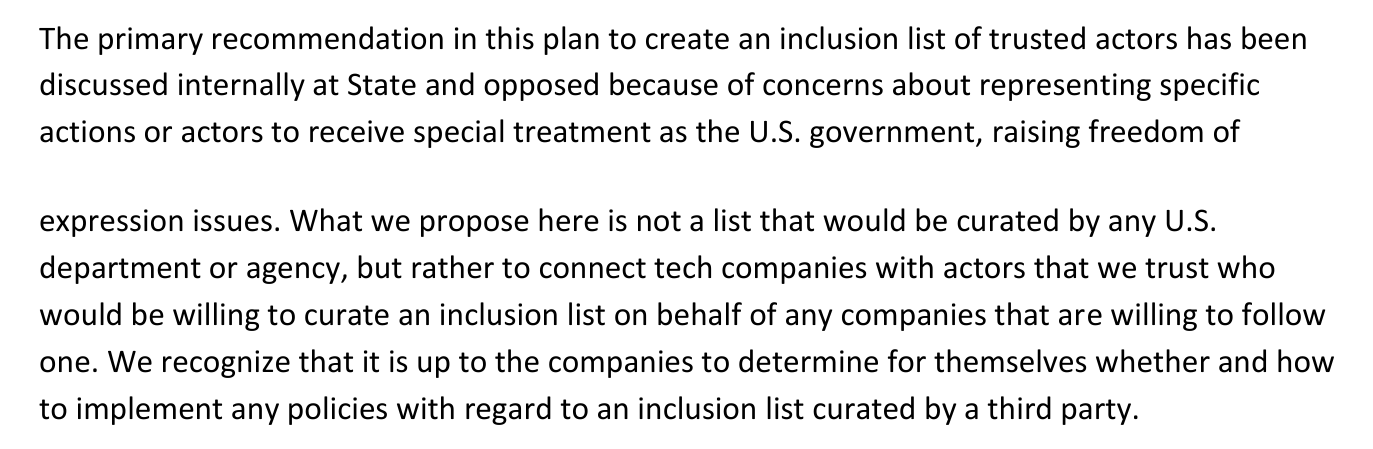
The State Department reacted to this idea by saying it was “discussed internally at State and opposed because of concerns about representing specific actions or actors to receive special treatment as the U.S. government, raising freedom of expression issues,” USAID noted.
USAID saw a way to work around this by having an NGO, not the government, hold the list: “What we propose here is not a list that would be curated by any U.S. department or agency, but rather to connect tech companies with actors that we trust who would be willing to curate an inclusion list on behalf of any companies that are willing to follow one.”
The State Department also wanted USAID to discuss the plan with the National Security Council (NSC) before engaging with Big Tech.
The case the USAID paper makes is that independent media and civil society groups in Russia are subjected to Kremlin censorship, but also, as a result of sanctions and US tech companies pulling their services from the country, they lost access to those platforms as well.
USAID’s partners “face effective censorship from two sides,” the paper says, adding that “denial-of-service policies” do not generally affect supporters of Putin’s regime, but “significantly handicap those who oppose the war.”
The real problem the paper is trying to address is how to help these anti-war outlets reach their audiences despite the internet blocking.
The plan was to have Google, YouTube, and others treat these handpicked media outlets better in search, recommendations, and ads.
For YouTube, the ask was to let these groups monetize their content even inside Russia, and “buy and publish ads in Russia and target content to users in Russia.”
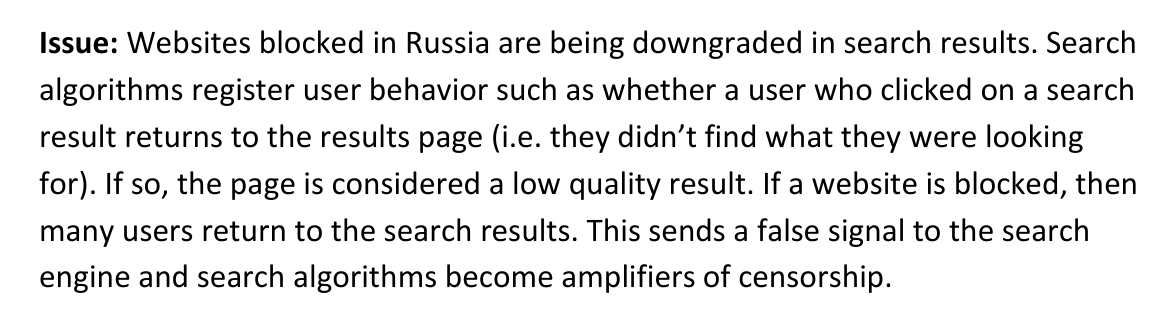
Google was asked to make sure its search algorithms do not downgrade blocked sites, because when users cannot access them, they bounce back, and “search algorithms become amplifiers of censorship.”
Meta was asked to review its recommendation algorithms and “minimize the possibility of shadow bans for the organizations on the inclusion list.”
MailChimp, Slack, SSL certificate authorities, and TechSoup were also on the list of companies that should keep serving groups “on the inclusion list.”
The paper does not only ask for a list that would give a boost to some, but also for algorithms to be tweaked to downgrade others. For example, Google is asked to “review recommendation algorithms to ensure they do not promote pro-war or government controlled content.”
Later in the paper, the language becomes even stronger, asking Google to “review the algorithms so that they would demote pro-war” content “and/or government controlled content.”
“Implement an exclusion list that Google Discover can use to avoid recommending domains that are sources of propaganda.”
The paper does not explain how any of this would be consistent with the free expression concerns that the State Department raised when the idea of a list was first discussed.
Another document, this one a prep note for a planned January 2024 meeting between USAID head Samantha Power and YouTube CEO Neal Mohan at Davos, shows that the idea of an inclusion list was still alive.
The note asks Power to inquire if Google would allow groups on this list, “created and managed by an independent and trusted press freedom NGO like Internews,” to buy and publish ads inside Russia, and target content to Russian users.
The note also asks if Google would make sure that pages belonging to entities on this list are not downgraded in search results. Internews, a USAID-funded media NGO, is named here as a possible holder of the list, but the document does not say if it agreed to that role.
In a spring 2022 call between USAID and Google staff, USAID asked Google how it could “streamline feedback from across U.S. departments / agencies, particularly on issues of concern?”
Google replied that it uses systems to “uprank content to surface authoritative information and then downrank less authoritative information.” USAID also inquired if “certain vetted partners” could be allowed to monetize their content on YouTube inside Russia, but was told that the company was “not making exceptions.”
In January 2024, YouTube CEO Mohan met with USAID officials and told them that sanctions were the reason the company could not monetize Russian traffic, “there was no way around this.”
Mohan also said that what was more important than content moderation was YouTube’s way of “raising/elevating content from legitimate and veritable sources.”
Nothing in the documents shows that Google or YouTube agreed to create or follow an inclusion list.
We previously covered USAID’s media funding network in a February 2025 piece looking into the agency’s media funding. We also covered Internews and its government funding in February 2025, and the Global Disinformation Index ad blacklist that was accused of political bias in February 2023. In 2020, we covered Big Tech’s practice of boosting so-called authoritative sources.
The problem of censorship and the need to support those suffering under it is real – but the solution cannot be to create more of the same problem, just with a different list, and a different gatekeeper.
A Draft Facebook Deal to Flag Election “Spoilers”
It’s not just the US elections that the US government is interested in moderating through Big Tech – and it’s not just the way the social media giants’ tools are weaponized in the process that’s the problem – but also, who gets to decide what information is “authoritative,” what voice is “inauthentic,” and who qualifies as a “spoiler.”
All that is already bad enough when it happens in the US, but when the same practice is applied to other countries, it’s even more egregious.
Two draft documents have been published as part of the USAID Files on the agency’s website, showing that the US government was drafting a deal with Facebook (Meta) that would give it access to the giant’s moderation machinery in other countries.
Both documents are drafts. One is headed “DRAFT” and is undated; it says the partnership “would potentially include” the items listed. The other is marked “DRAFT PREDECISIONAL”. Nothing in the files shows a signed agreement. Both were released this month.
Even as drafts, they reveal the intent of the US government to make Facebook an even more effective tool of US foreign policy.
The first document spells out the goal of the partnership as giving “USAID local partners with streamlined access to Facebook tools, training and trusted partner networks that address information integrity and content that has potential to cause harm.”
What would these partners get? Access to “Facebook’s CrowdTangle platform”; “ad credits and toolkits”; referral into Facebook’s “International Fact-Checking Network (IFCN)” program (“receive IFCN certification”), “Trusted Partners”, “Info-Centers.”
The US would also share with Facebook “an annually updated list of countries of concern.”
There’s also a provision for a complaint channel – “Process and point of contact by which State/USAID and its partners can raise concerns and get feedback related to the violation of Facebook’s community values, policies, and terms of service, including inauthentic behavior on the platform.”
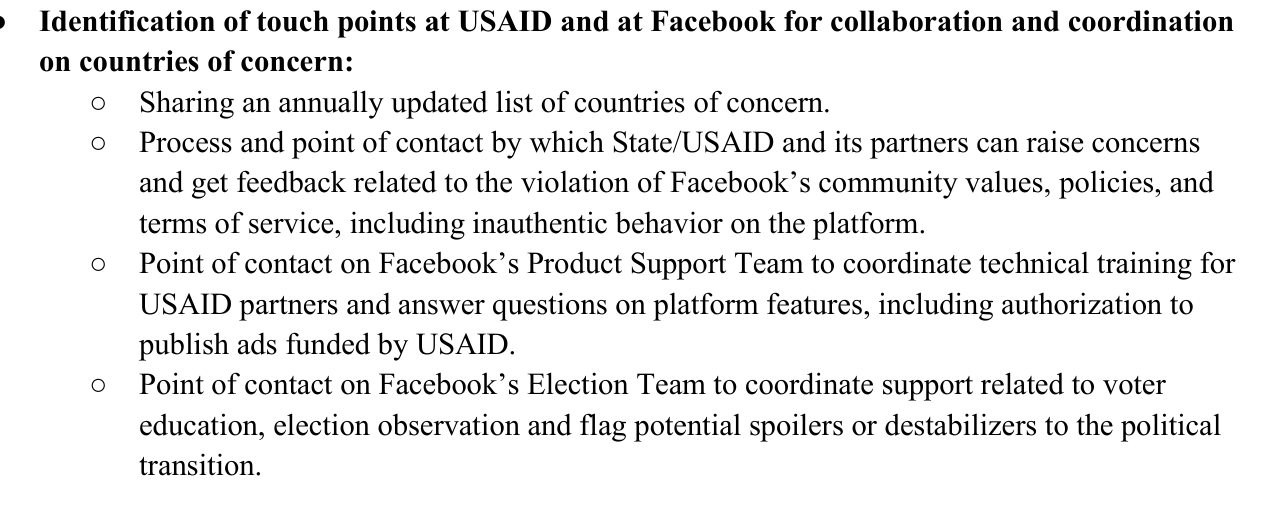
Then there’s the election team: “Point of contact on Facebook’s Election Team to coordinate support related to voter education, election observation and flag potential spoilers or destabilizers to the political transition.”
Note that flagging spoilers is listed in the same breath as “voter education” and “election observation” – all part of the same “coordination.”
The term “spoiler” is not defined in the document, but in peace and transition work, it refers to an individual or a group that seeks to wreck a settlement or transition. The draft agreement doesn’t go into who would decide who qualifies for the label, and what Facebook would do with the referral.
It does mention “authoritative content” and “Joint alignment of resources to / investment in local organizations to engage with Facebook to promote authoritative messaging.”
The second document is a planning paper for a “reset” in the USAID-Meta relationship, and is marked as “DRAFT PREDECISIONAL.” The cover note, signed by “Vera,” announces a meeting planned for the last week of September.
Guatemala is mentioned in the context of “engagement around mitigating the use of Meta products in the formation of mass migrant movements (Caravans) and cross-national migrant movements.”
This is listed alongside what is essentially law enforcement work: migrant smuggling (“coyotes”), human trafficking, and fraud about work visa programs.
Another request is to have a process to “streamline the referrals into Meta’s Trusted Partner Network and Cross Check Program” – and to have a venue to discuss the responsiveness of this network.
There’s a mention of Belarus and Nicaragua, where USAID wanted to organize “Trainings on cross Check, Meta Pro, Fact-checking program.”
In the case of Nicaragua, the document mentions “Coordination tracking troll networks targeting our partners (and doxing removal).”
In a note that appears to come from the lawyers, USAID is advised to “exercise additional caution if talking to social companies about their content moderation” and to “encourage direct collaboration between platforms and partners, so we are not part of the conversation.”

The reason for this caution is that “content moderation referrals are different than content moderation direction” – and “we don’t want to cross the line into a directive.”
Referral to Cross Check is a significant ask: according to a 2021 report by the Wall Street Journal (cited by CNBC), the program “creates special rules for content moderation” for VIP accounts on Facebook and Instagram – 5.8 million in 2020 alone.
Meta’s Oversight Board said in a December 2022 opinion that the program “appears more directly structured to satisfy business concerns” and that “because of cross-check, content identified as breaking Meta’s rules is left up.”
In the past, we have covered how USAID money has been used to fund censorship programs around the world.
Who gets to decide who a spoiler is in a foreign country’s elections or political process? The answer to that should be the citizens of that country, not Big Tech acting on behalf of a foreign government.
The Inclusion List the State Department Opposed
A US government aid agency, USAID, came up with a plan to have Google and YouTube treat a list of handpicked media outlets more favorably in search, recommendations, and ads.
This was revealed in a USAID planning paper, “Big Tech Engagement Action Plan“, published this month among the USAID Files on the usaid.gov website. The document reads like a draft, with empty action sections and tracked changes.
The paper’s Key Recommendation 1 is that tech companies implement an inclusion list for “verified actors.” And, the document says, those lists “should be private and managed in a decentralized manner through trusted third-party implementers.”
The State Department reacted to this idea by saying it was “discussed internally at State and opposed because of concerns about representing specific actions or actors to receive special treatment as the U.S. government, raising freedom of expression issues,” USAID noted.
USAID saw a way to work around this by having an NGO, not the government, hold the list: “What we propose here is not a list that would be curated by any U.S. department or agency, but rather to connect tech companies with actors that we trust who would be willing to curate an inclusion list on behalf of any companies that are willing to follow one.”
The State Department also wanted USAID to discuss the plan with the National Security Council (NSC) before engaging with Big Tech.
The case the USAID paper makes is that independent media and civil society groups in Russia are subjected to Kremlin censorship, but also, as a result of sanctions and US tech companies pulling their services from the country, they lost access to those platforms as well.
USAID’s partners “face effective censorship from two sides,” the paper says, adding that “denial-of-service policies” do not generally affect supporters of Putin’s regime, but “significantly handicap those who oppose the war.”
The real problem the paper is trying to address is how to help these anti-war outlets reach their audiences despite the internet blocking.
The plan was to have Google, YouTube, and others treat these handpicked media outlets better in search, recommendations, and ads.
For YouTube, the ask was to let these groups monetize their content even inside Russia, and “buy and publish ads in Russia and target content to users in Russia.”
Google was asked to make sure its search algorithms do not downgrade blocked sites, because when users cannot access them, they bounce back, and “search algorithms become amplifiers of censorship.”
Meta was asked to review its recommendation algorithms and “minimize the possibility of shadow bans for the organizations on the inclusion list.”
MailChimp, Slack, SSL certificate authorities, and TechSoup were also on the list of companies that should keep serving groups “on the inclusion list.”
The paper does not only ask for a list that would give a boost to some, but also for algorithms to be tweaked to downgrade others. For example, Google is asked to “review recommendation algorithms to ensure they do not promote pro-war or government controlled content.”
Later in the paper, the language becomes even stronger, asking Google to “review the algorithms so that they would demote pro-war” content “and/or government controlled content.”
“Implement an exclusion list that Google Discover can use to avoid recommending domains that are sources of propaganda.”
The paper does not explain how any of this would be consistent with the free expression concerns that the State Department raised when the idea of a list was first discussed.
Another document, this one a prep note for a planned January 2024 meeting between USAID head Samantha Power and YouTube CEO Neal Mohan at Davos, shows that the idea of an inclusion list was still alive.
The note asks Power to inquire if Google would allow groups on this list, “created and managed by an independent and trusted press freedom NGO like Internews,” to buy and publish ads inside Russia, and target content to Russian users.
The note also asks if Google would make sure that pages belonging to entities on this list are not downgraded in search results. Internews, a USAID-funded media NGO, is named here as a possible holder of the list, but the document does not say if it agreed to that role.
In a spring 2022 call between USAID and Google staff, USAID asked Google how it could “streamline feedback from across U.S. departments / agencies, particularly on issues of concern?”
Google replied that it uses systems to “uprank content to surface authoritative information and then downrank less authoritative information.” USAID also inquired if “certain vetted partners” could be allowed to monetize their content on YouTube inside Russia, but was told that the company was “not making exceptions.”
In January 2024, YouTube CEO Mohan met with USAID officials and told them that sanctions were the reason the company could not monetize Russian traffic, “there was no way around this.”
Mohan also said that what was more important than content moderation was YouTube’s way of “raising/elevating content from legitimate and veritable sources.”
Nothing in the documents shows that Google or YouTube agreed to create or follow an inclusion list.
We previously covered USAID’s media funding network in a February 2025 piece looking into the agency’s media funding. We also covered Internews and its government funding in February 2025, and the Global Disinformation Index ad blacklist that was accused of political bias in February 2023. In 2020, we covered Big Tech’s practice of boosting so-called authoritative sources.
The problem of censorship and the need to support those suffering under it is real – but the solution cannot be to create more of the same problem, just with a different list, and a different gatekeeper.