From “reclaimthenet.org”
The officer who arrested him later admitted under oath it never should have happened, and that doing it this way was department policy.
Reno police treated a casino’s facial recognition system as a reliable witness for years, arresting people on algorithmic say-so with no corroborating evidence, no follow-up investigation, and no department policy telling them to do otherwise.
A federal lawsuit now alleges this wasn’t one officer’s mistake. It was standard practice, applied to thousands of people.
The amended complaint, filed April 2, 2026, in US District Court, names Officer Richard Jager and the city of Reno as defendants after Federal Judge Miranda Du allowed the city to be added.
We obtained a copy of the complaint for you here.
Attorney Terri Keyser-Cooper, representing plaintiff Jason Killinger, stated that “Jager’s conduct was not a sporadic incident involving the wrongful actions of a rogue employee, but the result of a widespread custom and practice involving hundreds of municipal employees making thousands of arrests in the same manner over a period of years.”
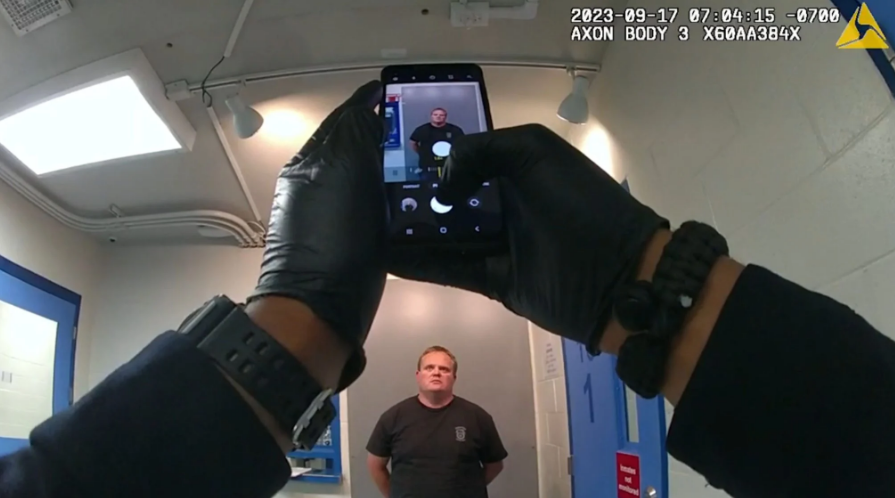
Killinger’s story shows exactly how this played out. He walked into the Peppermill Casino in Reno in September 2023, and the casino’s surveillance system flagged him as a “100 percent match” for a person who’d been banned from the property.
The match was wrong. Killinger carried three forms of identification, including a Real ID, and offered to get more from his vehicle. Jager’s arrest report mentioned none of that. The lawsuit alleges the report falsely claimed Killinger presented conflicting identification, a characterization that doesn’t survive comparison with the bodycam footage and documents now in the court record.
Killinger spent 11 hours in custody. A fingerprint check at Washoe County jail confirmed what his driver’s license, pay stub, and vehicle registration had already shown: he was not the man the Peppermill had banned.
Jager admitted under oath in January 2026 that the arrest “never should have happened.” He testified that the Reno Police Department’s custom and policy was to trust facial recognition software and to arrest people based on it without any other corroborating evidence.
What happened after the fingerprints cleared, Killinger is almost as troubling as the arrest itself. City prosecutors filed a criminal complaint under the name “John Doe,” and a municipal judge found probable cause for trespass, even though the jail’s own biometric data had already proven Killinger’s identity.
City attorney Jill Drake kept the case open after dismissal and referred it to an RPD fraud detective. That detective sided with Killinger, finding no identity theft and confirming the Peppermill had made an error. A Reno sergeant later told Jager there was probable cause for an identity theft charge against Killinger, despite the fraud detective’s findings. Jager declined to proceed.
The Reno Police Department operated for years without a policy stating that a facial recognition match alone can’t establish probable cause. That gap isn’t a technicality. The US Department of Justice published a policy template back in 2017 through its Bureau of Justice Assistance, characterizing facial recognition results as “advisory in nature” that “do not establish probable cause.” The template explicitly states that results are not to be treated as positive identification without further investigation.
RPD either ignored this guidance or never bothered to read it. Seven states now prohibit police from using facial recognition as the sole basis for an arrest, and four states require a warrant or probable cause before officers can even run a facial recognition search. Nevada has enacted no comparable restrictions, leaving departments like RPD to write their own rules, or, in this case, to write none at all.
The case fits a pattern that has become depressingly familiar. Detroit’s Robert Williams was wrongfully arrested at his home in 2020, in front of his wife and two children, after the department relied on an incorrect facial recognition match. That case produced a landmark settlement requiring Detroit police to stop arresting people based solely on facial recognition results.
The surveillance question here extends beyond police practices. Casinos like the Peppermill run facial recognition systems that scan every person who walks through the door, building biometric profiles of gamblers, tourists, and anyone else who happens to enter.
The trouble with treating facial recognition as gospel is that it inverts how policing is supposed to work. Probable cause requires evidence that a specific person committed a specific act. A facial recognition match provides neither. It provides a statistical guess that two faces look similar, generated by an algorithm whose methodology, training data, and error rates are typically proprietary and unavailable for scrutiny.
When police departments treat that guess as equivalent to an eyewitness identification or a fingerprint match, they’re building arrests on a foundation that no officer can explain and no defendant can meaningfully challenge.
The city attorney’s office maintains Jager followed correct protocol, a claim that becomes harder to square with Jager’s own deposition testimony and the department’s lack of any written protocol governing facial recognition arrests.
The complaint seeks punitive damages, compensation for injuries Killinger sustained while handcuffed, and attorney’s fees. A jury trial has been requested. No date has been set. The city did not respond to a request for comment.
More: Angela Lipps Spent 108 Days in Jail Because a Facial Recognition Algorithm Was Wrong