From “The Free Thought Project”
A Virginia man accused of destroying multiple flock cameras, who pleads not guilty because mass surveillance violates our rights.
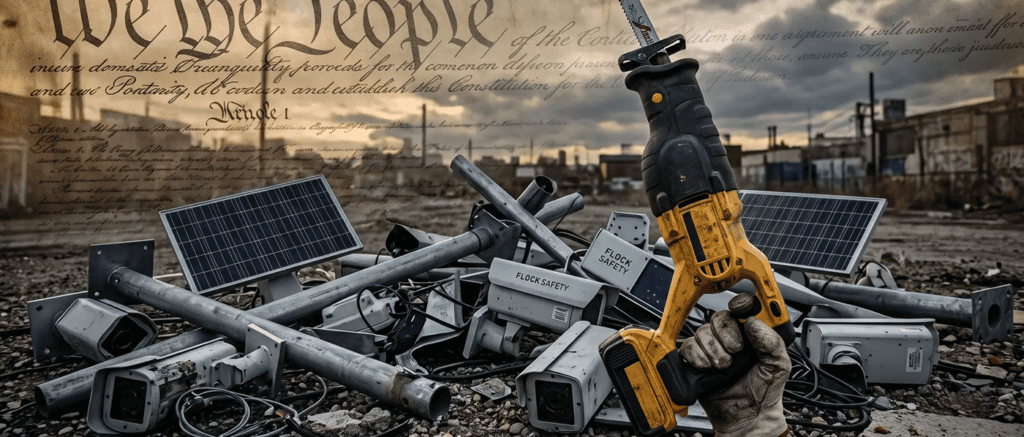
As millions of Americans passively consume state-sanctioned fireworks this Fourth of July, it is crucial to remember that Independence Day was not birthed from compliance, but from radical, unapologetic defiance against a monolithic empire. That raw spirit of 1776 has not been extinguished; it has simply shifted targets from a tyrant king to the digital panopticon. The surveillance state rarely takes kindly to those who blind its all-seeing eye, and the latest casualty in this modern war for liberty is a 41-year-old Suffolk, Virginia resident named Jeffrey Scott Sovern. Between April and October of 2025, local authorities allege Sovern channeled that revolutionary energy by systematically dismantling 13 Automated License Plate Reader (ALPR) cameras operated by the private surveillance behemoth Flock Safety.
Investigators claim Sovern separated the two-piece mounting poles and removed the tracking equipment with tools, targeting the $1,300 setups that include the camera, solar panel, and mounting hardware. For allegedly blinding the panopticon, Sovern now faces 13 counts of felony destruction of property, six counts of petit larceny, and six counts of possessing burglary tools.
The official narrative, conveniently laid out in a criminal complaint, asserts that after Sovern was arrested on October 17, 2025, on unrelated warrants, he outright confessed to disassembling the units. Police claim he admitted to keeping solar panels, batteries, and other hardware at his Nicklaus Drive residence, which culminated in a raid that allegedly recovered six of those stolen solar panels.
Unsurprisingly, a spokesperson for Flock Safety issued a statement expressing gratitude toward law enforcement for holding individuals accountable when their devices are damaged. Yet, this corporate applause completely ignores the glaring constitutional crisis created by the very existence of these devices on public roadways.
These ALPR networks act as an unconstitutional dragnet, indiscriminately logging the movements of innocent, peaceful individuals without a shred of probable cause. In fact, just a year prior in June 2024, a Circuit Court judge in neighboring Norfolk correctly ruled that collecting location data from the city’s 172 Flock cameras constitutes a search under the Fourth Amendment, accurately likening the vast database to warrantless tracking devices.
The state’s portrayal of a clean, by-the-book investigation is already facing heavy public scrutiny. Individuals claiming to have been inside Sovern’s residence during the raid publicly asserted that police stormed the home, forced a resident to cower in a towel, and threatened everyone with handcuffs while refusing to immediately produce a warrant.
While disabling a device that is actively executing an unconstitutional search on your person might seem like a righteous defense of liberty, bringing that dismantled hardware into your home is a fatal tactical error. By allegedly harvesting the state-contracted property for personal use, Sovern crossed the threshold into petit larceny, handing the monopoly on violence the exact legal pretext it needed to execute a traumatic raid and levy multiple felonies.
To enforce the protection of their massive surveillance grid, the state didn’t hesitate to escalate its own aggression against a citizen. Investigators openly admitted in the criminal complaint that they obtained a search warrant for a GPS tracker, slapping it onto Sovern’s vehicle prior to his arrest to secretly monitor his movements and place him near the scenes of the disabled cameras.
This localized battle in Virginia is just a microcosm of the staggering corporate-state panopticon expanding across the country. According to a 2025 review by the Electronic Frontier Foundation, there were roughly 12 million searches conducted across approximately 3,900 law enforcement agencies using these very systems.
This massive dragnet is far from flawless, as a 2021 study by the surveillance research firm IPVM found a 10% error rate in Flock’s Falcon cameras, inaccuracies that have directly resulted in the wrongful arrests of innocent people across several cities. The nightmare is only deepening, with May 2025 reports revealing Flock’s development of a product called Nova, intended to supplement camera data with public records to track individuals without a warrant—a system the EFF aptly described as a dystopian nightmare.
Add to this the glaring security vulnerabilities discovered by cybersecurity researchers in 2025, which allowed anyone to access live camera feeds from the Flock Condor line. While Flock hastily claimed this was a mere misconfiguration affecting limited devices, it highlights the severe danger of entrusting private corporations with the mass collection of our daily movements.
It appears that Sovern’s direct action has sparked a wildfire of decentralized resistance. Social media is currently flooded with videos of anonymous individuals taking power tools to Flock cameras in cities across the entire country, a phenomenon recently highlighted by Jason Bassler on X. This is exactly what happens when the state attempts to herd free humans like digital cattle into a corporate-controlled panopticon; this type of visceral resistance should not only be expected, but it is practically inevitable.
State officials might be clutching their pearls over the damaged hardware, but they can trust that vastly more people in this country will offer quiet support for these vigilantes than would ever dare turn them in. We are witnessing a bloodless revolution of sorts, an organic, decentralized uprising against an invisible cage. It is just one battle in a massive, ongoing war against the surveillance state, but for the first time in a long time, it appears the people are winning.
If you feel that cutting down and destroying Flock cameras is your path forward, no one is stopping you, and, in fact, many will support you. But if you don’t want to risk being locked in a cage, there are many other ways to fight Flock without a sawzall. We must out-innovate the surveillance state, utilizing decentralized, technological solutions and grassroots action to actively protect our constitutional liberties.
Free Thought Project co-founder Jason Bassler recently outlined eight crucial strategies to dismantle the surveillance grid from within the system. You can demand an audit, forcing the city council to show empirical evidence that these cameras actually reduce violent crime—a burden of proof they usually fail to meet. You must also find out exactly when the contract expires by using FOIA requests to uncover original agreements, amendments, and termination clauses, ensuring the community organizes before the renewal, not after.
Before any surveillance device is deployed with public funds, demand the Privacy Impact Assessment, a civil liberties review, and a constitutional analysis. If the city never conducted one, asking them publicly why not puts them on the defensive. You have to show up before they vote, utilizing tools like community portals to set automatic notifications for upcoming council meetings so you can speak out before the budget is approved and the cameras go up.
Follow the money to uncover the real motives; ask for grant applications, DHS grants, and DOJ funding, because surveillance programs usually take root simply because outside federal money makes them appear “free.” Simultaneously, ask about data sharing agreements and MOUs to expose exactly which external agencies—often federal entities—are actually searching your city’s license plate database.
Public records requests aren’t just for contracts; you must audit every search by publicly requesting logs showing the date, user, reason, and case numbers to expose abuse long before it makes the news. Finally, download your city’s crime data and compare property and violent crime rates before and after Flock was installed. If there is no meaningful change, demand to know why taxpayers are still funding their own subjugation.
Beyond bureaucratic warfare, you can protect yourself immediately on the road. One method to reclaim your anonymity is the use of Infrared (IR) license plate covers. Digital ALPR cameras rely heavily on IR light to read plates at night, and privacy-enhancing IR LED frames effectively wash out the camera’s sensor with blinding white light while appearing completely normal to the naked eye of a passing police officer.
For those looking to avoid the grid entirely, open-source mapping projects like DeFlock allow citizens to crowdsource and log the exact GPS coordinates of these invasive cameras. By consulting these decentralized maps before traveling, peaceful individuals can physically route their daily lives around the dragnet, effectively starving the corporate database of their location metadata.
When activists do inevitably face the wrath of the state, relying on easily weaponized platforms like GoFundMe is a massive vulnerability, as state actors can effortlessly freeze, seize, or subpoena fiat-compliant systems. Defense funds must transition immediately to privacy-centric financial ecosystems like Monero or our sponsor Zano, utilizing their confidential layers to ensure that your financial support of dissidents cannot be tracked by the very state prosecuting them.
Finally, the battle must be brought directly to the local level through aggressive legislative nullification. Communities must demand their local city councils terminate these invasive contracts, following the lead of municipalities like Denver that have faced massive public pushback, and several other cities that have already severed ties with Flock over deep-seated privacy concerns and data misuse.
The monopoly on violence will never voluntarily dismantle the digital cage it built to subjugate you, leaving it entirely up to a defiant public to ensure their panopticon is starved, legislated, or sawed into absolute obsolescence.