This article was originally published by John W. Whitehead at The Rutherford Institution It has been republished with permission from the author. Please contact the author directly for republishing information.
“The people are the only legitimate fountain of power.”—James Madison
This is a year of strange anniversaries.
Two hundred and fifty years ago, a band of revolutionaries declared their independence from a king.
America’s founders rejected concentrated power. They denounced standing armies. They distrusted government secrecy. They risked their lives to escape a ruler who could tax without consent, wage war without accountability, and govern without meaningful restraint.
Twenty-five years ago, after the attacks of September 11, 2001, America embarked on a very different journey.
The federal government claimed extraordinary emergency powers. Surveillance expanded. Wars multiplied. Executive authority grew. Constitutional safeguards were weakened in the name of security.
One anniversary marked a revolt against empire. The other marked the normalization of it.
Now, as America prepares to celebrate 250 years of independence, we are confronted with a bitter irony: the republic born in rebellion against empire has become an empire in everything but name.
Worse, the U.S. government is violating the very principles that justified the American Revolution.
Graft, grift and corruption. Endless wars. Profiteering. Trillions squandered abroad while the nation sinks deeper into debt at home.
A government that governs increasingly by executive order and emergency decree. A government that wastes taxpayer money with impunity, rewards political loyalty over constitutional fidelity, installs loyalists in positions meant to serve the public, dismantles safeguards against corruption, shields insiders from scrutiny, and treats accountability as an inconvenience.
National states of emergency that never seem to end. Efforts to nullify constitutional guarantees such as birthright citizenship. Expanded death penalty powers. A growing willingness to bypass Congress, sidestep constitutional restraints and rule by fiat.
Surveillance programs that track where we go, what we buy, who we know, what we say and what we believe. Fusion centers, facial recognition, license plate readers, AI-assisted monitoring, financial tracking, intelligence-sharing agreements and a sprawling security apparatus that treats privacy as a loophole and dissent as a threat.
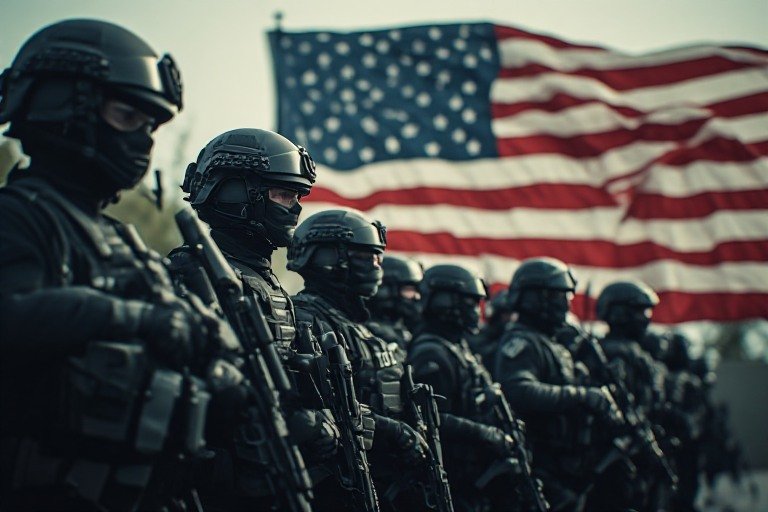
Military action undertaken without congressional authorization. National Guard deployments that blur the line between civilian government and military authority. The militarization of policing. Federal agents arresting people at courthouses. Protesters treated as security threats. Legal residents threatened with deportation because of their political speech and associations. Immigrants and asylum seekers swept up in raids, detained, deported or disappeared into a bureaucratic maze before courts can fully review the legality of what has been done.
Whistleblowers, journalists, activists and critics targeted for speaking truth to power. Expanding “extremist” classifications that increasingly encompass lawful speech, political dissent and ideological opposition rather than criminal conduct.
This is not freedom.
This is the architecture of a police state.
Nor is this merely the accumulated rot of past administrations.
Republican and Democratic presidents alike helped build the machinery of permanent emergency. They expanded the surveillance state, normalized undeclared wars, empowered the military-industrial complex, deferred to intelligence agencies, and taught Americans to accept secrecy, suspicion and fear as the price of safety.
Donald Trump inherited that machinery.
Then he weaponized it.
No modern president has done more to expose the danger of allowing so much power to accumulate in one office.
Trump did not invent the imperial presidency, but he has shown what happens when a president treats constitutional limits as obstacles, dissent as disloyalty, the courts as irritants, Congress as irrelevant and federal power as a personal weapon.
Nor has he hidden his intentions. From efforts to consolidate authority within the executive branch to the installation of loyalists whose allegiance appears directed more toward a president than the Constitution, the Trump Administration has tested the limits of executive power in ways that would have alarmed the generation that fought the Revolution.
We have also witnessed growing efforts to sideline due process protections, weaken the ancient safeguard of habeas corpus, expand detention powers, and normalize the notion that constitutional rights can be suspended whenever government officials invoke national security, immigration enforcement or emergency necessity.
This is what happens when a government built for emergencies never leaves emergency mode.
The danger is no longer hypothetical.
The tools of authoritarianism exist.
The police state machinery exists.
The surveillance apparatus exists.
The permanent war powers exist.
The question is who controls them—and what remains to stop them.
The American Revolution was not fought over minor policy disagreements. It was fought over the danger of unaccountable power. The colonists objected to a king who could deploy troops, impose taxes, conduct searches, punish dissent and wage war without meaningful consent of the governed.
The Declaration of Independence was not merely a list of grievances.
It was an indictment.
King George III had made the military superior to civilian authority. He had maintained standing armies without consent. He had cut off trade, imposed taxes, obstructed justice and transported colonists overseas for trial.
Time and again, the Declaration returned to the same central complaint: concentrated power had become a threat to liberty.
The Revolution was not fought over a tax on tea.
It was fought over the danger of a government that had placed itself above the people.
When the framers later gathered to draft the Constitution, they did so with those lessons fresh in mind.
The founders understood that power is inherently expansive. Given enough time, every government seeks more authority, more secrecy and more control.
That is why they created a constitutional system in which power was divided. The branches were intended to restrain one another. No person was to be trusted with too much authority.
Yet history shows how quickly constitutional restraints weaken in times of fear.
John Adams signed the Alien and Sedition Acts and criminalized political dissent.
Abraham Lincoln suspended habeas corpus.
Woodrow Wilson prosecuted anti-war activists.
Franklin Roosevelt ordered the internment of more than 120,000 Japanese Americans.
Richard Nixon weaponized federal agencies against political opponents.
Each expansion of executive power was justified as necessary.
Each left constitutional scars.
Then came September 11, 2001.
In the months and years that followed, Congress passed the USA PATRIOT Act, vastly expanding government surveillance powers. The Department of Homeland Security was created. Military tribunals were revived. Warrantless surveillance became commonplace. Watchlists multiplied. Fusion centers spread across the country. Indefinite detention became normalized.
War abroad justified surveillance at home.
Terror threats justified government secrecy.
National crises justified executive emergency powers.
What began as a response to a terrorist attack gradually became a governing philosophy.
Twenty-five years later, the emergency state has become embedded in the architecture of government.
Every crisis expands executive power.
Every war contracts liberty.
Every emergency leaves behind powers that rarely disappear.
This is how tyranny rises and freedom falls.
Presidents of both parties have inherited extraordinary powers and expanded them further. Congress has repeatedly surrendered responsibilities it was meant to exercise. Courts have increasingly deferred to executive claims involving national security, immigration and emergency authority.
The result is a government that often functions by executive decree rather than representative self-government.
Executive orders increasingly substitute for legislation. National emergencies become permanent governing authorities. Constitutional guarantees such as birthright citizenship are challenged by presidential decree rather than constitutional amendment. Congress is bypassed. Courts are treated as obstacles. Separation of powers becomes a formality rather than a safeguard.
The presidency has evolved into something the framers would scarcely recognize.
What Donald Trump has done is expose the fatal flaw in the system Americans allowed to be built after 9/11: once government is handed the machinery of permanent emergency, all that remains is for the wrong person to seize the controls.
For decades, Americans were told not to worry.
We were told surveillance powers would only be used against terrorists.
We were told emergency powers would only be invoked during genuine crises.
We were told national security authorities would remain subject to constitutional limits.
We were told the Constitution’s checks and balances would hold.
We were told no president would ever be allowed to exercise such powers without meaningful restraint.
They were wrong.
And we were wrong to trust power to restrain itself.
The lesson is the same one the founders learned from bitter experience: power granted in the name of necessity rarely remains confined to necessity.
Every emergency becomes a precedent.
Every precedent becomes a power.
Every power becomes permanent.
The founders also warned against standing armies and perpetual war.
Having lived under military occupation, they understood that governments organized around war inevitably become organized around power.
What they feared was not merely the presence of soldiers but the rise of a permanent warfare state—a government that uses conflict, fear and national security as justification for expanding its authority.
Today, those dangers extend beyond foreign battlefields. National Guard units are increasingly federalized and deployed domestically. Military tactics, equipment and personnel continue to flow into civilian law enforcement. The line separating the soldier from the police officer grows fainter with each passing crisis.
Look around.
The United States has spent much of the last quarter century engaged in military operations somewhere in the world. Wars are launched without formal declarations. Emergency powers become permanent. Defense budgets swell while domestic needs go unmet. Intelligence agencies operate with extraordinary secrecy. Technologies developed for foreign battlefields migrate into local police departments and domestic surveillance programs.
Today, even as the Trump Administration and its so-called War Department continue to pound the war drums, Americans are once again being told to trust government officials operating behind closed doors, often with little public debate and even less accountability.
The founders understood a simple truth: governments that prepare constantly for war eventually begin treating their own citizens as potential enemies.
That is the logic of empire.
Enemies abroad justify surveillance at home. War powers abroad justify police powers at home. National security becomes the excuse for secrecy, militarization, censorship, detention and control.
Perhaps nowhere is this more evident than in the rise of the surveillance state.
Long before shots were fired at Lexington and Concord, colonists were outraged by writs of assistance—general warrants that allowed British agents to search homes, businesses and personal property without meaningful justification.
Those abuses helped inspire the Fourth Amendment.
Today, government agents no longer need to kick down your door to invade your privacy.
Your cell phone tracks your movements. Your vehicle reports your location. Your purchases reveal your habits. Your social media activity exposes your associations. Your digital footprint creates a detailed record of your life.
Government agencies can access location data, financial records, license plate readers, facial recognition databases and vast stores of personal information, often with little transparency and even less oversight.
Meanwhile, Congress continues to renew and expand surveillance authorities while intelligence agencies deepen information-sharing arrangements with domestic and foreign partners. Americans are increasingly monitored not because they are suspected of wrongdoing, but because technology has made mass surveillance possible and government has found it useful.
The surveillance state has no borders. Nor does it have clear limits.
Government agencies increasingly rely on broad and elastic “extremist” classifications that often extend beyond violence or criminal conduct to encompass lawful speech, political dissent and ideological opposition.
What begins as a tool to identify dangerous actors inevitably expands into a mechanism for monitoring unpopular viewpoints. Information collected for one purpose is shared for another. Data gathered abroad finds its way home. Intelligence systems built to monitor foreign threats are repurposed to watch domestic populations.
King George’s agents needed boots and battering rams to search your home.
Today’s government can search your life without ever leaving its desk.
And then there is the matter of accountability—or rather, the lack of it.
The Declaration of Independence repeatedly condemned a government that had placed itself above the law.
That grievance remains painfully relevant.
Government officials who violate constitutional rights are frequently shielded from accountability by doctrines such as qualified immunity. Secret courts authorize secret programs. Bureaucrats operate behind layers of classification and administrative complexity. Government agencies routinely fail audits, lose records, misuse surveillance powers and exceed their authority, yet meaningful consequences remain rare.
Meanwhile, ordinary Americans face an entirely different standard.
When government officials make costly mistakes, taxpayers foot the bill.
When unconstitutional policies trigger lawsuits, taxpayers foot the bill.
When unlawful detentions result in settlements, taxpayers foot the bill.
When militarized raids, wrongful arrests, surveillance abuses and civil-rights violations generate years of litigation, taxpayers foot the bill.
Even now, Americans are being asked to absorb the financial costs of government misconduct on a staggering scale—from unlawful enforcement actions and unconstitutional executive orders to politically motivated spending schemes and settlements designed to shield those in power from scrutiny.
The public pays for the government’s mistakes while those responsible often walk away untouched. In some cases, public office itself has become a vehicle for private gain, with self-enrichment schemes, conflicts of interest and insider favoritism blurring the line between public service and personal profit.
The pattern is impossible to ignore.
Profits are privatized. Power is centralized. Accountability is deferred.
The bill is sent to the American people.
Whether it involves unlawful surveillance, unconstitutional arrests, retaliatory investigations, speech-based censorship, ICE raids that terrorize communities, warrantless tracking, civil asset forfeiture, the targeting of whistleblowers, journalists and activists, endless wars or political corruption, the pattern is the same: power protects itself.
The founders did not risk their lives because taxes were too high.
They risked their lives because government had become detached from the people, insulated from accountability and convinced that power justified itself.
Sound familiar?
The uncomfortable truth is that many of the abuses that sparked the American Revolution have returned, only this time they arrive wrapped in the language of national security, public safety, emergency management and administrative necessity.
The faces have changed. The technology has changed. The rhetoric has changed.
The danger remains the same.
Which brings us back to this strange anniversary year.
The 250th anniversary of American independence should have been an opportunity to renew our commitment to limited government, constitutional accountability and the principle that no one is above the law.
Instead, the lesson of 9/11 is being repeated in a different form.
Twenty-five years ago, fear became the pretext for permanent emergency.
Today, patriotism is becoming the backdrop for presidential spectacle, military pageantry and the celebration of the very concentration of power the American Revolution was fought to resist.
Much of the celebration has been transformed into a spectacle of power: military displays, patriotic pageantry, strongman politics and the elevation of political leaders into larger-than-life figures whose authority is expected to be admired rather than questioned.
Yet the founders did not launch a revolution so Americans could celebrate authoritarian power.
They launched a revolution to remind future generations that power is dangerous, liberty is fragile and no ruler should ever be elevated above the Constitution.
For 250 years, Americans have treated the Declaration of Independence as the nation’s birth certificate.
What we have failed to recognize is that the Declaration of Independence was also a warning: freedom is fragile, power is relentless, and no generation remains free simply because a previous generation fought for liberty.
As America approaches its 250th anniversary, the most important question is not whether the nation survived. Nations survive. Empires survive. Governments survive.
The real question, as I make clear in Battlefield America: The War on the American People and its fictional counterpart The Erik Blair Diaries, is whether the principles that inspired the American Revolution survived as well.
Thus, the question is not whether America survived 250 years.
The question is whether the principles of 1776 can survive the American police state.