From “The Free Thought Project”
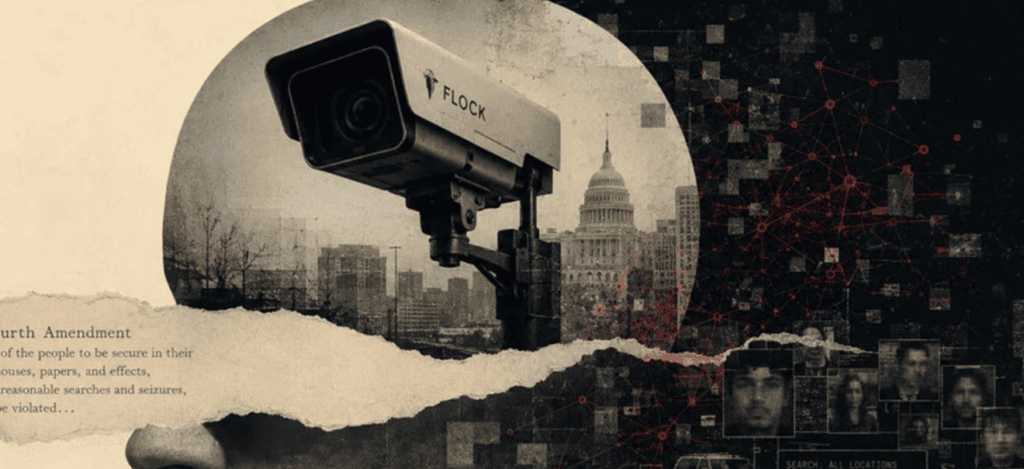
Flock Safety and the private surveillance companies building an American panopticon one municipal contract at a time.
(Josh Walkos) The black pole does not look like tyranny.
That is the point.
It looks like street furniture. A small black camera. A solar panel. A utility box. Nothing dramatic. No uniformed officer standing beside it. No marked police vehicle. No flashing lights. No warrant presented to the driver. In many communities, there was barely any public debate before it appeared.
Yet the device photographs nearly every vehicle that passes. It reads the license plate, records the time and location, identifies the make, model and color, and may catalogue distinctive features such as bumper stickers, roof racks, dents, scratches and damage. That information is uploaded into a cloud platform where police can search for vehicles across time and geography. [1]
The government once needed detectives, informants, stakeouts and court orders to follow someone across a city.
Now it can type a plate number into a privately operated dashboard.
Flock Safety calls this public safety.
A more accurate description is a privately administered ledger of American movement.
This is not merely a story about one overly ambitious technology company. Flock is the case study, but the real subject is the creation of a public-private surveillance regime in which corporations collect the data, venture capital finances the infrastructure, local governments purchase access, federal agencies find side doors into the system, and ordinary citizens are told that none of this is particularly concerning because they were technically visible while driving on a public road.
The state did not formally repeal the Fourth Amendment.
It outsourced its erosion.
From Neighborhood Watch to National Tracking Network
Flock Safety was founded in Atlanta in 2017 by Garrett Langley, Matt Feury and Paige Todd. The company’s origin story was almost quaint. Langley began experimenting with cameras after burglaries in his neighborhood and the early systems were marketed heavily to homeowners associations as a smarter version of neighborhood watch. [2]
There was an important difference.
Traditional neighborhood watch involved residents observing suspicious behavior.
Flock’s model recorded everybody first and searched for suspicious people later.
That inversion became the foundation of the company.
Instead of beginning with an identified crime and gathering evidence about a particular suspect, Flock created a system in which the movements of thousands of innocent people could be collected continuously, stored and searched after an investigation began.
Police no longer had to know whom they were looking for before surveillance commenced.
The database would already be waiting.
Flock expanded beyond subdivisions into apartment complexes, schools, hospitals, retailers, corporate campuses and municipal roads. The company now markets interconnected camera, audio, drone and investigative systems to police agencies, businesses and private communities. [3]
This architecture allows privately owned cameras to become nodes in a law-enforcement network. The cameras may have been purchased by an HOA, shopping center or corporation, but the information can still become available to police through sharing agreements and platform integrations.
The distinction is financially convenient and constitutionally consequential. When the government installs a surveillance system, citizens may demand hearings, records, policies and legal justification. When a shopping center or homeowners association installs the sensor and later opens the data to police, responsibility becomes diffused.
The corporation says it merely provides a service.
The police say they merely consult available information.
The city council says the vendor handles the data.
The vendor says the customer controls access.
Everybody participates.
Nobody claims ownership of the constitutional consequences.
In March 2025, Flock announced that it had raised another $275 million at a valuation of $7.5 billion. The round was led by Andreessen Horowitz and included Peter Theil’s Founders Fund, Greenoaks, Bedrock, Meritech Capital, Matrix Partners, Sands Capital, Kleiner Perkins, Tiger Global and Y Combinator. [5]
Reuters reported that the financing brought Flock’s total outside investment to more than $950 million. At the time, the company said it had reached roughly $300 million in annual recurring revenue, growing approximately 70 percent year over year, while serving more than 4,800 law-enforcement agencies and 1,000 businesses. [6]
This was no longer three engineers experimenting with cameras around a dining-room table.
It had become an extraordinarily well-financed surveillance corporation with government customers, recurring subscriptions, proprietary infrastructure and investors who understood that public-safety technology offers something most software companies can only dream of: taxpayer-funded contracts, institutional lock-in, political protection and a virtually endless supply of fear-based marketing.
Founders Fund’s involvement places Flock within a larger venture-capital ecosystem interested in defense, intelligence, artificial intelligence, policing and government data infrastructure. That does not mean Thiel secretly controls every camera. It means the surveillance of ordinary citizens has become a lucrative Silicon Valley growth industry whereby human movement is now an asset class.
Proliferation Was the Product
Much like most Silicon Valley companies, Flock’s business model depends upon scale.
A single camera may help identify a stolen car but thousands of interconnected cameras can map a person’s movements. Better yet, tens of thousands can begin to resemble a national tracking system.
Flock’s current website claims that more than 12,000 communities use the company’s products and that its network supported more than one million cases during 2025. These are Flock’s own promotional figures, not the product of independent nationwide evaluation, but they demonstrate the breadth of the company’s stated reach. [7]
The company has marketed its system around stolen cars, missing children, Amber Alerts, violent offenders and organized retail theft. These are real problems and there is little doubt that license-plate readers have helped solve some genuine crimes but utility does not decide constitutionality.
General warrants were useful too.
The central question is not whether a camera has ever helped find a murderer. It is whether the possibility of finding a murderer justifies continuously logging everyone else.
Flock’s network transforms a momentary public observation into a persistent historical record. An officer standing at an intersection may see one car pass once. A network of cameras can show where that vehicle traveled yesterday, where it appears at night, which medical office it visited, which church it attends, which political meeting it approached and which other vehicles repeatedly appeared nearby.
Individual observations become surveillance through aggregation.
That is precisely what Flock’s defenders habitually obscure.
They reduce the system to a single photograph taken in public, as though the controversy concerns whether a police officer is allowed to see a license plate.
It does not.
The controversy concerns whether tens of thousands of cameras may automatically catalogue the movements of millions of innocent people, place those records in a searchable corporate database, combine them with artificial intelligence and make the resulting information available across jurisdictional lines without a warrant.
A photograph is not necessarily a tracking system but having billions of searchable photographs certainly turns it into one.
Flock’s CEO Says the Quiet Part Out Loud
Garrett Langley has articulated the company’s philosophy with remarkable bluntness.
In a 2026 interview, Langley described the public-policy question as deciding what degree of “privacy erosion” Americans are willing to accept in exchange for increased safety. He also claimed that people driving on public roads constitutionally have no expectation of privacy. [8]
This is the worldview at the heart of Flock.
Privacy is not treated as a constitutional presumption that the government must overcome through probable cause and particularized suspicion. It is treated as a negotiable commodity that officials and corporations may incrementally trade away in exchange for promised improvements in public safety.
That philosophy is anti-constitutional in spirit.
The Bill of Rights was not written to maximize administrative efficiency. It was written to place deliberate obstacles between government power and the individual.
Langley’s claim about public roads is also far too categorical to represent modern Fourth Amendment law accurately.
The Supreme Court has repeatedly recognized that aggregated location data can reveal intimate details about a person’s life, even where individual movements occurred in public or the records were maintained by a private company.
In Carpenter v. United States, the Court held that government acquisition of historical cell-site location records constituted a Fourth Amendment search. The Court explained that comprehensive location information can provide an “intimate window” into a person’s life. [9]
On June 29, 2026, the Supreme Court extended that reasoning in Chatrie v. United States, holding that police conducted a Fourth Amendment search when they obtained a person’s Google Location History. The Court emphasized that even short-term monitoring can reveal familial, political, professional, religious and sexual associations. [10]
The third-party doctrine is not an unlimited blank check allowing government access to every piece of location information held by a corporation.
Visibility is not the same as permanent legibility.
The fact that a stranger may see you enter a church does not mean the government should possess a searchable list of everyone who entered every church.
The fact that a license plate is visible does not automatically settle whether police may reconstruct weeks of someone’s movements without judicial authorization.
Langley’s formulation conveniently collapses those entirely different propositions.
The Constitutional Line Is Already Under Litigation
Norfolk, Virginia, became one of the first major battlegrounds.
The city installed roughly 176 Flock cameras. Two residents, Lee Schmidt and Crystal Arrington, obtained records showing that the system had photographed their vehicles hundreds of times. They sued, arguing that Norfolk had created a warrantless tracking network capable of reconstructing ordinary residents’ movements. [11]
In January 2026, a federal judge ruled that Norfolk’s system, on the specific record before the court, did not violate the Fourth Amendment. The court’s ruling was a victory for Norfolk and Flock, but it was not a constitutional endorsement of unlimited vehicle surveillance. Reporting on the ruling noted that a denser camera network, longer retention period or more sophisticated analytical capability could change the constitutional analysis. [12]
That qualification matters.
Surveillance products do not remain static, because the cameras multiply, Retention periods change and search functions improve.
Artificial intelligence identifies additional attributes and separate databases become interoperable.
A system that narrowly survives constitutional review in one configuration may become something fundamentally different after another software update, acquisition or sharing agreement.
The constitutional threat expands with the product.
The Misuse Is Not Hypothetical
Flock’s defenders frequently answer privacy concerns by pointing to audit logs, access controls and written policies.
Those mechanisms are better than nothing but they have not prevented abuse.
The Abortion Search
In 2025, records revealed that the Johnson County Sheriff’s Office in Texas conducted a nationwide Flock search for a woman believed to have self-administered an abortion.
The search description reportedly stated: “had an abortion, search for female.”
The query reached more than 83,000 cameras. [13]
Officials initially described the incident as a welfare check intended to locate a potentially endangered woman. Later court records obtained by the Electronic Frontier Foundation showed that deputies were conducting an abortion investigation and had considered potential criminal charges, contradicting the reassuring narrative presented by both the sheriff and Flock. [14]
The point is not to relitigate abortion politics, the point is that a system sold using stolen-car recoveries was used to conduct a nationwide search for a woman based on a pregnancy-related allegation.
The infrastructure does not care which political faction controls the login.
Today it may be used to find a woman who had an abortion or tomorrow it may be used to locate a gun owner, dissident, immigration activist, journalist’s source, donor to a controversial organization or parent accused of violating some future emergency order.
The database has no ideology but the operator does.
Immigration Enforcement Through the Side Door
Flock has repeatedly emphasized that it does not have a direct contract with Immigration and Customs Enforcement but that answer evades the actual issue.
Reporting by 404 Media found that local police agencies were conducting Flock searches for ICE and immigration investigations, effectively giving federal authorities side-door access to the network through state and local departments. The reviewed data included more than 4,000 nationwide or statewide searches conducted for federal agencies or immigration-related purposes. [15]
Later reporting revealed that Customs and Border Protection had access to more than 80,000 Flock cameras through a pilot program, sometimes without participating police departments fully understanding the breadth of the arrangement. Flock subsequently said it had paused its federal pilots. [16]
This exposes the fiction of local control.
A town can purchase cameras to locate stolen vehicles.
An outside agency can ask another department to search them for an entirely different purpose.
The community that paid for the cameras may never understand how its data was ultimately used.
Anyone cheering warrantless immigration searches under one administration should consider how the same mechanism might be used by another administration pursuing different political enemies.
A surveillance power does not become harmless because your preferred faction currently holds it.
Police Officers Tracking Romantic Interests
In Sedgwick, Kansas, Police Chief Lee Nygaard admitted using Flock to track his former girlfriend and her new boyfriend.
He reportedly searched their vehicles 228 times over approximately four months and used his police vehicle to follow them. He later resigned. 17]
The Institute for Justice has identified at least 14 reported incidents in which law-enforcement personnel used license-plate-reader systems to monitor romantic partners, former partners or women who had attracted their attention. [18]
These cases destroy the comforting fiction that audit trails eliminate abuse.
An audit trail may help discover misconduct after the victim has already been tracked. It does not prevent an officer from learning where she lives, where she spends the night or whom she meets.
A record of an abusive search does not unsearch the victim.
Tracking a Police Critic
Police in Lenexa, Kansas, used automated license-plate readers while investigating Canyen Ashworth, a man who wrote an opinion article critical of the department’s participation in immigration enforcement.
According to records described by the ACLU, the investigation began the same day Ashworth’s article was published. Police connected him to posters critical of ICE and used license-plate technology to track his movements. [19]
This is where every discussion of surveillance must eventually arrive.
The technology will not always be used by the noble detective in the company advertisement.
It will sometimes be used by the irritated official, jealous officer, political appointee, incompetent investigator or bureaucrat seeking leverage over a critic.
Constitutional safeguards exist for the bad operator, not the imaginary perfect one.
Searching for People, Not Cars
In July 2026, 404 Media reported that police departments had used Flock’s FreeForm feature to search for people based on tattoos, clothing, sports apparel, race and other physical descriptions.
The searches included people wearing particular shirts and a man riding a skateboard. [20]
This is a major escalation.
The product is no longer merely matching a known stolen plate against a hot list.
It is becoming a general-purpose visual search engine for human beings moving through public space.
Once artificial intelligence can search clothing, appearance, race, behavior, associations and movement patterns, the license plate becomes merely one identifier among many.
The roadside camera becomes an automated informant that never sleeps, never forgets and never demands a warrant.
False Matches and Armed Police Stops
Flock’s systems have also produced erroneous matches with serious real-world consequences.
Business Insider documented multiple incidents in which innocent motorists were stopped, jailed, held at gunpoint or attacked by a police dog after Flock cameras misread license plates or officers failed to verify alerts.
In one case, a camera reportedly confused a “7” with a “2.” [21]
Flock instructs officers to verify alerts before taking enforcement action which seems like a sensible policy but It is also an acknowledgment that the machine’s output cannot be treated as fact.
Yet an automated alert arrives wrapped in the authority of technology. Officers may approach the vehicle believing they have located a violent suspect or stolen car. The driver does not know an algorithm has made a mistake. The encounter begins with fear, weapons and an enormous information imbalance.
The innocent citizen bears the risk of the error and the vendor simply keeps the contract.
The Surveillance System Was Exposed Too
In December 2025, 404 Media yet again reported that at least 60 Flock Condor pan-tilt-zoom cameras had been exposed to the open internet.
Reporters could reportedly view live feeds, access archived footage, manipulate camera functions and follow people through public spaces. [22]
In a separate incident, public-record releases exposed details involving millions of license-plate searches and surveillance targets after agencies failed to properly redact Flock audit logs. [23]
This should permanently end the argument that enormous centralized surveillance systems are safe merely because access is formally restricted.
Read the Contract, Not the Marketing
Flock repeatedly says customers retain ownership of their data.
Its contractual terms are more complicated.
The ACLU’s analysis of Flock’s revised terms found that customers formally retain ownership, while Flock maintains substantial control over how data is accessed. The terms also reportedly grant Flock a perpetual right to use customer data to support and improve its services, potentially continuing after a municipality terminates its relationship with the company. [24]
A separate ACLU records investigation found that Flock’s standard police agreement granted the company a worldwide, perpetual, royalty-free license to disclose agency data for investigative purposes unless the customer negotiated different language. [25]
This does not prove that Flock is selling every driver’s location data.
demonstrate that the phrase “the customer owns the data” is radically less reassuring than it sounds.
“At minimum, this dragnet surveillance means warrantless tracking of everyone on the road. At worst, it means a digital police state wherein law enforcement officials in far-flung jurisdictions outside of Massachusetts can track protesters, political opponents, immigrants, patients, and others not suspected of any crime and use the information to hurt them.“
In 2025, internal information obtained by 404 Media revealed that Flock was developing Nova, a people-search product designed to connect license-plate records with personal information, public records, relationships and other data sources. [26]
The company initially considered incorporating data obtained from breaches and the dark web. After internal opposition and public reporting, Flock announced that Nova would not include stolen or breached data. [27]
That reversal was welcome.
It did not change the direction of travel.
The camera observes a vehicle.
The plate identifies the registered owner.
The owner is connected to an address, phone number, email account and relatives.
Commercial databases add purchasing patterns and device locations.
Facial recognition identifies passengers.
Social-media analysis maps associations.
A real-time crime center places everything on one screen.
At that point, the product is no longer a camera.
It is a dossier generator.
Flock is also expanding into automated police drones. The company markets its Alpha system as a drone that can launch automatically in response to 911 calls, provide live video, integrate with license-plate and dispatch systems, and read plates from as far as 2,000 feet away. [28]
Flock is not an aberration.
It is a prototype.
Axon, originally known primarily for Tasers and police body cameras, is building its own integrated public-safety ecosystem.
In February 2024, Axon acquired Fusus, a real-time crime-center platform designed to combine location mapping, alerts, livestreaming and public and private camera feeds. [29]
Axon describes Fusus as a unified interface where officer locations, dispatch information, license-plate alerts and video feeds appear together on a live map. [30]
In 2025, Axon announced Outpost and Lightpost, fixed surveillance products offering live video, plate reading and vehicle-attribute recognition. Axon said these cameras would integrate directly with Fusus and provide shared visibility across jurisdictions. [31]
Axon says Fusus can combine private and public video feeds, officer positions, ShotSpotter alerts, floor plans and other data into a common operational picture. [32]
This is the public-private surveillance model in its purest form.
Ring and the Privatization of the Police Camera Network
Amazon’s Ring helped normalize this architecture by convincing millions of Americans to install networked surveillance cameras on their own homes.
The product was marketed as protection against burglars and package theft.
The police partnerships came later.
Records obtained by the Electronic Frontier Foundation showed that Ring provided free or discounted cameras to police and developed relationships with thousands of departments. [33]
The LAPD later requested Ring footage connected to Black Lives Matter protests, demonstrating how a product sold for neighborhood security could be redirected toward monitoring political activity. [34]
After sustained criticism, Ring announced in 2024 that it would stop facilitating warrantless police requests for user footage through its Request for Assistance tool. [35]
The retreat did not last cleanly.
Ring later announced integrations with police-technology companies, including Axon and Flock. The planned Flock partnership was abandoned in February 2026 after public backlash, although both companies said it ended because the integration required more time and resources than expected. Ring said the feature never launched and no customer videos had been transmitted to Flock. [36]
The cancelled partnership proves that resistance can work.
It also demonstrates how close consumers came to another major expansion of the surveillance web.
A camera purchased to monitor a front porch could become another node in a national police-intelligence platform.
Surveillance Capitalism Built the Raw Material
Before police departments could purchase a privately operated panopticon, Big Tech had to normalize constant data extraction.
Smartphones record location.
Applications collect identifiers.
Advertising companies follow users across websites.
Data brokers combine purchasing behavior, demographics, browsing activity and physical movement.
Consumers supposedly consent through terms that virtually nobody reads and few could meaningfully negotiate.
The result is surveillance capitalism, an economic order in which human behavior is continuously observed, predicted, packaged and sold.
Flock did not create this system, it just industrialized the police access point.
The Federal Trade Commission took action against Mobilewalla for allegedly collecting and selling sensitive location information without adequate verification that consumers had consented. The FTC said the information could reveal an individual’s home and other sensitive locations. [37]
The FTC separately acted against Gravy Analytics and Venntel, alleging that they unlawfully tracked and sold information involving visits to health facilities, churches, military installations and other sensitive locations. [38]
The people whose movements generated this information often had no meaningful understanding that an application in their pockets was supplying a commercial location market.
Government agencies then discovered that purchasing location information could be easier than seeking it through traditional surveillance orders.
This is how constitutional restraint is bypassed without being formally abolished.
Government agencies no longer need to build every component of a surveillance system themselves. They can allow private companies to collect information during ordinary commercial activity, permit data brokers to aggregate and package it, and then purchase or request access when an investigative need arises. Advertising technology created the raw material by turning location, browsing behavior and device activity into commercially valuable data. Brokers constructed the marketplace through which that information could be bought and combined, while police-technology companies converted it into searchable investigative infrastructure. Government then emerged as one of the most consequential customers.
This arrangement weakens the constitutional encounter that a warrant is supposed to require. A warrant forces the state to identify whom it suspects, specify what information it seeks and demonstrate to an independent judge why the search is justified. A commercial surveillance dashboard can replace that process with a login screen, allowing information originally collected for advertising or private security to become available for government investigation without the same degree of probable cause, particularity or judicial scrutiny.
The American Version of China’s Surveillance State
Comparisons between the United States and China are often dismissed as hyperbole, and the political differences between the two countries should not be minimized. China operates a centralized authoritarian system characterized by extensive censorship, political repression and limited judicial independence. The United States still possesses constitutional litigation, an adversarial press, elected local governments, public-records laws and civil-society organizations capable of exposing and challenging surveillance programs. Those distinctions remain substantial.
The technological logic, however, is beginning to converge. China’s Sharp Eyes program sought comprehensive video-surveillance coverage of public space by integrating government systems with cameras operated by communities, businesses and local authorities. Chinese national planning documents reportedly established the goal of extending surveillance coverage across essentially all public spaces. [39]
The American model is less centralized and more commercially disguised. China builds its panopticon through state planning and party decree. The United States increasingly assembles comparable technical capabilities through municipal contracts, venture-capital financing, homeowners-association fees, federal police grants, smartphone applications and terms-of-service agreements that almost nobody reads.
China describes its system in the language of social stability, while American companies market theirs as innovation, efficiency, convenience and public safety. The branding is different, but the cameras, databases and analytical systems are increasingly directed toward the same objective: making the population continuously visible and historically searchable.
There is also a critical difference in public perception. Chinese citizens understand that their government has constructed a surveillance state. Americans are encouraged to believe that no equivalent system exists because much of the infrastructure is owned and operated by private corporations. That fragmentation may make the American model more politically durable. A government camera immediately raises suspicion, while a Ring doorbell feels convenient. A national police database sounds ominous, while a cloud-based public-safety platform sounds modern. A national tracking system sounds unconstitutional, while thousands of local subscriptions appear harmless.
The architecture becomes difficult to recognize because no single agency possesses the entire system. One company controls the cameras, another manages facial recognition, another aggregates location data, another integrates police records and a separate vendor operates the real-time crime center. Each entity can plausibly claim that it controls only one limited component. Together, however, those interoperable components form the functional equivalent of a comprehensive surveillance apparatus.
We Did Not Remain Vigilant
The modern surveillance state did not emerge through one dramatic act of Congress or a televised declaration that constitutional privacy had been suspended. It developed gradually through a succession of conveniences that appeared minor when considered individually. Americans accepted phones that continuously reported their locations because navigation applications were useful. They placed microphones in their homes because voice assistants could play music and answer questions. They installed networked cameras on their doors because packages were being stolen. They accepted facial recognition because it made unlocking a phone faster, and they tolerated data brokers because targeted advertising appeared to subsidize free digital services. License plate cameras were accepted because police departments produced compelling photographs of stolen vehicles that had been recovered.
Each concession appeared narrow and practical. The cumulative result is a system capable of reconstructing where people travel, whom they associate with, what they purchase, which medical offices they visit, where they worship and which political events they attend. The danger exists not merely in any one device, but in the ability to connect information across platforms and preserve it for future use.
Americans have also been trained to confuse privacy with secrecy. The familiar assertion that people with nothing to hide have nothing to fear assumes that privacy exists primarily to conceal wrongdoing. That argument ignores the ordinary role privacy plays in a free society. People close bathroom doors without committing crimes, seal lawful letters, lower their voices during personal conversations and resent strangers who follow them home even when the stranger remains on public streets. These reactions are not admissions of guilt. They reflect the basic human expectation that a person should be able to move through life without continuous examination by institutions possessing far greater power than the individual being observed.
Privacy provides the breathing room in which people develop beliefs, form relationships, seek medical care, communicate with confidential sources and associate with unpopular causes. A society under constant observation inevitably behaves differently. People become less willing to attend controversial meetings, visit sensitive clinics, join political demonstrations, meet journalists or associate with groups likely to attract government attention when they know their movements may be recorded and revisited later. The chilling effect does not require an officer to knock on every door. The existence of the database, and the knowledge that officials may search it, can alter behavior on its own.
The Resistance Is Growing
For years, Flock expanded more quickly than the public understood the technology or the scale of the network being constructed. That period appears to be ending. The ACLU has launched a national “Get the Flock Out” campaign that encourages citizens to identify cameras, obtain municipal contracts, request audit logs, examine data-sharing arrangements and demand public votes before new systems are deployed. [40]
Independent activists also created DeFlock, a crowdsourced map documenting the locations of automated license plate readers. Flock responded with a cease-and-desist letter alleging trademark infringement, but the project refused to shut down and received legal support from the Electronic Frontier Foundation. [41]
By 2026, opposition had moved beyond civil-liberties organizations and into city councils, police departments, courtrooms and local procurement processes. On July 13, 2026, the Los Angeles Police Department allowed its Flock contract to expire after raising concerns involving civil liberties, civil rights, privacy, data storage, security and information sharing. LAPD had operated 138 Flock cameras since 2023. [42]
Other communities, including Mountain View, California, and South Portland, Maine, ended or suspended relationships with Flock amid concerns about privacy and immigration enforcement. In Connecticut, Windsor and Killingworth moved to abandon the company’s cameras after scrutiny revealed questions about outside searches and immigration-related access.[43]
Columbus, Ohio, halted statewide sharing after an audit identified approximately 15,000 immigration-related searches involving its Flock system, prompting a public hearing on the technology and its oversight. [44]
The Wall Street Journal reported in July 2026 that approximately 50 cities and counties had cancelled or rejected Flock contracts since early 2025, with opposition emerging in both progressive and conservative communities. [45]
This resistance has taken the form of records requests, public hearings, local reporting, litigation, contract cancellations and independent technical research. Its defining feature is a refusal to accept corporate assurances as a substitute for enforceable limits. The movement is not inherently hostile to policing. It is hostile to the construction of a panopticon. Police departments can investigate serious crimes, recover stolen vehicles and locate dangerous suspects without maintaining a permanent and warrantless record of every innocent person’s travels. Those positions are compatible, regardless of how aggressively surveillance vendors attempt to present mass collection as the only alternative to public disorder.
What Real Safeguards Would Look Like
Any serious legal framework must distinguish between a narrowly targeted alert involving a vehicle already connected to a serious crime and a retrospective search designed to reconstruct an individual’s movements. An immediate notification that a stolen vehicle has passed a particular camera raises different constitutional questions from entering someone’s plate into a national database and retrieving every recorded location associated with it. The latter should ordinarily require a warrant supported by probable cause.
Nationwide and interstate sharing should also be disabled by default. A town purchasing cameras to locate stolen vehicles should not automatically contribute to a national tracking network available for immigration enforcement, political investigations, reproductive-health cases or unrelated federal inquiries. Expanded sharing should require explicit public authorization, written limitations and a documented investigative basis.
Retention periods should be measured in days rather than months or years. Information unrelated to a documented investigation should be deleted quickly and irreversibly. The argument that historical records might someday prove useful is precisely the logic that transforms a targeted investigative tool into a generalized archive of innocent movement.
Searches touching upon political activity, religious worship, medical care, immigration status, reproductive health, firearms ownership, protest participation or journalism should receive heightened legal protection. These categories implicate not only privacy but also freedom of speech, association, religion and the press. Surveillance of such activity should require judicial authorization and a clearly articulated connection to a legitimate criminal investigation.
Every deployment should be subjected to public approval before cameras are installed. Contracts, data-sharing agreements, retention policies, audit procedures, technical capabilities and vendor terms should be published in full. Cities should reject provisions granting vendors perpetual rights to use public-surveillance data for product development, artificial-intelligence training or unrelated commercial purposes.
Independent auditors should evaluate false-match rates, unauthorized searches, cybersecurity failures, data-sharing practices and actual public-safety outcomes. Vendors should not be permitted to define the success metrics, conduct the evaluation and then cite their own findings as proof that the system works. A company selling surveillance technology cannot be allowed to grade its own homework.
People harmed by abusive or erroneous searches also need meaningful civil remedies. An officer who uses a license plate system to stalk a former partner should face consequences greater than an internal policy review. A company that exposes live camera feeds or allows sensitive search records to become publicly accessible should face penalties beyond an embarrassed statement and revised security guidance.
Congress should close the data-broker loophole by preventing government agencies from purchasing information they would otherwise need a warrant to obtain. Constitutional protections should not become optional merely because a private company collected the information first. Outsourcing surveillance does not eliminate the constitutional injury. It merely obscures who is responsible for it.
The Choice in Front of Us
Flock will continue pointing to crimes its cameras helped solve, and those examples deserve serious consideration. They do not resolve the larger question of whether the government should possess a searchable record of the movements of millions of people who are not suspected of any crime.
The same camera that identifies a murderer can locate a political dissident. A database capable of finding a kidnapped child can also expose a journalist’s source. A network used by one administration to locate an undocumented immigrant can later be used by another to identify a gun owner, religious dissenter, medical patient or political organizer. Surveillance infrastructure does not share the ideology of the officials who initially purchase it. The hardware has no politics, but the person controlling the login does.
Flock did not create America’s indifference to privacy. It recognized that indifference, built a business around it and converted it into recurring subscription revenue. The company encountered a society already conditioned to exchange personal information for convenience, government agencies eager to reduce the cost and friction of traditional investigation, and local officials terrified of being accused of opposing tools marketed as essential to public safety.
The result was mass data collection wrapped in the language of community protection and sold through annual municipal contracts. This is how rights are more likely to disappear in a modern managerial state.
The process does not require troops in the streets, a public announcement that the Fourth Amendment has been suspended or the sudden construction of an unmistakably totalitarian apparatus.
Rights can erode through procurement meetings, software updates, expanded sharing defaults, emergency exceptions and repeated assurances that only dangerous people have anything to fear.
The black camera beside the road may be physically small, but the constitutional opening it creates is not.
If you’ve made it this far, I thank you for your exceptional attention span and simply ask that you consider giving me a follow on X or support my work by subscribing to my Substack — We The Free here.
References:
[1]
[2]
Wired, “Flock Safety Says Its License Plate Readers Reduce Crime. It’s Not That Simple”
[3]
Flock Safety, “What Is Flock?”
[4]
The Colorado Sun, “Are Flock and Palantir Both Owned by Billionaire Peter Thiel?”
[5]
Hypepotamus, Flock Safety 2025 financing round
[6]
Reuters, “US Startup Flock Safety Raises $275 Million”
[7]
Flock Safety corporate website
[8]
Cheeky Pint, Garrett Langley interview
[9]
Supreme Court, Carpenter v. United States
[10]
Supreme Court, Chatrie v. United States
[11]
Institute for Justice, Norfolk Flock surveillance lawsuit
[12]
WHRO, Norfolk federal court ruling
[13]
404 Media, Texas abortion-related nationwide search
[14]
Electronic Frontier Foundation, Texas abortion investigation records
[15]
404 Media, ICE access through local police
[16]
404 Media, CBP access to more than 80,000 Flock cameras
[17]
The Wichita Eagle, Sedgwick police chief’s misuse of Flock
[18]
Institute for Justice, police use of license-plate readers to stalk romantic interests
[19]
ACLU, Lenexa police tracking a critical op-ed writer
[20]
404 Media, police using Flock to search for people rather than cars
[21]
Business Insider, false Flock matches and wrongful police encounters
[22]
404 Media, exposed Flock Condor cameras
[23]
404 Media, unredacted Flock audit logs
[24]
ACLU, analysis of Flock’s revised terms and conditions
[25]
ACLU, Flock’s data-sharing license language
[26]
404 Media, Flock Nova people-search platform
[27]
404 Media, Flock’s decision not to incorporate hacked data into Nova
[28]
Flock Safety, Alpha Drone as First Responder
[29]
[30]
[31]
Axon, Outpost and Lightpost ALPR announcement
[32]
Axon, unified real-time crime-center interface
[33]
Electronic Frontier Foundation, Ring’s early police partnerships
[34]
Electronic Frontier Foundation, LAPD requests for Ring footage connected to protests
[35]
Electronic Frontier Foundation, Ring ends facilitated warrantless police requests
[36]
Associated Press, Ring and Flock abandon planned integration
[37]
Federal Trade Commission, Mobilewalla location-data action
[38]
Federal Trade Commission, Gravy Analytics and Venntel location-data action
[39]
Georgetown CSET, China’s Sharp Eyes surveillance program
[40]
ACLU national campaign against warrantless ALPR surveillance
[41]
Electronic Frontier Foundation, DeFlock rejects Flock’s cease-and-desist demand
[42]
TechCrunch, LAPD allows Flock contract to expire
[43]
NBC Connecticut, Windsor and Killingworth end Flock contracts
[44]
Axios Columbus, Flock public hearing and immigration-search audit
[45]
The Wall Street Journal, nationwide resistance to Flock cameras