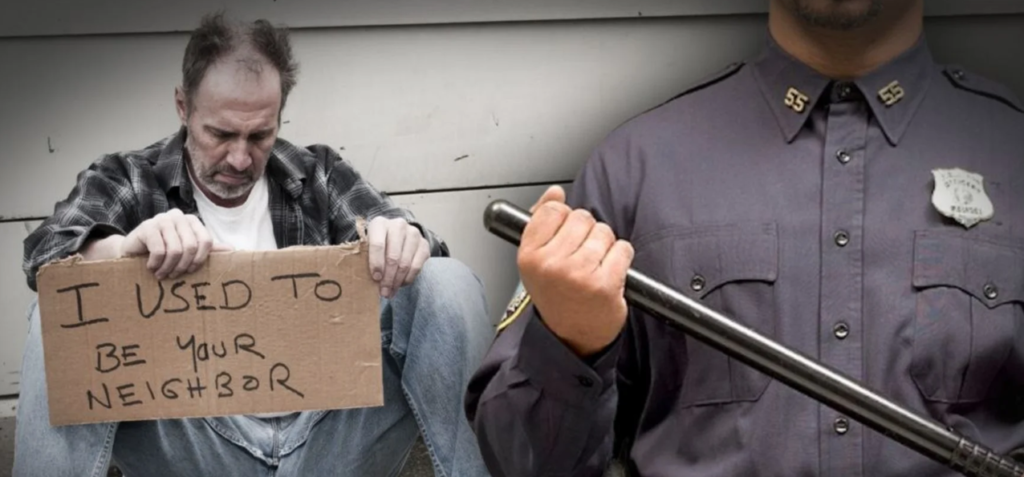
From “The Free Thought Project”
Aggressive anti-homeless legislation only serves to further exacerbate an increasingly inhumane approach to the homeless crisis.
There’s an old saying that says “you are always closer to being homeless than you are to being a millionaire”, meant to emphasize the rampant wealth inequality and deteriorating quality of life for most Americans. That statement is becoming truer by the day. The economic downturn is worsening, the value of the dollar continues to deteriorate, inflation increasing, goods becoming more expensive. According to Consumer Affairs home affordability has hit record lows. It is simply getting harder for Americans to afford to live, and to make matters worse we have a president that openly admits he simply doesn’t care “not even a little bit” about the financial woes of American citizens.
With this being the case it is no surprise that the homelessness crisis in the United States is still quite dire despite a slight decline in early 2026 from the record high of 2024.
One state hit particularly hard by increasing poverty rates is Louisiana, and one would think as this crisis worsens that elected officials would be hard at work to lessen its impact on vulnerable citizens. However, in The Pelican State, the opposite has proven to be true.
Louisiana legislature has recently advanced an anti-homeless bill that advocates of the unhoused have called one of the cruelest In the country.
House Bill 211, passed the Louisiana House of Representatives by a vote of 70 to 28 in April, aims to bring criminal charges against the homeless for the newly invented crime of “public camping”, defined as “lodging or residing overnight in an outdoor space” not designated for that use, with penalties consisting of a fine up to $500, imprisonment up to six months or both, according to NOLA.com.
Repeat offenders could face one to two years in prison with hard labor and a $1,000 fine.
In a gross and blatantly Orwellian application of doublespeak the bill is referred to as the “Streets to Success Act”, with its author Rep. Debbie Villio claiming that the bill is meant to “create opportunities” for the unhoused and insisting that it “does not criminalize homelessness” despite the fact that that is exactly what it does in plain english.
Additionally, the new legislation presents a potential boon for the prison-industrial complex, a provision within the bill provides the “option” for the penalized homeless to avoid incarceration by opting in to a mandatory treatment program for at least twelve months. But there’s a catch, as reported by Common Dreams ―
The bill requires homeless defendants to pay “all or part of the cost of the treatment program to which he is assigned,” a steep cost for many, as the average cost for residential drug and alcohol rehab treatment in Louisiana is more than $4,400 per week, according to the addiction referral service directory Addicted.org.
According to the bill, those who cannot afford this steep cost would be required to perform unpaid labor for the state or a local community center in lieu of payment.
“Unpaid labor” is, of course, just a sugar coated term for slavery. Especially when those engaging in it were coerced to do so with no real alternative.
Just as concerning, the bill allows for the creation of government run semi-permanent homeless encampments, which would have to be established in remote areas to abide by residential property guidelines. New Orleans City Councilmember Lesli Harris has likened the bill to “internment camps”, saying it would produce “no lasting housing, no services, and no real path forward for the people involved.”
The National Homelessness Law Center referred to the bill as “one of the cruelest anti homeless bills in the country.” while the homeless advocacy group Housing Not Handcuffs said in a press release the bill “clearly evokes debtor’s prisons, convict leasing, and the ugliest day of Jim Crow.”
BREAKING: Louisiana has advanced one of the cruelest anti-homeless bills in the country. It would force homeless people to choose between jail and involuntary treatment, make them pay for it, and if they can't pay, force them to perform unpaid labor. https://t.co/0J9rBRtKkA
— National Homelessness Law Center (@homeless_law) April 16, 2026
Congressman Troy Carter said in a statement:
“House Bill 211 does not solve homelessness. It relocates it. It hides it. It pushes people from one block to the next, from one parish to another, from one jail cell to the next. This is not policy. This is avoidance,” … “What this bill risks doing is deepening the very crisis it claims to address.”
Heinous Treatment Toward The Unhoused
As The Free Thought Project has previously reported, in recent years several states are increasingly moving to penalize and criminalize homelessness, largely facilitated by the Cicero Institute, a CIA backed right wing think tank dedicated to addressing the issue of homelessness headed by Palantir co-founder Joe Lonsdale.
As evident by their advocacy for a heavy handed approach to the issue, Lonsdale and the Cicero Institute do not view homelessness as a humanitarian crisis to be solved, but rather as a nuisance to be eliminated.
At the insistence of the Cicero Institute, the Trump administration has gone all in on waging war against America’s homeless population, leading to increases of mass incarceration much to the benefit of the for profit prison industry.
Even prior to these most recent escalations of inhumanity, many localities across the country had taken to enacting harsh treatment towards the vulnerable unhoused population. The implementation of hostile architecture quickly became a popular choice for city planners who just wanted to make the homeless “go away”. The installation of street spikes, awkwardly curved or slanted public benches, strategically placed large boulders and more have all become methods of deliberately displacing the homeless population.


Using such designs to make life even more difficult for people who already have next to nothing is unimaginably evil.
Despite this, some locations have gone further, beyond passive anti homeless architecture to deliberate state sponsored attacks on the unhoused. In 2016, as TFTP reported, musician Elvis Summers crowdfunded over $100,000 through his nonprofit to build several tiny homes for the homeless of Los Angeles County. This grand gesture of charity was met with ire and indignation from the local government who promptly evicted those staying in them, seized the homes, and demolished them.
Similar incidents occurred in 2020 and 2022 in Las Vegas after two non profit organizations, Food Not Bombs and the Sidewalk Project, crowdsourced funding and volunteers to build several tiny homes to help some of the local homeless. The city took the same approach as Los Angeles, having local police raid the private property the homes were built on and destroyed them on site.
In 2018, another particularly egregious assault against the homeless population occurred in Kansas City, Missouri, when local police raided a charity picnic designed to feed the homeless and promptly destroyed all of the food by dousing it with bleach.
Criminalization As A Predatory Policy Choice
Studies have consistently shown again and again that criminalizing homelessness and displacing the unhoused does not in fact reduce homelessness. Instead exacerbating the problem as individuals with criminal records experience greater challenges when attempting to receive assistance and gain employment.
Research published by the John Hopkins Bloomberg School of Public Health in 2025 outlined concisely what it would take to effectively tackle the homeless crisis in America, the primary solution being the simplest and most obvious ― A Housing First initiative. The school explains:
Housing First solves the immediate and foundational need of giving people a safe, permanent place to live with no preconditions. Once that basic need is met, people can opt to use supportive services that meet other needs, such as access to health care, employment assistance, or programs to treat substance use disorders.
The Center for Budget and Policy Priorities further elaborates how the decisions made by policymakers only serve to exacerbate the homeless crisis by not addressing the fundamental causes of it. The center goes on to illustrate the ways in which Housing First initiatives, as well as adequate access to supportive services and sustained rental assistance programs prove to be the most cost effective and viable approach to consistently reducing homelessness.