From “technocracy.news”
Pay close attention to my recent articles, especially Gaza Emerges As The First Controlled Experiment For Technocracy. This exposes the dark underbelly of Technocracy and brings meaning to the phrase “You will own nothing.” The endgame of Technocracy is in full view, for anyone who dares to take a look. With my co-author, Courtenay Turner, The Final Betrayal: How Technocracy Destroyed America, we turned the soil and planted the seeds to see the biggest heist of property in the history of the world. If you haven’t read it, do it now.
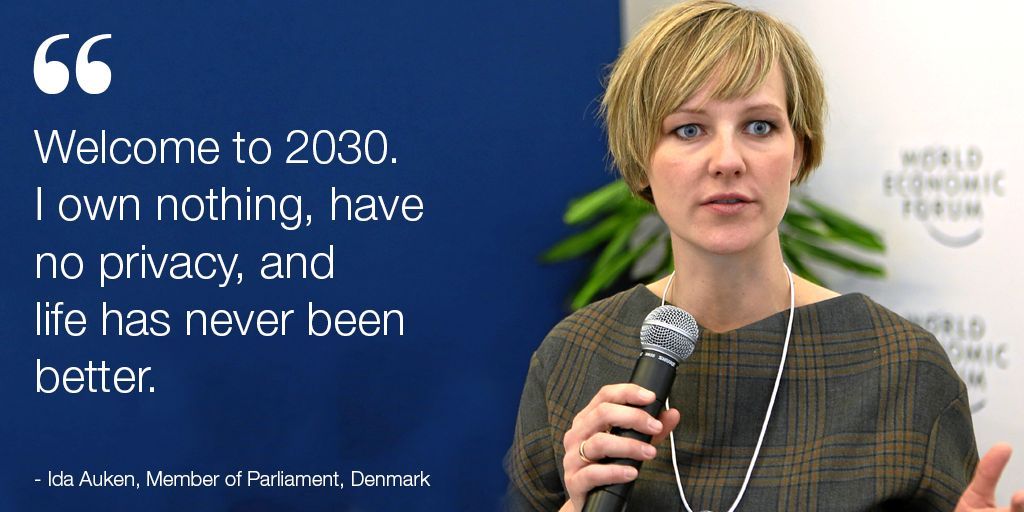
In 2016, the World Economic Forum released a now-infamous promotional campaign titled “8 Predictions for the World in 2030.” Among the predictions, one stood out with chilling clarity: “You’ll own nothing. And you’ll be happy.” The backlash was swift, and the WEF scrambled to reframe the statement as merely one possible “scenario” among many. But the damage was done—not because the statement was shocking, but because it was honest. It described, in plain language, the operational endgame of a system that has been under construction for nearly a century. The question was never whether they meant it. The question was how they intended to accomplish it.
Most people interpreted the WEF’s declaration through a twentieth-century lens: governments would confiscate property, communism would return in new clothing, and jackbooted bureaucrats would knock on doors. But this fundamentally misunderstands the sophistication of the mechanism now being deployed. The architects of this system have no need for crude confiscation. They are building something far more elegant—a world in which ownership itself becomes a meaningless concept, replaced by tokenized access permissions administered through digital platforms that no individual can control or exit.
The reconstruction of Gaza following the devastation of recent conflicts offers a disturbing case study in how this system is being created. The proposal to implement World Liberty Financial’s USD1 stablecoin as the primary payment rail for Gaza, combined with the tokenization of Gazan assets and revenue streams, represents what may be the first greenfield deployment of a fully integrated digital control economy on a defined population. What is being created in Gaza will not stay in Gaza.
The system rests on three interlocking layers. The first is the currency layer—a programmable digital dollar such as USD1 that replaces physical cash and traditional banking. Every transaction becomes visible, traceable, and—critically—subject to conditions imposed by the platform operator. Unlike cash, which is bearer-settled and anonymous, a programmable stablecoin can be designed to restrict what you buy, where you buy it, when you buy it, and from whom. The currency ceases to be a neutral medium of exchange and becomes an instrument of behavioral control.
The second layer is tokenization. When World Liberty Financial or any similar entity tokenizes real property—land, buildings, infrastructure, businesses, agricultural output—they convert tangible assets into digital tokens on a blockchain. The advocates of tokenization celebrate this as “democratization,” pointing to the ability of ordinary people to purchase fractional ownership of assets they could never afford whole. A Gazan family that could never buy a building can now own 0.003 percent of one. But fractional ownership is not ownership in any historically or legally meaningful sense. You cannot live in your fraction. You cannot will it to your children as a family inheritance. You cannot improve it, defend it, or exercise dominion over it. You hold a speculative financial instrument that exists entirely within the rules of a platform you did not build and cannot influence. If the platform operator decides to delist the token, adjust the smart contract, or revoke access, your “ownership” evaporates.
The third layer is digital identity. When a biometric or credential-based digital ID is required to access the currency platform and the tokenized asset marketplace, every participant becomes a known, tracked, and permissioned entity within the system. Access to property, commerce, and economic participation becomes conditional on maintaining one’s standing within the identity framework. The convergence of these three layers—programmable money, tokenized assets, and digital identity—produces a closed system in which nothing needs to be confiscated because nothing was ever truly owned. The word “own” simply loses its meaning.
This is not a new idea. It is, in fact, a very old one dressed in new technology. In my book Technocracy Rising, I documented how the original Technocracy movement of the 1930s proposed replacing the price system and private property with an energy-based allocation mechanism administered by engineers and technical experts. Citizens would receive “energy certificates”—non-transferable, automatically expiring units that tracked consumption and controlled distribution. There would be no private property, no savings, no accumulation of wealth. Every resource would be centrally monitored and allocated according to the technocrats’ efficiency calculations.
The parallels are unmistakable. USD1 is the energy certificate made digital, programmable, traceable, and potentially subject to expiration or conditions. Tokenized assets are the technocratic abolition of private property made palatable through the language of financial innovation. Digital identity is the surveillance architecture that ties every individual to the system with no possibility of exit. What the original technocrats could only dream about in the age of punch cards and slide rules, their intellectual descendants can now implement with blockchain, biometrics, and artificial intelligence.
There is a fault line that runs beneath these developments, and it is ultimately theological. The biblical account of creation establishes that human beings, made in the image of God, were given dominion over the earth. This dominion includes the stewardship of property—land, resources, and the fruits of labor. The Mosaic Law codified property rights so seriously that even God’s own redistributive mechanism, the Year of Jubilee, operated by returning property to its original family rather than centralizing it under state control. The commandment “thou shalt not steal” presupposes the legitimacy and sanctity of private ownership. Property, in the biblical framework, is not merely an economic arrangement; it is an expression of the dignity of persons created in God’s image, exercising the dominion they were given.
The tokenization model does not steal property. It does something more radical—it dissolves the concept entirely. When everything you “have” exists as a permission token on someone else’s platform, subject to smart contract conditions and platform governance, the relationship between human beings and the material world has been fundamentally severed. You are no longer a steward exercising dominion. You are a user consuming a service. The shift from owner to user is not merely economic; it is anthropological. It redefines what a human being is in relation to creation itself.
This is the real meaning of “you will own nothing.” It was never about confiscation. It was about redefinition. The goal is to build a system in which the very infrastructure of economic life makes ownership impossible—not illegal, but structurally nonexistent. You may still have a roof. You will still eat. You may still move from place to place. But every one of these functions will be mediated through a digital platform that you do not control, operating on terms you did not set, accessible only so long as you remain in compliance with conditions you cannot negotiate. This is not freedom. This is not prosperity. This is the most sophisticated system of human management ever devised, and it is being tested, right now, on the most vulnerable population available.
Those with eyes to see should be watching Gaza very carefully. What happens there is a blueprint—not a local experiment, but a template for the world.
Unfortunately, we see President Trump leading the pack of arch-Technocrats with the Board of Peace and his company, World Liberty Financial. Together, they are flipping the world out of a debt-based economic system and into an asset-based system controlled like a digital gulag.